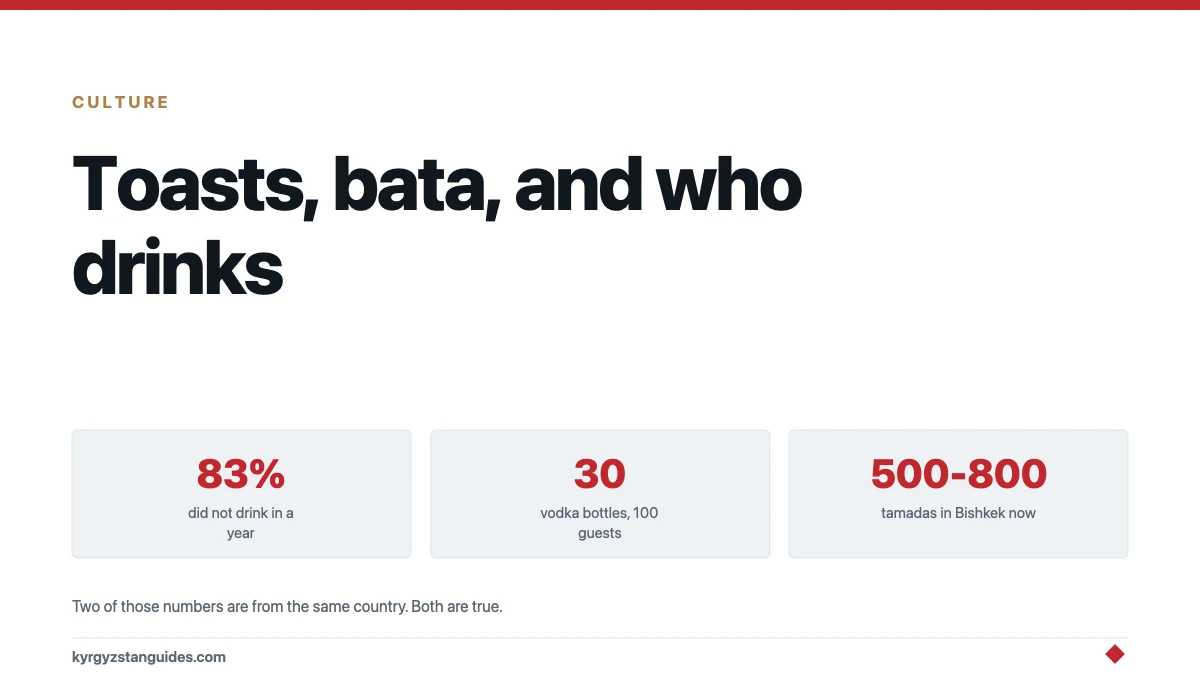
Two facts about the same country, both true.
83 per cent of adults in Kyrgyzstan did not drink alcohol at all in the past twelve months, and 70 per cent have never drunk in their lives. Recorded consumption has fallen from 5.4 litres of pure alcohol per adult in 2015 to 2.9 in 2024.
And a 100-guest celebration budgets a minimum of 30 bottles of vodka, eight of cognac and ten of wine.
Both come from real sources. Together they describe a largely abstinent society with a small, heavily male drinking population and a celebration culture where spirits are on the table anyway.
The tamada is modern, and that matters
Search for Kyrgyz toasting customs and you will be given a tamada, a sequence of toasts and a set of formulas, usually borrowed wholesale from the Caucasus.
Here is what we found instead. Two serious ethnographic works on Kyrgyz table behaviour — a 2016 monograph from Arabaev University and a 2022 article in Ethnographic Review — do not contain the word tamada at all. What they describe at length is the bata, the blessing.
That does not mean the tamada is fake. It means it is recent and professional rather than customary. A 2017 round table on the toi industry gives the numbers: in the 1990s there were about 15 tamadas in the entire country. Bishkek alone now has 500 to 800. The fee at a Bishkek-scale event is around $500.
So the tamada is a paid master of ceremonies in a booming events industry, not an inherited role. The same round table's complaint is that the craft has collapsed into clichés — "give them a hand."
We also could not establish any canonical Kyrgyz order of toasts. Sources that give one are projecting the Caucasian model. We are not going to invent a sequence to fill the gap.
The bata is the real thing
Bata, from the Arabic fātiḥa, is a spoken blessing. It is the speech act that structures a Kyrgyz meal, and unlike the toast it has documented mechanics.
Where it sits. A bata is pronounced after the guests have finished eating, and one is sought only once a dastorkon has been spread and an animal slaughtered — you must first fill people's stomachs. Nobody rises and nothing is cleared until it has been said.
How it runs. A child of the household asks for it. The asker stands at the lower end of the cloth facing the seated company and opens both palms toward his own face. The company spread their hands. The eldest present, or the eldest guest, speaks the wish, says "Oomiyin", and everyone draws their palms down over their faces. The person who asked for the bata speaks last.
Cover your head. Giving or receiving a bata bareheaded is wrong.
Who gives it. Aksakals, learned and morally standing people, poet-singers, and senior women in the white elechek — ak elechek baibiche is a fixed phrase for a respected elder woman. A specialist is a bataköy or tilekchi.
Two recorded texts, to show the register. One attributed to the scholar Kusein Karasaev: "May there be livestock, may there be a head; may the food be blessed; may life be long." One attributed to the akyn Jengijok: "Be the ninth of the stars. Be the falcon of the Kyrgyz."
The grammar is optative throughout — let it be given, let it be, protect — and repetition is the device that is understood to increase its force.
Its mirror image. A kargysh is a curse, and it also closes with "Oomiyin." An elder's blessing is believed to carry weight, and so is an elder's curse. That is why offending an old person at a table is treated as genuinely dangerous rather than merely rude.
You will meet bata constantly: at naming, at the cradle rite, at first steps, at circumcision, on first mounting a horse, before a journey, on arriving and on leaving. A person accumulates the blessings of elders across a whole life.
The numbers on drinking
From the World Health Organization's data, for Kyrgyzstan:
| Measure | Figure |
|---|---|
| Recorded consumption, litres pure alcohol per adult, 2015 | 5.4 |
| Same, 2024 | 2.9 |
| Spirits share of that 2024 total | 76% |
| Lifetime abstainers | 70.3% — men 61.9%, women 78.2% |
| Did not drink in the past 12 months | 83.2% — men 76.3%, women 89.6% |
| Binge drinking in past 30 days, among drinkers | 34.5% |
The shape is clear. Few people drink; those who do drink spirits, and a third of them binge. Wine and beer are marginal — 0.2 and 0.5 litres respectively.
Consumption has roughly halved since 2013. The abstention figures are modelled and stop at 2020, so treat those as the latest available rather than current.
Kyrgyzstan's census does not record religion. The nearest official proxy is the 2022 census by ethnicity, where historically Muslim groups make up 93.8 per cent of the population, and a 2024 presidential decree refers officially to Islam as the religion of the majority.
The organised push against drinking
This is not a purely private trend.
Religious figures promote the adal toi — a "permissible" celebration held without alcohol. Many families now host them, and it is the term to use if you want a dry event.
At local level, clergy in some raions have pressured shopkeepers to stop selling alcohol, some villages have imposed sales bans, and in one case residents bought and destroyed three containers of spirits.
The chief mufti has publicly opposed forced prohibition, arguing the mission is achieved by calling people to piety rather than by bans and destruction — which tells you the pressure is real enough to need a position on.
The law limits how far this can go. A local council may restrict the hours and places of alcohol sales, but it may not ban sales outright where licensed businesses are complying. A draft put to public discussion in January 2026 would ban retail alcohol sales nationwide between 23:00 and 08:00 and within 100 metres of central squares and parks, exempting bars and restaurants, and would raise the purchase age from 18 to 21. Whether it has been adopted, we could not confirm.
Separately, many village councils now require all celebrations and all restaurants to close by 22:00.
What a visitor should actually do
You are not obliged to drink. In a country where five in six adults did not drink last year, declining is unremarkable. Say you don't drink; no explanation is needed.
But you may be pressed at a toi, because the people who do drink at celebrations drink in earnest, and pouring for a guest is hospitality. The graceful refusal is to accept the glass, touch it, and leave it.
Do not leave before the bata. This is the actual obligation, and it is the one foreigners break.
At the closing blessing, cover your head if you can, hold your palms up, and draw them down your face at "Oomiyin." Nobody expects you to say anything.
If you want to say something, a short wish for the household — health, long life, prosperity — lands correctly in any language. Do not attempt a comic toast.
Note that the drink register underneath all this is not alcoholic at all: kymyz, ayran, maksym and bozo. Maksym was inscribed by UNESCO in 2025. The historical Kyrgyz drink was bozo, before distilled spirits spread under the Russian Empire — a point made by a working tamada, which is as good an irony as this subject offers.
See also tea and bread customs and hospitality rules, where the seating and the meat portions are set out.
FAQ
Do Kyrgyz people drink alcohol?
Most do not. WHO data puts lifetime abstainers at 70.3 per cent and those who did not drink in the past twelve months at 83.2 per cent. Recorded consumption fell from 5.4 litres of pure alcohol per adult in 2015 to 2.9 in 2024, and three-quarters of what is drunk is spirits. Among those who do drink, about a third binge.
Is there a traditional Kyrgyz toasting order?
We could not find one in any ethnographic source. The two authoritative Kyrgyz works on table behaviour do not mention the tamada at all; they describe the bata, the blessing. Accounts giving a fixed toast sequence appear to be projecting the Caucasian model.
What is a bata?
A spoken blessing, from Arabic fātiḥa. It is asked for by a child of the household after eating, spoken by the eldest present or the eldest guest, and closed with "Oomiyin" while everyone draws their palms down over their faces. Nobody leaves the table before it is given.
What is a tamada in Kyrgyzstan?
A paid professional master of ceremonies at a celebration. The role is modern rather than customary: there were around 15 tamadas in the whole country in the 1990s and Bishkek alone now has 500 to 800, at roughly $500 an event.
Can I refuse alcohol at a Kyrgyz celebration?
Yes, easily. Most adults in the country do not drink and no explanation is expected. If you are pressed, accepting the glass and leaving it untouched works. Alcohol-free celebrations have their own name, adal toi, and are increasingly common.
What do people drink instead?
Kymyz, fermented mare's milk; ayran; and the grain drinks maksym and bozo. Maksym was inscribed on UNESCO's Representative List in 2025. Bozo was the historical Kyrgyz drink before distilled spirits spread under the Russian Empire.