The most reliably good evening you can have in Bishkek in winter costs a few hundred som and involves being hit with a bundle of wet birch twigs by a stranger.
The banya is a fixture of life here and almost no visitor uses one, mostly because nobody explains the procedure and the prospect of getting it wrong in a room full of naked strangers is off-putting. It isn't complicated. Here is the whole thing.
What a banya is
Not a sauna, though it contains one, and not a hammam.
A Finnish sauna is dry heat. A Turkish hammam is wet heat at a lower temperature with washing on a heated slab. A banya is high heat with bursts of steam, generated by throwing water on hot stones, combined with beating and cold immersion.
It came into Central Asia with Russian settlement and was then formally endorsed by the Soviet state as a health facility, which is why every town of any size has one and why the buildings look like municipal infrastructure rather than spas. Comparisons of the banya with the Finnish sauna and the Turkish hammam set out the differences in temperature and humidity that make each one a distinct thing rather than a regional variant.
In the post-Soviet world the banya functions as a social club: saunas, plunge pools, professional scrubbers, masseurs, sometimes hairdressers, a café and a place to sit and talk for three hours. Going alone is normal. Going with friends and staying half the day is more normal.
The procedure
Step by step, because the first ten minutes are the only confusing part.
1. Pay at the lobby. You get a receipt, a locker key and a sheet. Entry is usually by the hour or by the session.
2. Present the receipt at the changing room. Undress completely, wrap the sheet around yourself, and take it and a hat if you have one.
3. Wash before you steam. Shower first. This isn't optional and it is the most commonly broken rule by visitors.
4. Into the steam room. Sit low first — heat stratifies violently, and the top bench can be twenty degrees hotter than the bottom one. Five to ten minutes is plenty to start.
5. Cold. Plunge pool, cold shower, or in winter and if the place has it, snow. This is the part people skip and it is the part that makes it work.
6. Rest. Sit, drink tea, cool down properly. Ten to twenty minutes.
7. Repeat. Three or four rounds is standard.
The venik
The bundle of leafy branches. Usually birch, sometimes oak or juniper.
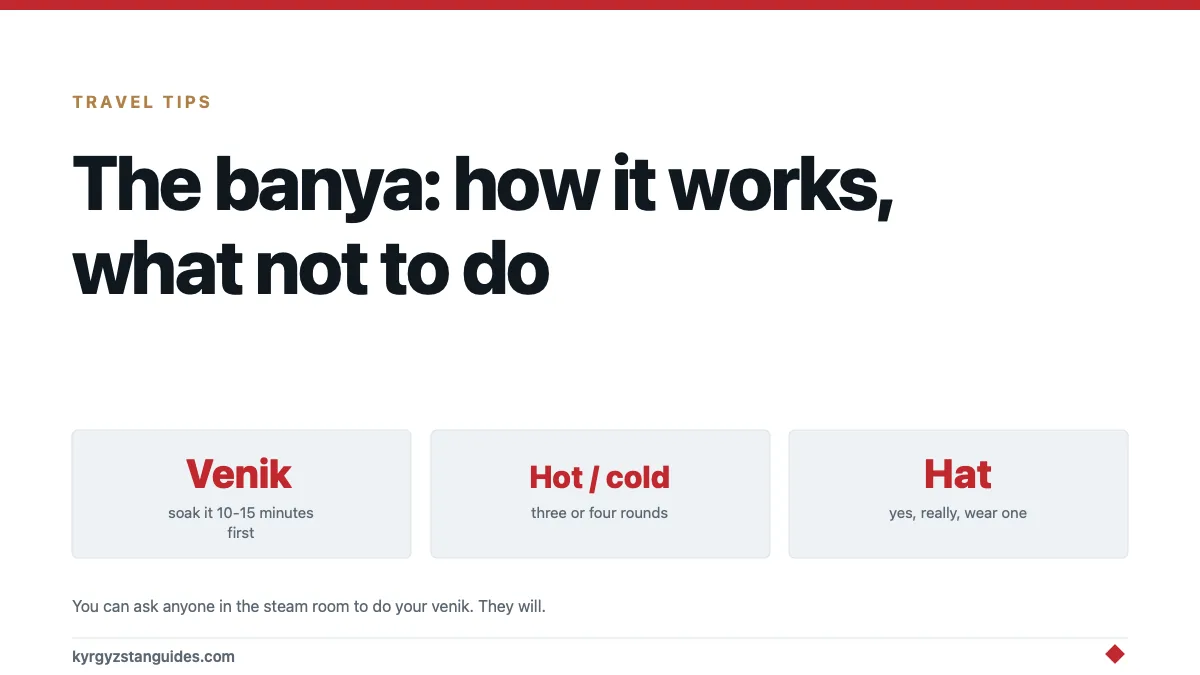
Soak it in very hot water for ten to fifteen minutes before use, or it'll be brittle and will scratch rather than slap.
Then someone uses it on you while you lie on a bench: fanning hot air down onto the skin, then striking rhythmically, working from feet to shoulders. It isn't a beating and it doesn't hurt; it's closer to a percussive massage that drives heat into the skin.
The etiquette is the useful bit: you can ask anyone in the steam room to do it for you, and they will not refuse. That is an actual convention, not a hopeful interpretation. Nor will anyone find the request strange. Reciprocating is polite.
The rules nobody tells you
Gender-separated, always. Men and women use separate sections or separate hours. Some places have private rooms bookable by a group or a family.
Wear the hat. A felt banya hat looks absurd and is functional: it keeps your scalp and ears from overheating while your body takes the temperature. Buy one at the door.
Flip-flops. Wet tiled floors, shared space. Bring them or buy them there.
Sheet on the bench. Sit on your sheet or a towel, not directly on the wood.
Do not pour water on the stones without asking. Everyone in the room shares the consequence. Someone is usually managing it.
Do not drink alcohol in the steam. It is common, it is widely done, and it's genuinely dangerous in that heat combined with cold immersion. Tea between rounds is the sensible version.
Do not stay in because someone else has. People who use a banya weekly are acclimatised. There is no prize.
Take it seriously if you have a heart condition or high blood pressure. Extreme heat followed by cold plunging is a real cardiovascular load. Brown University Health's guidance for people with heart disease is specific and worth following: with stable heart disease, cap it at 20 minutes, cool down gradually, and don't plunge into cold water. Unstable angina, decompensated heart failure, severe aortic stenosis and a heart attack in the last two weeks are all reasons not to do this at all. If you take blood pressure medication, the combined vasodilation can drop you when you stand up.
Hydrate between rounds, not during. You will lose a surprising amount of fluid. Tea, water, or the sour fermented drinks that turn up in banya cafés.
Where to go
Bishkek has both Soviet-era public baths and newer private complexes. The old public ones are cheaper, plainer and more interesting; the private ones are more comfortable and can be booked as a private room. Our things to do in Bishkek covers the city more broadly.
Karakol and Osh both have working banyas, and in Karakol in winter it is one of the best things in town after a day on the mountain.
A first-timer's account of a Bishkek public bathhouse is worth reading if you want to know what the room actually looks like before you walk into it.
Guesthouses in trekking areas frequently have their own — a small wood-fired cabin behind the house. After a multi-day trek this is a substantially better experience than anything municipal, and it is often included or costs very little. Ask.
Don't confuse a banya with a "sauna". In some contexts locally, a venue advertised as a private sauna isn't primarily a bathhouse. The municipal public baths and guesthouse banyas are unambiguous.
Why bother
Because it's one of the few genuinely social institutions a visitor can walk into.
A guesthouse dinner is hospitality directed at you. A banya is people doing something they were going to do anyway, in which you're simply present. That is a different and better kind of access, and the conversations are better for it.
It's also, practically, the correct thing to do after four days on a horse, at the end of a trek, or in January when it is -20°C and the heating in your apartment is uncertain.
FAQ
What is a banya?
A Russian-style bathhouse combining high heat with steam from water thrown on hot stones, beating with a leafy branch bundle called a venik, and cold immersion between rounds.
How is a banya different from a sauna?
A Finnish sauna is dry heat. A banya uses bursts of steam at high temperature, includes the venik, and is built around alternating hot and cold rather than sustained heat.
What is a venik?
A bundle of leafy branches, usually birch, soaked in hot water for ten to fifteen minutes and then used to fan and strike the skin, driving heat in. It works as a percussive massage.
Are banyas in Kyrgyzstan gender-separated?
Yes. Men and women use separate sections or separate hours, though private rooms can often be booked by a group or family.
What should I bring to a banya?
Flip-flops, a towel or two, and a felt hat, which can usually be bought at the door. A sheet is normally provided with your entry ticket.
Is a banya safe?
For most people, yes, provided you build up gradually, hydrate, avoid alcohol and do not stay in the steam too long. Anyone with a heart condition or high blood pressure should be cautious and skip the cold plunge.