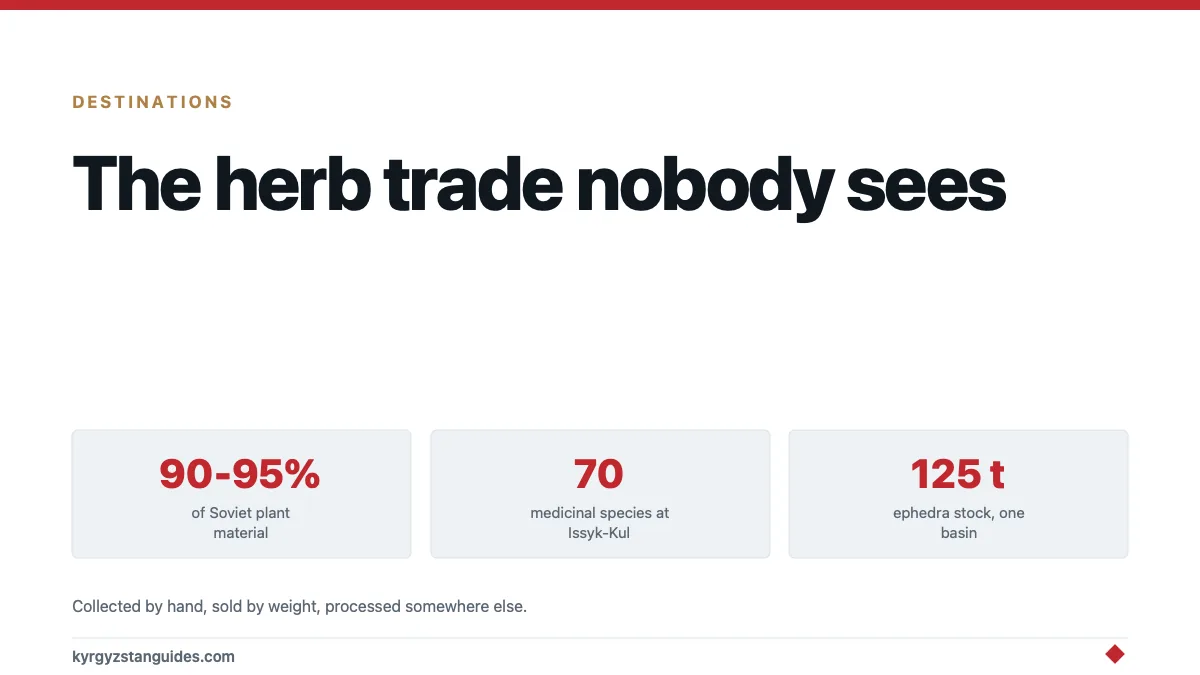
At its peak, the Kyrgyz SSR supplied somewhere around 90–95% of the plant material used by the entire Soviet medical industry.
Ephedrine and thermopsidine were processed here and shipped across the union and beyond. The Issyk-Kul region alone holds around 70 species of medicinal plants. The raw material still goes out today. To Uzbekistan, South Korea, India, France, Russia, Japan and China.
You'll walk past this industry constantly and never see it. The sacks of dried root at the back of a bazaar, the people on a hillside with bags in August, the smell of drying herbs in a courtyard: that's a supply chain reaching into global pharmaceutical and cosmetics manufacturing.
What grows here
Kyrgyzstan's altitude range is the reason. A country that runs from 400 m in the Fergana valley to over 7,000 m in the Tien Shan contains a very large number of ecological zones stacked into a small area, and medicinal plants tend to be zone-specific.
Ephedra (Ephedra equisetina) is the historically important one. A study of the Kurshab river basin found it occupying roughly 450–500 hectares there with a biological stock estimated at about 125 tonnes. Ephedra is the natural source of ephedrine, which is precisely why the Soviet pharmaceutical industry cared about these mountains.
Liquorice root is the volume trade across Central Asia: used in confectionery, tobacco, pharmaceuticals and cosmetics, and almost all of it wild-collected rather than farmed.
Sea buckthorn is the growth story. Demand has returned strongly for use in medicine, food, cosmetics and land restoration, and it is one of the few of these plants moving from wild harvest into deliberate cultivation.
Thermopsis, the source of thermopsidine, used in cough preparations.
Plus the long tail: wild thyme, St John's wort, rose hip, juniper berry, mountain mint, and a great many others that go into teas and traditional preparations rather than into industrial processing.
How it works
Almost entirely by hand, by rural households, seasonally.
The structure is consistent across Central Asia: individual collectors gather in the wild and sell to a local buyer, who sells to a consolidator, who sells to an exporter. The collector is at the bottom of that chain and receives the smallest share of the eventual value.
For a household in a mountain village with limited cash income, a season of collecting is real money. It's also, very often, a supplement to a household already relying on remittances from a relative abroad, one of the few ways to earn without leaving.
The sustainability problem
Wild collection at commercial volume has an obvious failure mode.
Ephedra is a slow-growing shrub. Liquorice is harvested by digging up the root, which kills the plant. When prices rise, collection intensifies, and in a system where the person doing the collecting has no secure claim on the land and no guarantee of next year's income, there's no incentive to leave anything behind.
TRAFFIC, the wildlife trade monitoring network, has worked on this directly: its research on the liquorice root trade documents the Central Asian supply chain and the push toward sustainable sourcing, and its wild harvest improvement projects are trials of what better practice looks like on the ground.
The FairWild standard is the certification framework that has emerged from this work, covering both resource management and what the collector actually gets paid.
The pattern is the same one running through the walnut-fruit forests and the Issyk-Kul fishery: a wild resource, a real economic need, no effective management, and a decline that nobody individually chose.
Why nobody has replaced the Soviet buyer
The interesting question is why an industry that supplied most of a superpower's plant pharmacopoeia didn't simply carry on.
The customer was a planning system, not a market. Collection quotas, processing plants and distribution were all allocated centrally. When that dissolved, what remained was the plants and the people who knew where they grew. Not the contracts, the laboratories or the buyers.
The processing left. Extracting ephedrine is chemistry, done in a facility. Several of those facilities were elsewhere in the union, and the ones here largely didn't survive the 1990s.
Certification is now the gate. Selling plant material into European or Japanese pharmaceutical supply chains requires documented species identity, contamination testing and traceability to the collection site. A supply chain that starts with an individual on a hillside and passes through three informal intermediaries can't produce that paperwork.
So the material still leaves, but at the bottom of the value chain, into markets that will accept undocumented bulk. That is the gap the FairWild work is trying to close, and it's a slower problem than it sounds, because the fix is administrative rather than agricultural.
What a traveller will actually encounter
Bazaar herb stalls. Osh Bazaar in Bishkek and the markets in Karakol and Osh all have them. Sacks of dried material, sold by weight, usually with no labelling in any language you read. Our souvenirs guide covers what travels well.
Mountain tea. Herbal tea served at guesthouses and yurt camps is frequently local and wild-collected, and asking what's in it is a genuinely good question that people enjoy answering.
Sea buckthorn everything. Juice, jam, oil, syrup. It's sharp, orange, extremely high in vitamin C, and it is everywhere on the north shore of Issyk-Kul.
Offers of remedies. Kyrgyz traditional medicine is a living practice, and our guide to it covers the cultural side.
A few cautions worth stating plainly:
Do not buy ephedra. It's a controlled substance in many countries, it's a precursor chemical, and carrying it across a border is a serious problem you don't want. This isn't a theoretical risk.
Herbal isn't the same as safe. Unlabelled bulk plant material of unknown species, dose and contamination status isn't a low-risk purchase, particularly if you take other medication.
Check import rules. Many countries restrict plant material entirely, regardless of what it's.
Buy processed, not raw. Sea buckthorn jam in a jar is a souvenir. A kilo of unidentified dried root is a customs conversation.
Why it's worth knowing
Because it is another case where Kyrgyzstan's economy turns out to be built on exporting raw material that becomes valuable somewhere else.
Gold leaves as ore. Herbs leave as dried plant matter. Labour leaves as people. Analysts writing about raising the export value of Kyrgyz medicinal herbs keep arriving at the same recommendation (process it here) and the same obstacle, which is that processing requires capital the country does not have.
The mountains you are walking through are a functioning resource base, worked by the people who live in them, on terms set elsewhere. That is worth noticing while you're up there.
FAQ
What medicinal plants grow in Kyrgyzstan?
Ephedra, liquorice, sea buckthorn, thermopsis, wild thyme, St John's wort, juniper and many others. The Issyk-Kul region alone holds around 70 medicinal species.
Was Kyrgyzstan important to Soviet medicine?
Yes. The republic supplied an estimated 90–95% of the plant raw material used by the Soviet medical industry, including ephedrine and thermopsidine production.
Where are Kyrgyz medicinal plants exported?
Mainly to Uzbekistan, South Korea, India, France, Russia, Japan and China, largely as raw or minimally processed material.
Is the wild plant trade sustainable?
Often not. Liquorice harvesting destroys the plant and ephedra regrows slowly, and collectors have little incentive to conserve. TRAFFIC and the FairWild standard are working on sustainable sourcing in the region.
Can I buy herbs at a Kyrgyz bazaar?
Yes, sold loose by weight and usually unlabelled. Buy processed products like sea buckthorn preparations rather than bulk raw material, check your own country's import rules, and never buy ephedra.
What is sea buckthorn used for?
Juice, jam, syrup and oil, in food, medicine and cosmetics. It is very high in vitamin C and is one of the few wild-harvested species here moving into deliberate cultivation.