Kyrgyzstan has become a serious ski touring and freeride destination. Karakol, Jyrgalan, Suusamyr, and a great deal of untracked terrain that would be roped off in the Alps.
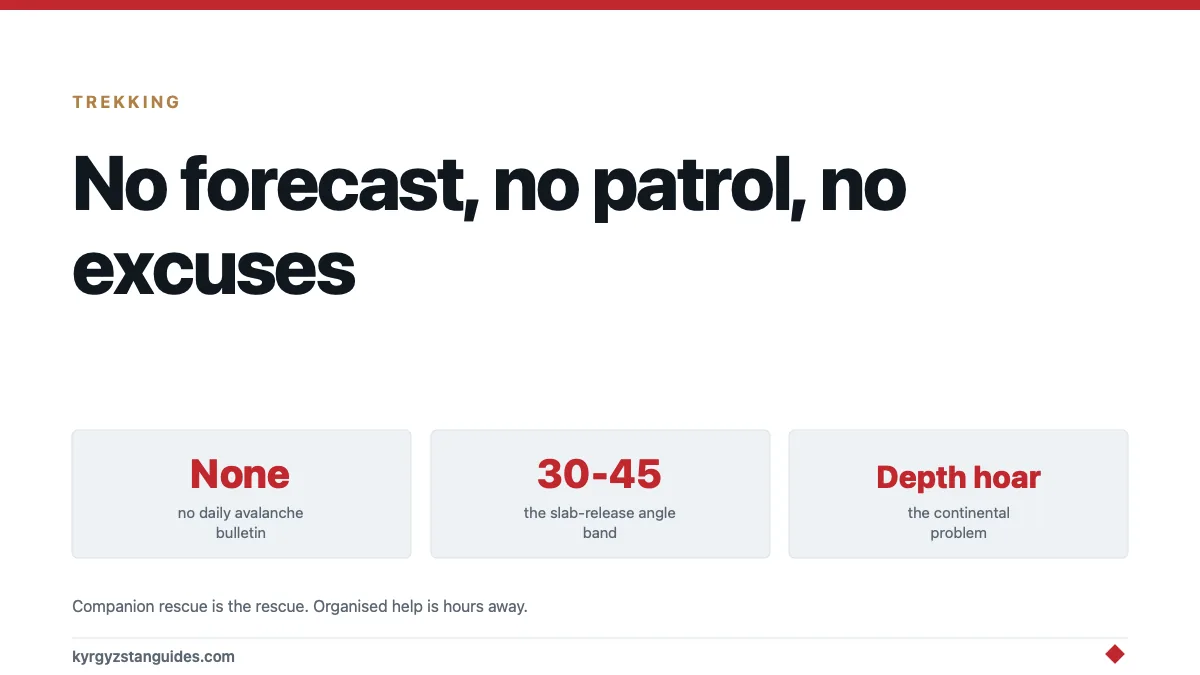
It doesn't have an avalanche forecast service of the kind ski tourers in Europe and North America take for granted. There is no daily regional bulletin with a danger rating and a problem type for most of the country. There is no patrol outside the resort boundary, and there's no Alpine-style rescue network.
That combination, world-class terrain, no forecast, no patrol, is the single most dangerous thing about winter travel here.
What makes the snowpack here difficult
Continental climate. Cold, dry, and far from any ocean. That produces exactly the snowpack that kills people: shallow, cold, and prone to forming persistent weak layers.
Depth hoar. In a cold, thin snowpack, large temperature gradients between the ground and the surface drive faceting at the base. The result is a layer of sugary, structureless crystals that can sit there all season and fail under load months after it formed.
This is the same mechanism that makes Colorado, Utah and the interior ranges of Canada notoriously dangerous, and it's the opposite of a deep maritime snowpack that heals itself.
Wind. Constant, and it loads leeward slopes into slabs.
Big terrain. Long runout zones, terrain traps, and few natural anchors above the tree line.
What you do not have
No daily bulletin for most areas. Some operators and local groups produce observations, and they aren't a substitute for a forecast service.
No patrol control work outside resort boundaries. No explosives, no closures, no assessment.
No trailhead signage telling you the day's rating.
No rapid rescue. A companion rescue is the rescue. Organised help is hours away at best, and our mountain rescue guide explains why.
Limited local data history. Snowpack records exist at some sites and are nothing like the density of an Alpine network. Kyrgyzhydromet issues weather warnings, which isn't the same thing as a snowpack assessment.
What that means practically
Bring the full kit and know how to use it. Transceiver, probe, shovel, on every person, every day. An airbag pack if you have one.
Take training before you come, not here. A recognised avalanche course with practical rescue drills. Reading about it isn't the same thing.
Hire a guide with local knowledge. Not simply a certified guide. A guide who has been watching this snowpack all season. Our ski touring guide covers the operators.
Build your own picture. Pit tests, observations, and a running mental log of what fell, when, and on what wind. In the absence of a bulletin, you're the forecast service.
Respect persistent weak layers. A continental snowpack with depth hoar does not stabilise in three sunny days the way a maritime one does. Patience is the skill.
One at a time on exposed slopes. Every time.
Carry a satellite messenger. As with everything remote here, there is no phone signal.
Register with the Mountain Rescue Service. It requires preregistration and evacuation insurance with a stated minimum, as our rescue guide sets out. Do it before the season, not from a hut.
Check your insurance covers off-piste and touring. A great many winter sports policies exclude both, and the exclusion is where people discover the problem rather than before it. See our insurance guide.
Reading the terrain instead
With no bulletin, terrain selection carries the weight that a danger rating carries elsewhere. Four things to be able to judge by eye.
Slope angle. Most slab avalanches release between roughly 30 and 45 degrees. Below about 30 it is hard to start one; above 50 the snow tends to sluff rather than slab. Carry an inclinometer and actually use it: people routinely misjudge angle by ten degrees.
Aspect. Wind loads leeward slopes, so the safe aspect changes with the storm. In a country with prevailing westerlies, easterly and north-easterly slopes accumulate. Shaded northerly aspects hold weak layers longest in a cold snowpack.
Terrain traps. Gullies, stream beds, abrupt flats and trees. A small slide in a terrain trap buries deeply; a large slide on an open apron may not. Most burials here happen in traps.
Consequence. What is below you. A slope with a clean runout is a different proposition from the same slope above a gully mouth.
The discipline that keeps people alive isn't identifying stable snow. It's choosing terrain where being wrong is survivable.
Where people ski
Karakol has a resort with patrolled terrain inside its boundary and extensive touring outside it. Our ski season guide and Karakol guide cover the practicalities.
Jyrgalan is the freeride and touring village, with yurt-based and guesthouse operations.
Suusamyr, high, open and wind-affected, reached over the Töö-Ashuu pass.
Arslanbob in the south, lower and with tree skiing in the walnut forest.
Bishkek-side bases for short days.
The uncomfortable point
Kyrgyzstan is cheap, and cheap attracts people who are stretching.
A group that could not afford a guided week in Chamonix can afford one here, and the terrain is comparable while the safety net isn't. That is a combination that produces accidents, and it has.
The country's mountaineering history contains the deadliest disaster in the sport — 43 people killed by an ice avalanche on Pik Lenin in 1990, in a camp, while asleep. Nobody there had made a mistake.
You will not get that kind of event ski touring. You will get a human-triggered slab on a persistent weak layer, which is what kills recreational skiers everywhere, and here it'll be you and your partners digging.
Learning the framework
If you are new to this, the international structures are worth knowing even though Kyrgyzstan does not run one.
The European Avalanche Warning Services publishes the five-level danger scale and the typical avalanche problem types used across Europe. Avalanche.org covers the North American equivalent and has free educational material, and the American Avalanche Association publishes the observation standards most professionals work to.
Those frameworks are how you should be thinking even where no one is publishing a rating. The scale is a vocabulary for your own assessment, not only a number somebody hands you.
FAQ
Is there an avalanche forecast in Kyrgyzstan?
Not a national daily bulletin of the kind Europe and North America provide. Some operators and local groups share observations, but there's no substitute for a forecast service in most areas.
Why is the Kyrgyz snowpack dangerous?
It's continental (cold, dry and shallow) which promotes depth hoar and persistent weak layers that can fail long after they form. Strong winds also build slabs on leeward slopes.
What avalanche equipment do I need in Kyrgyzstan?
Transceiver, probe and shovel for every member of the party, plus training in companion rescue. An airbag pack is a useful addition, not a substitute.
Is there avalanche patrol at Kyrgyz ski areas?
Inside resort boundaries at Karakol there's patrolled terrain. Outside the boundary there is no control work, no closures and no assessment.
Should I hire a guide for ski touring in Kyrgyzstan?
Yes, and specifically one who has been observing this season's snowpack locally rather than only holding a certification.
Where is ski touring best in Kyrgyzstan?
Karakol and Jyrgalan are the main bases, with Suusamyr for high open terrain and Arslanbob for lower tree skiing in the south.