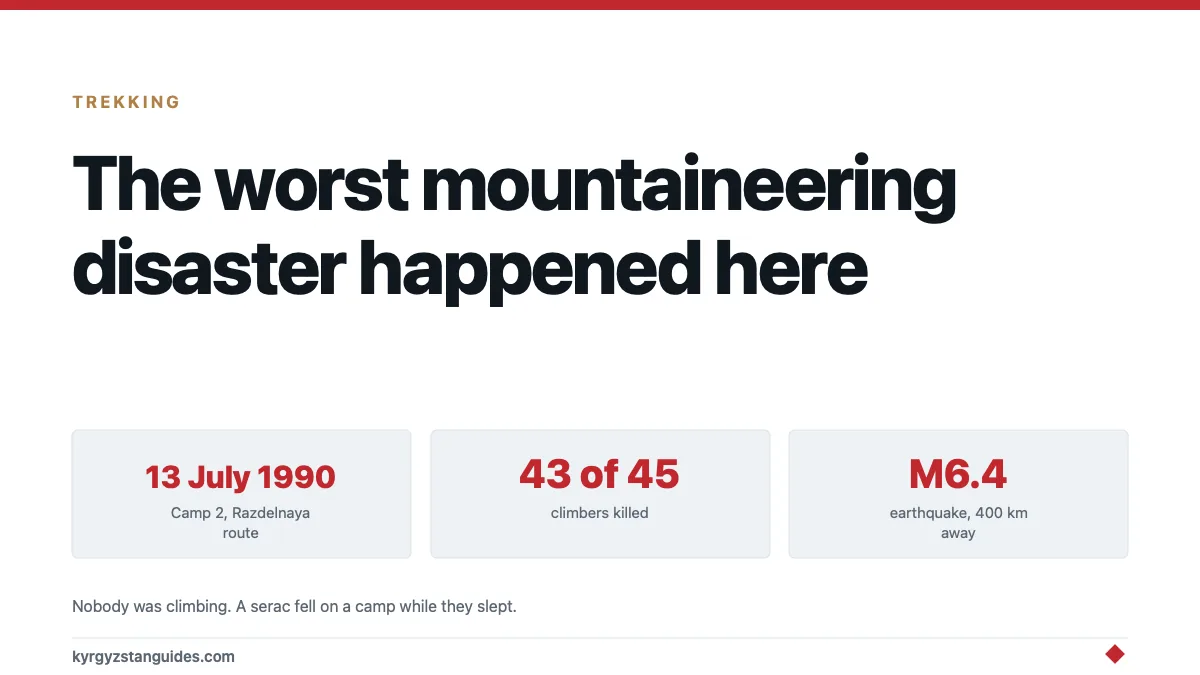
On the night of 13 July 1990, an earthquake in Afghanistan shook loose a block of glacial ice the size of a building from the slopes of Chapaev Peak. It fell onto Camp 2 on the Razdelnaya route on Pik Lenin.
There were 45 climbers in the camp. 43 died. It's recognised as the deadliest mountaineering disaster in history.
Pik Lenin is in Kyrgyzstan, on the border with Tajikistan, and it is one of the most popular 7,000-metre mountains in the world specifically because it is considered the easiest. Our Pik Lenin base camp trek guide covers the approach that trekkers take, which is a beautiful and reasonable thing to do. This is the part of the mountain's history that the trekking pages leave out.
What happened
The trigger was not on the mountain. A magnitude 6.4 earthquake struck at a depth of around 217 km beneath the Hindu Kush in Afghanistan. Deep, distant, and not strong enough at the surface to be dangerous in itself.
It was enough to destabilise a serac: a tower or block of glacial ice, in this case on Chapaev Peak, adjacent to the route.
At around 9:30 p.m. local time the serac released. The resulting ice avalanche ran down onto Camp 2, at roughly 5,300 metres, where climbers from several expeditions were camped on what was regarded as a safe, standard site.
Two people survived, one with a broken arm and one with a broken leg. Both reported afterwards that some of the buried were still conscious. Rescue failed because avalanche debris of that mass compacts into something close to solid glacier ice within minutes.
The dead came from the Soviet Union, Czechoslovakia, Israel, Switzerland and Spain.
Guinness World Records lists it as the worst mountaineering disaster on record, and ExplorersWeb's history of the mountain places it alongside the peak's other serious accidents.
Why Pik Lenin specifically
This is the uncomfortable part, and it matters for anyone considering the mountain.
Pik Lenin, at 7,134 m, has a reputation as the easiest 7,000er on earth. The standard route isn't technically demanding. There is no crux pitch, no serious rock, no sustained ice climbing. Fit, acclimatised people with basic glacier skills summit it.
That reputation attracts a very large number of climbers, many of whom are on their first mountain of that height. It also produces a specific kind of complacency: a mountain described as easy gets treated as safe, and those are different properties.
The 1990 disaster illustrates the difference exactly. Nobody was climbing when it happened. Nobody made a technical error. They were asleep in a camp at a standard location, and an earthquake four hundred kilometres away in another country killed forty-three of them.
Pik Lenin has one of the highest absolute death tolls of any mountain in the world. That is partly a numbers effect, lots of people climb it, and partly that objective hazard on it's real: avalanche, crevasse, altitude and weather that can change extremely fast on an exposed summit ridge.
The earthquake connection
Worth understanding because it applies beyond this one night.
The Pamir and Tien Shan are rising because the Indian plate is pushing north. That process generates constant seismicity, including the deep-focus earthquakes under the Hindu Kush that are among the most persistent in the world. Our guide to earthquakes in Kyrgyzstan covers the mechanics.
What 1990 demonstrated is that a deep earthquake far away, too weak to damage buildings, can still release a serac on a slope four hundred kilometres distant. On a glaciated mountain, seismic energy translates into falling ice, and the timing isn't predictable in any useful sense.
That has a specific implication: camp placement matters more than route difficulty. Anything under a serac or in an avalanche runout is exposed regardless of how good you're, and no skill compensates.
The other thing that happened on this mountain
1990 is the famous one. It isn't the only one.
Pik Lenin has a long history of mass-casualty accidents, which is what happens when a mountain attracts very large numbers of people to an exposed high ridge.
In August 1974, an all-female Soviet team of eight climbers led by Elvira Shatayeva summited on the 5th and was caught on the descent by what was described as the worst storm in the region in twenty-five years, winds over 100 km/h, temperatures below -20°C. All eight died. Their bodies were found by Japanese and American climbers who had ridden out the same storm a few hundred metres lower. CNN's account of the expedition is the fullest English telling.
The team had real experience — between five and eighteen years each, two of them with previous ascents of this mountain.
Two catastrophes of that scale on one peak, sixteen years apart, from completely different causes: weather in one case, seismically triggered ice in the other. Neither involved a technical climbing error.
That is the argument against the word "easy" in a single line. The technical grade of a route describes the climbing. It says nothing about what the mountain can do to you while you are standing still on it. Accounts of the 1990 night make the same point from the inside.
What this means for a trekker
Most people reading this will go to base camp, not the summit, and that's a genuinely good trip.
Base camp and Camp 1 are trekking. Achik-Tash base camp sits around 3,600 m in an extraordinary meadow below the north face, reachable by vehicle from Sary-Mogol. The walk up toward Camp 1 at the Traveller's Pass is a day hike with a view of the whole mountain.
Above that is mountaineering. Glacier travel, crevasse rescue, rope work. Not a step up from trekking; a different activity.
Altitude is the near-universal problem. Base camp is already high enough to cause trouble. Read our altitude guide before you go, not after you feel unwell.
Permits and registration. This is a border zone with Tajikistan. Our mountaineering permits guide covers what's required.
Judge operators by what they say about risk. An operator who talks about objective hazard, camp placement and turnaround times is a better sign than one who emphasises how accessible the summit is.
Why the story is worth telling
Because "easiest 7,000er" is a phrase that gets repeated everywhere and has killed people.
Pik Lenin is a wonderful objective and the base camp trek is one of the best short trips in Kyrgyzstan. Both of those things can be true alongside the fact that on one night in 1990 the mountain killed forty-three people who had done nothing wrong.
Mountains here are young, seismically active and heavily glaciated. That combination is what makes them spectacular and it's the same thing that makes them dangerous, and the glaciers that produce the views are also what comes down.
FAQ
What was the Lenin Peak disaster?
On 13 July 1990, an ice avalanche triggered by a distant earthquake destroyed Camp 2 on Pik Lenin, killing 43 of the 45 climbers present. It is regarded as the deadliest mountaineering disaster in history.
What caused the 1990 Pik Lenin avalanche?
A magnitude 6.4 earthquake at around 217 km depth beneath the Hindu Kush in Afghanistan dislodged a serac on neighbouring Chapaev Peak, which collapsed onto the camp.
How high is Pik Lenin?
7,134 metres, on the border between Kyrgyzstan and Tajikistan in the Pamir range.
Is Pik Lenin really the easiest 7,000er?
It's technically straightforward by its standard route, which is why it's popular. It isn't low-risk: it has one of the highest absolute death tolls of any mountain, from avalanche, crevasses, altitude and weather.
Can trekkers visit Pik Lenin?
Yes. Achik-Tash base camp at around 3,600 m is reachable by vehicle from Sary-Mogol, and the walk toward Camp 1 is a day hike. Going above Camp 1 requires mountaineering skills and equipment.
Do you need a permit for Pik Lenin?
Yes. It lies in a border zone with Tajikistan, and climbing and access permits must be arranged in advance through an operator.