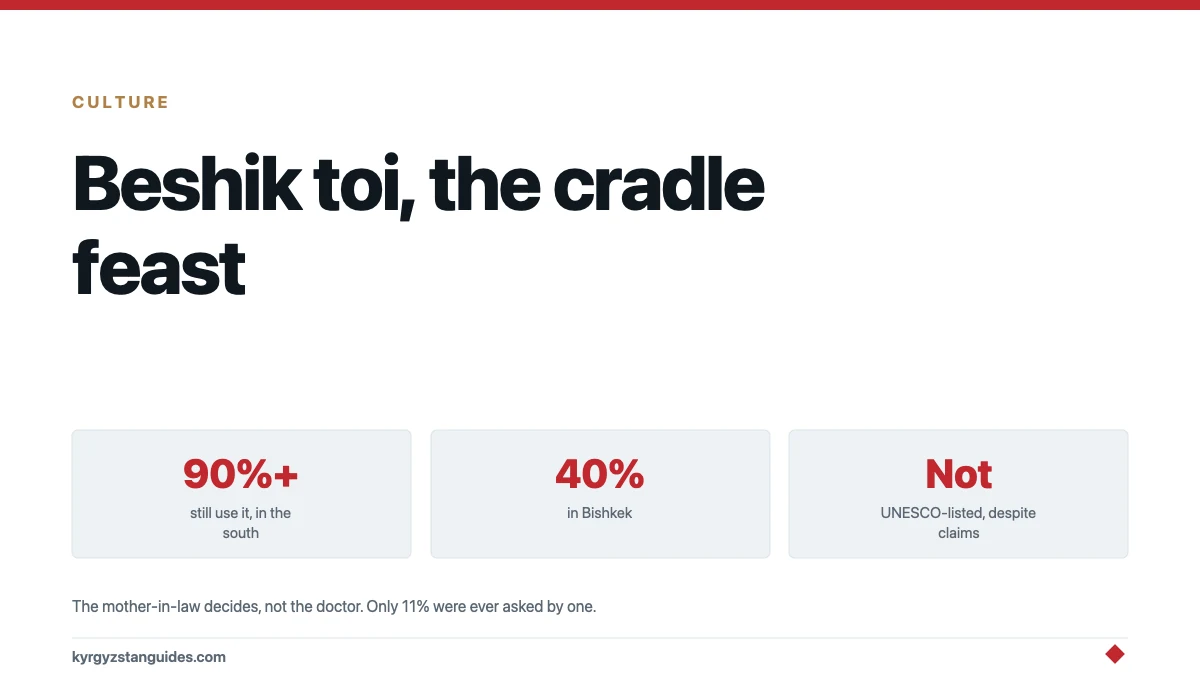
In a survey of 481 mothers across Osh and Jalal-Abad provinces, more than 90 per cent said they used the beshik. Only 11 per cent had ever been asked about it by a health practitioner.
That gap is the honest starting point. The beshik — the traditional Kyrgyz wooden cradle — is not a museum object or a folklore display. It is in current, majority use across the south of the country, and the feast held when a baby is first put into it is one of the ceremonies a visitor is most likely to be invited to.
What the cradle actually is
A beshik is a small wooden bed built for swaddling and rocking, and it has named parts.
The older nomadic type was built from two hoops bent out of birch or willow, about a fathom long and as thick as a forearm, with holes bored in their feet. Crossbars fit into the holes, cords run lengthwise across the crossbars, and a felt mat with a cut-out hole lies over the cords.
Through that hole sits the shimek, the urination tube, made from a sheep's cannon bone or from wood, with a vessel — the kültük — tucked underneath. Then the swaddling kit: small pillows, wide bands, square wrappers.
The word shimek is worth a note, because the same term is used for the hard pin through the centre hole of a hand-quern. Its core sense is a peg set through a hole, which is exactly what it does here. One English-language ethnography calls the tube chechek instead, so the terminology is not settled.
The later type, the jorgo beshik or "ambler cradle", is made by specialist craftsmen from willow or mulberry: about 1 to 1.1 metres long, half a metre wide and high, with thin solid boards nailed underneath instead of cords and a hole left only for the vessel, which may be tin, clay or glass. Its hoops are broad wood bent like an arch, and bow-shaped rockers are joined to the two soles so it rocks easily. It is painted and carved.
There is a rare third form, the asma beshik or "wind cradle", made from rope tied to the tops of the yurt's lattice.
The ceremony
The rite is performed by a respected senior woman, and who exactly that is varies. The state encyclopedia says the first placing is done by the maternal grandmother or by the kindik ene, the woman who cut the umbilical cord. A field account from Talas says it is done by a baibiche — an elderly, many-childed woman from a prosperous family, chosen because "her well-being will open the path to the child's well-being."
The sequence, drawn from both:
The cradle is fumigated inside and out with juniper, in the Talas account accompanied by the cry "Away! The owner has come." Talismans are attached: an evil-eye bead, an amulet, and a wolf's knucklebone.
The child is laid in from the right side, with an invocation to Umay ene, the protective mother figure. The words recorded in Talas are "Mother of the Cradle, hold him fast; Mother Umay, give him sound sleep."
Objects go into the cradle according to the child's sex: scissors and jewellery for a girl, knucklebones and a whip for a boy, sometimes a craftsman's tools so the child will follow that trade.
A piece of sary mai, clarified butter, is put in the baby's mouth so its life will be rich.
Then the mother lifts the child and bows to the seated guests, who give blessings. One recorded formula translates as: "May your cradle suit you, may your parents be capable; may your life be long, may your pasture be wide."
Boorsok is fried, livestock is slaughtered, the whole village eats, and guests scatter boorsok, sweets and fruit — and money — over the cradle.
There is also a piece of theatre in the Talas version. The baibiche pretends to sit on the cradle and ride away. The others shout "Where are you going?" She answers "Far away." They beg her to stay and to give the cradle to the child's mother, and she is then paid a ransom by the family.
Nobody agrees on when it happens
This is the detail every travel article states confidently and gets differently. Four sources, four answers:
| Source | Timing |
|---|---|
| Kyrgyz state encyclopedia | The day the baby leaves the swaddling pad |
| Talas field account, 2019 | Seven days after the umbilical stump falls and the wound heals |
| Russian Academy of Sciences fieldwork, 2019 | Cradle at about two weeks; the feast only when the mother's relatives are ready with the gifts, "sometimes after seven or eight months" |
| Academic study of Kyrgyz and Yakut birth rites, 2010 | The fortieth day, at the kyrk chygaruu |
Two further sources, found after this article was first written, sharpen rather than settle it. A Kyrgyz education paper gives seven days as the practice. And an academic comparison of Kyrgyz and Yakut birth rites places the first laying in the cradle on the fortieth day, at the kyrk chygaruu — so the forty-day figure is not merely a tourism invention, as we first assumed, but an older or regional norm with a scholarly source behind it. Seven days appears to be the more common practice now; the fortieth day is the other real tradition.
The same Academy of Sciences fieldwork adds two structural points that resolve part of the confusion. The beshik is provided by the wife's family, and the gift from the mother's parents — a calf for a girl, a foal for a boy, or the cash equivalent — is what the feast waits for. And a large beshik toi is held only for the first child. Later children go into the same cradle with a modest gathering of close relatives.
Who still does it, by region
This is the part that is actually measured rather than asserted. A survey of 219 respondents in Bishkek, sorted by their parents' home region, found beshik use splits sharply north to south:
| Region | Use |
|---|---|
| Batken | 100% |
| Osh | 96% |
| Jalal-Abad | 91% |
| Naryn | about 75% |
| Talas | 62.5% |
| Chui | 56% |
| Bishkek | 40% |
| Issyk-Kul | 40% |
Longer residence in Bishkek correlates with dropping the practice, and Russification was the strongest single predictor.
The larger southern survey found education and household income made little difference. What decided it was the extended family, and mothers-in-law in particular. Even among Russian mothers in Osh and Jalal-Abad, 44 per cent used the beshik; one explained simply, "Because my mother-in-law told me to."
The most common reason given for using it, by a third of respondents: the baby will not get cold.
Russian fieldwork records the counter-trend from the other side — that many families, especially in the northern districts, are moving to ordinary cots and away from tight swaddling.
It is not UNESCO-listed
You will see the beshik described as UNESCO heritage. It is not.
We checked Kyrgyzstan's full set of inscribed elements. Nothing there is a cradle element. The nearest are Midwifery: knowledge, skills and practices, inscribed in 2023, and yurt craftsmanship, inscribed in 2025.
Kyrgyzstan does maintain a national inventory of intangible heritage, established in 2008 and updated in 2011 and 2012, organised around seven domains and coordinated by the culture ministry. Whether the beshik or the beshik toi sits on that national list we could not establish: UNESCO confirms the inventory exists but does not publish its contents, and the document server refuses automated access. There is an indication that the beshik is indexed under wood-carving rather than as a ceremony, which we could not open to confirm.
Where beshik toi sits in the sequence
The rites around a Kyrgyz birth run in a recorded order: süyünchü, the good-news gift; köründük, the payment for the right to first see the newborn; the naming; jentek; the beshik toi; tushoo kesüü, the cutting of the ties at first steps; and later the circumcision.
A note on jentek, because it is used two ways. The encyclopedia and the academic fieldwork treat it as the birth feast itself — not called for a fixed day, with children running to relatives with the news, visitors giving köründük before viewing the baby, and the gift-giving proper beginning two or three weeks later. The Talas account instead uses jentek for a dish: crushed wheat mixed with sugar and ghee, rolled into sweet balls. Both usages are real.
The fortieth day has its own rite, kyrkynan chygaruu: the child is bathed in forty spoonfuls of water, attended only by women, usually by the mother-in-law, with forty pieces of sheep dung or salt added — sea salt and bubble bath, in town. The forty-spoon pour is the element that survives modernisation intact. For the first forty days the mother does no housework and is not left alone at night with the baby, and the baby is not shown to outsiders; if carried out, it gets a dot of soot or lipstick on the forehead against the evil eye.
If you are invited
Bring a gift for the child rather than for the parents, and expect to give it openly — scattering money and sweets over the cradle is part of the event, not a private gesture.
Do not expect a fixed schedule. The date depends on the mother's family being ready, which is why the timing varies so much in the sources.
And if you are in the south, understand that you are not watching a revival. Nine in ten households there are doing this anyway.
For the wider set of customs see Kyrgyz nomadic culture, and for the object's setting, the yurt and its construction.
FAQ
What is a beshik toi?
The feast held when a Kyrgyz baby is first placed in the traditional wooden cradle. A respected senior woman performs the placing, the cradle is fumigated with juniper, amulets are attached, guests scatter sweets and money over it and give blessings, and the household slaughters an animal and feeds the village.
When does the beshik toi take place?
Sources disagree substantially. Answers range from the day the baby leaves its swaddling pad, to seven days after the umbilical stump falls, to two weeks, to "sometimes seven or eight months" while the mother's family assembles the gifts. The forty-day figure is a genuine older or regional norm, attested in an academic study of Kyrgyz birth rites, rather than a tourism invention.
Do Kyrgyz families still use the beshik?
Yes, and heavily in the south. A survey of 481 mothers in Osh and Jalal-Abad found over 90 per cent used one. By region of origin, use runs from 100 per cent for Batken and 96 per cent for Osh down to 40 per cent for Bishkek and Issyk-Kul.
Is the beshik UNESCO heritage?
No. Kyrgyzstan's UNESCO inscriptions include midwifery, inscribed in 2023, and yurt craftsmanship, inscribed in 2025, but no cradle element. Kyrgyzstan does keep a national intangible heritage inventory, established in 2008, whose contents are not published.
Who gives the cradle?
The wife's family. Russian Academy of Sciences fieldwork records the beshik coming from the mother's side, along with a calf for a girl or a foal for a boy as the child's portion, and notes that a large beshik toi is normally held only for the first child.
What is the shimek in a beshik?
The tube set through a hole in the cradle's felt mat that carries urine into a vessel below, traditionally made from a sheep's cannon bone or from wood. One English-language source records the term as chechek instead, so the vocabulary varies.
The other great family celebration, and the most expensive one after a wedding, is sunnot toi.