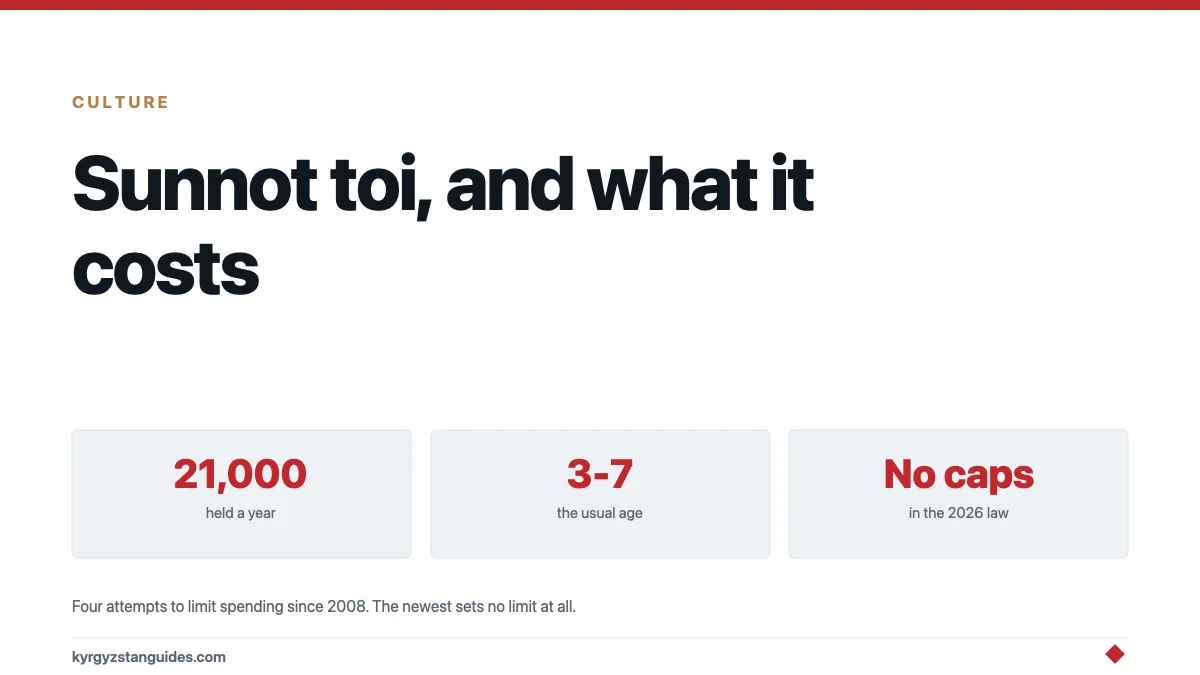
Around 21,000 sunnot toi are held in Kyrgyzstan every year, out of roughly 154,000 to 161,000 family celebrations of all kinds — about one major event for every 45 to 50 people in the country.
Children's celebrations, the category sunnot toi falls into, cost roughly half of the wedding baseline. A wedding budgets 1.1 to 1.5 million som for about 200 guests. That puts a mid-range sunnot toi somewhere around 350,000 to 750,000 som, against an average monthly wage of 39,456 som.
Fifteen months of average earnings, for a party. That is the pressure the government has spent four attempts trying to relieve.
What it is
Sünnöt comes from the Arabic sunna. The procedure itself is sünnötkö oturguzuu, literally "to seat the boy for the sunnat", and the act is also described as making the child halal or adding him to the ranks of Muslims.
It is framed as an obligation rather than a choice: the parz, the duty and the debt of parents toward a son.
Age
The traditional rule is an odd year — three, five, or at the outside seven — with spring preferred. Current practice still clusters at three to seven.
Medical opinion pulls the other way. Specialists quoted in the Kyrgyz press argue for infancy, within the first month, citing faster healing and less distress, and contrast this with Arab practice within a month and Jewish practice within a week. A Bishkek urologist is blunt that medically, age has no significance.
So the range you will hear is: folk norm three to seven, medical recommendation zero to one month.
The event
The older form runs three days. Day one is the family council and the slaughter of the animals brought by the boy's grandfather and maternal uncles. Day two the guests arrive and are billeted in village houses, with games. Day three is the cutting, after which people eat and disperse.
The traditional rite is specific. The grandfather holds the boy on his lap. The boy's eyes are bound with a white kerchief, bread is put between his teeth, both hands are put in cold water and someone holds his feet. He is made to hold a tibia bone from a special dish. Women are not allowed in while it is done.
The practitioner, an usta, is paid beforehand with a gift called the "hand-binder". A small piece of the excised foreskin was traditionally given to childless women as a fertility charm.
Then the public part. A herald calls the people, horns are played, akyns and manaschy perform, and horse games are run — jamby atysh, kyz kuumay, oodarysh, alaman baige, tyiyn engmey, jorgo chabysh, wrestling, ordo — with prizes announced in livestock.
Guests bring köründük, the seeing-gift, and lead in livestock; the boy and his parents are dressed in sarpay, robes of honour. The grandfather gives the bata, everyone answers "Oomiyin" and wipes their palms down their faces, and then sweets and coins are scattered over the boy's head for the children to scramble for.
One blessing recorded at a sunnot toi: be an unquenchable lamp for one travelling in the dark; a spring for the thirsty; a star for the wayfarer; be small if you become great.
Who performs it now, and a real safety problem
Most families now use medical facilities. The procedure takes ten to twenty minutes and requires blood work, a temperature check and paediatric clearance.
That shift happened for a reason. A Bishkek urologist reports that badly done historic procedures in Naryn and Issyk-Kul left men aged forty to fifty needing corrective surgery.
The problem is not solved. Kyrgyz reporting from 2022 documented a seven-year-old boy who died after a circumcision at the National Hospital in Bishkek, from blood loss, and a comparable death of a three-year-old in Issyk-Kul district in 2019. The same reporting found a veterinarian performing circumcisions without anaesthesia using an unsterilised knife, and warned against clinics advertising painless laser procedures.
We are stating this plainly because it is in the Kyrgyz press and is not a foreigner's squeamishness. If you are a resident family reading this, the relevant advice in that reporting is a hospital, blood work first, and scepticism about anything marketed as painless.
The gift system, and why it escalates
The vocabulary tells you how the money moves. Köründük, the gift for seeing the child. Sarpay, robes of honour put on the family by guests. Kol baylar, the gift to the practitioner. Chachyla, the sweets and coins scattered afterward. Jeen tabak, the "nephew's dish", which the boy's maternal kin come specifically to receive.
Livestock is led in "according to the standing relationship" — the Kyrgyz gift economy is reciprocal and effectively ledgered. What you give is what you will be given back, and what you were given you must exceed. That is the mechanism behind the cost escalation, and it is why exhortation does not work on it.
Per-guest catering gives the scale. In a rural Osh oblast restaurant, 150 som a head. In Osh city, 1,000. In Bishkek, from 1,500, and at a top restaurant 2,600 — which is 780,000 som for 300 guests before food and drink. A separate survey gives per-guest minimums by region running from 400 som in Batken to 1,000 in Bishkek, with a cow for slaughter around 70,000 som and a horse around 80,000.
Households that merely attend other people's celebrations spend 3,000 to 100,000 som a year doing so.
The sector as a whole is estimated at 100 to 150 billion som a year — 5 to 8 per cent of GDP, and 10 to 15 per cent of the entire service sector. In the first half of 2022, microfinance organisations issued 9.56 billion som in consumer loans, celebration expenses included.
Four attempts to legislate, and what the newest one does
2018. The culture ministry proposed capping celebrations at three hours and 150 guests. Parliament voted it down.
February 2022. Presidential decree No. 54 named vanity and extravagance, and the fact that families take loans and then go abroad as labour migrants to repay them. It instructed local authorities to adopt their own rules and recommended the muftiate issue fatwas against extravagance. No numbers, no fines.
January 2025. Two MPs put draft laws out for discussion with actual limits: weddings capped at 250 guests, bride send-offs at 100, one large animal and three cars, memorial feasts at the third, seventh and fortieth days banned outright. Fines of 300,000 som for the organiser, 200,000 for an official, 100,000 for the restaurant. The Cabinet supported them in principle in April 2025 while noting Kyrgyzstan's obligations under the 2003 UNESCO intangible heritage convention.
Note that none of the reporting on that draft mentions sunnot toi. The caps were written for weddings, send-offs and funerals.
July 2026. A law signed on 28 July amended the local government act. City mayors and village heads are now statutorily obliged to assist in preventing excessive extravagance at family celebrations and memorial rites.
It sets no spending caps, no guest limits and no fines. After four attempts across eighteen years, the state's current position is a duty to assist in prevention.
What does have numbers is local. Village councils have adopted their own rules under the 2022 decree — one, in September 2025, recommends a single day and no more than 150 invited guests, bans amplified music outdoors after 22:00, and requires all celebrations and all restaurants and banquet halls to close by 22:00.
An economist's counter-argument is worth hearing: restaurant revenues grew 30 per cent in 2024 on the back of these events, but the spending produces no capital accumulation. The laws are an attempt to change a behavioural model, not to raise revenue.
If you are invited
You will be, if you spend any time in a Kyrgyz village. Three things.
Bring a gift for the boy and give it openly. Cash in an envelope is normal and expected; the amount depends on your relationship and there is no shame in asking someone what is appropriate.
You will not be present for the procedure and should not ask to be. The event you are attending is the feast.
Do not leave before the bata. See our guide to bata and toasting for how the blessing runs, and hospitality rules for the seating and the meat.
FAQ
What is a sunnot toi?
The Kyrgyz celebration held for a boy's circumcision. Around 21,000 are held each year. The traditional form runs three days, ending with the procedure, and involves horse games, gifts of livestock, robes of honour for the family and a closing blessing from the boy's grandfather.
At what age are Kyrgyz boys circumcised?
Traditionally at an odd age — three, five or at most seven — with spring preferred, and that remains the common practice. Medical specialists quoted in the Kyrgyz press argue instead for the first month of life, citing faster healing, and note that medically the age has no significance.
How much does a sunnot toi cost?
Children's celebrations run at roughly half the wedding baseline of 1.1 to 1.5 million som, so approximately 350,000 to 750,000 som depending on scale. Per-guest catering ranges from 150 som in rural Osh oblast to 2,600 som at a top Bishkek restaurant. Average monthly earnings were 39,456 som in early 2025.
Is there a law limiting spending on celebrations in Kyrgyzstan?
Not an effective one. A 2018 bill was voted down, a 2022 presidential decree set no numbers, a 2025 draft with guest caps and fines has not passed, and the law signed on 28 July 2026 only obliges mayors and village heads to help prevent extravagance, with no caps and no fines. Some village councils have adopted their own limits.
Is circumcision safe in Kyrgyzstan?
Mostly it is done in medical facilities in ten to twenty minutes with blood work and paediatric clearance first. But Kyrgyz reporting has documented deaths of a seven-year-old in Bishkek in 2022 and a three-year-old in Issyk-Kul in 2019, procedures performed by a veterinarian without anaesthesia, and clinics advertising "painless laser" methods that the same reporting warns against.
What should I bring if invited to a sunnot toi?
A gift for the boy, given openly. Cash in an envelope is normal. The traditional gift is the köründük, the "seeing-gift", and guests historically led in livestock according to the standing reciprocal relationship with the family. Ask a local what amount fits your relationship.