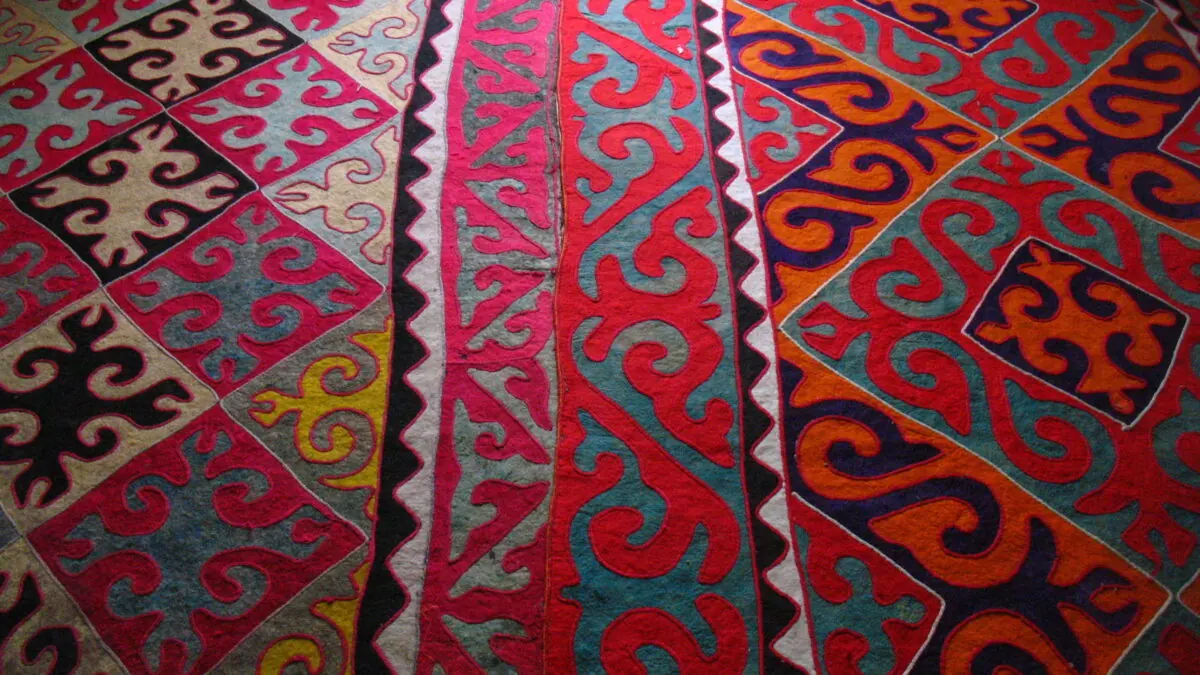
What is that thick, boldly patterned felt rug on the floor of every yurt, and why does a real one cost so much more than the souvenir-stall version? It’s a shyrdak, the Kyrgyz felt carpet. A genuine shyrdak is hand-made from sheep’s wool through a mosaic technique, two contrasting felt colors cut to mirror each other and stitched together, and a good one takes weeks to months of work, which is exactly why the authentic article isn’t cheap. The craft is considered endangered enough that UNESCO inscribed the Kyrgyz art of felt carpets, ala-kiyiz and shyrdak, on its List of Intangible Cultural Heritage in Need of Urgent Safeguarding.
Here is how a shyrdak is actually made, how it differs from the other Kyrgyz felt carpet you’ll be shown (the ala-kiyiz), how to tell a real one from a factory fake, and where to buy the genuine thing: with the town of Kochkor as the reliable answer.
How a shyrdak is made
It starts with wool and hot water. Sheep’s wool is washed, dyed, laid out, and rolled — traditionally wrapped around a reed mat and rolled by hand, forearm, or even dragged behind a horse — while soaked in hot water and pressed until the fibers mat into solid sheets of felt. That felting stage is the physical, communal part, often done by a group of women working together.
The artistry comes next. The maker takes two sheets of felt in contrasting colors, stacks them, and cuts a pattern through both at once. Because both layers are cut from the same stencil, the shapes are mirror images: the positive shape from one color drops into the negative gap of the other, so a single cut yields two interlocking panels — red pattern on blue, and its exact reverse, blue on red. These are stitched together edge to edge, the seams often covered with a twisted cord called a jheek, and the panels are quilted onto a felt backing. The motifs aren’t random. Ram’s horns, running water, plant curls, and other symbols carry meaning passed down through generations. A full carpet can take one or several people weeks to months.
Shyrdak vs ala-kiyiz
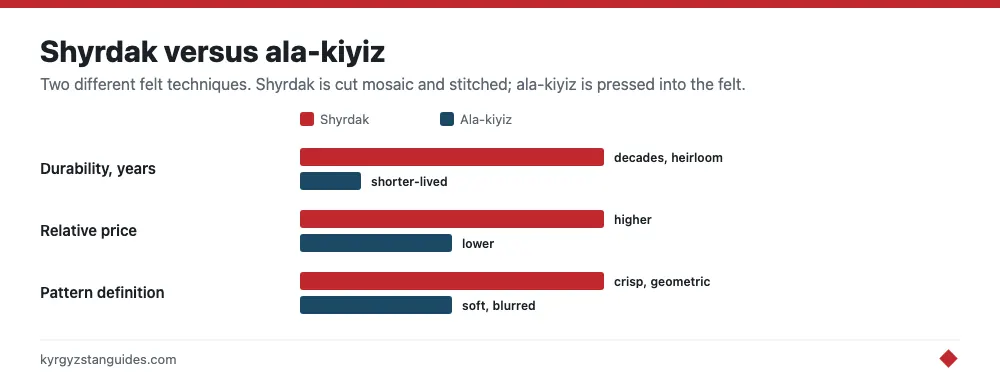
You’ll be shown both, and they aren't the same thing or the same price. The shyrdak is the cut-and-stitched mosaic described above: durable, structured, sharp-edged patterns, built to last decades, often passed down as an heirloom. The ala-kiyiz is the simpler cousin. A pattern pressed directly into the felt during the rolling stage, so the design is fused into a single layer rather than cut and sewn. Ala-kiyiz is faster to make, softer, less durable, and cheaper; its patterns have blurred, painterly edges rather than the crisp geometry of a shyrdak.
Neither is “better”, an ala-kiyiz makes a lovely, affordable wall hanging or light rug, while a shyrdak is the investment piece. But you should know which you’re being sold, because the price gap is large and some sellers blur the line. The table below is the quick reference.
| Shyrdak | Ala-kiyiz | |
|---|---|---|
| Technique | Cut mosaic, stitched panels | Pattern pressed into felt |
| Pattern edges | Crisp, geometric | Soft, blurred |
| Durability | Decades; heirloom | Shorter-lived |
| Relative price | Higher | Lower |
Telling real from fake
Souvenir shops sell machine-made or synthetic imitations that look the part from a distance. A few checks help. Flip the carpet: a hand-made shyrdak shows the stitching and the mirrored two-color logic on both panels, and the back reveals honest hand-sewn seams rather than a printed or glued surface. Feel the material: real wool has a slightly greasy, springy hand and a faint sheep smell; synthetic felt is uniform and squeaky. Check whether the two colors truly mirror each other, which is the signature of the cut technique. And be realistic about price: a genuine, sizeable shyrdak that took weeks to make cannot cost the same as a printed mat.
Where to buy a real one: Kochkor
The reliable answer is Kochkor, a small town on the way south toward Song-Kul that has become the center for authentic felt. Women’s craft cooperatives there, the best known is the Altyn Kol handicraft cooperative, sell shyrdaks and ala-kiyiz made by local members, and several run workshops where you can watch the felting and cutting, or even try rolling wool yourself. Buying at the source means the money reaches the makers and you can see the process that justifies the price.
Kochkor is an easy stop by marshrutka from Bishkek or as part of a route to the high pastures, and the cooperatives can arrange to ship a large carpet home if you can’t carry it. If Kochkor isn’t on your path, community-based tourism offices in other towns and reputable shops in Bishkek also stock genuine pieces. Just apply the flip-and-feel checks above. For the wider list of what’s worth carrying home, our Kyrgyzstan souvenirs guide covers felt alongside the rest, and a shyrdak pairs naturally with the yurt-and-pasture world our nomadic culture guide describes. If the textile side of that world interests you beyond carpets, our guide to Kyrgyz women’s dress covers the elechek, the shökülö and the beldemchi, with an honest note on which are genuinely still worn.
Our take: if you want one meaningful object from Kyrgyzstan, make it a real shyrdak bought in Kochkor. Buy the size you’ll actually use, confirm it’s cut-and-stitched rather than pressed, pay what the labor is worth, and arrange shipping rather than talking yourself out of it at the door.
UNESCO listed it as endangered, not as a highlight
This is the detail that changes how you should read a shyrdak on a bazaar wall. The element — officially “Ala-kiyiz and Shyrdak, art of Kyrgyz traditional felt carpets” — was inscribed by UNESCO in 2012, but on the List of Intangible Cultural Heritage in Need of Urgent Safeguarding. That is a different list from the Representative List that carries kok-boru and the Manas epic. It is the one for traditions judged to be disappearing.
UNESCO's own reasoning on the element page is blunt: the number of practitioners is diminishing, with most over forty years of age, and it names the lack of governmental safeguarding, the disinterest of the younger generation, the dominance of inexpensive synthetic carpets, and the poor quality and low availability of raw materials. Of the two crafts, it records that ala-kiyiz carpets “have practically disappeared from Kyrgyz homes”, while shyrdaks are “under serious threat of being lost”.
The transmission problem is structural. The knowledge passes, as UNESCO puts it, as a rule by older women inside families, mostly in rural and mountain areas — which means it travels with a way of living rather than through any school, and it stops when that way of living does. The raw-material line matters too, and it connects to something covered elsewhere on this site: Kyrgyz wool mostly has no buyer and the processing capacity did not survive the 1990s, as our post on the wool problem sets out.
Safeguarding has happened, at a modest scale. UNESCO's Almaty office and the EU ran master classes and exhibitions at the Frunze Museum in Bishkek in late September 2019, with a policy round table bringing in MPs, the Ministry of Culture and artisans, under the Silk Roads Heritage Corridors project. No outcome figures were published. On the market side, a cooperative called Uz-Anar joined an International Trade Centre e-commerce programme in 2021 and made its first international sales through eBay.
Did any of it work? I am not going to tell you, because nobody has published the answer. The element is still on the urgent-safeguarding list, which is the only hard fact available. A periodic report was submitted in 2017 and the next is due around 2026 or 2027, with sources disagreeing on the date.
The practical consequence for a buyer: when you pay a real price for a hand-stitched shyrdak from a Kochkor workshop rather than a cheap machine-made imitation, you are acting on exactly the economics UNESCO identified as the threat.
Frequently Asked Questions
What is a shyrdak?
A shyrdak is a traditional Kyrgyz felt carpet made from sheep’s wool using a mosaic technique: two contrasting colors of felt are cut to mirror each other and stitched together into bold geometric patterns. Durable and often handed down as an heirloom, it is the carpet you’ll see on the floor of a yurt.
What’s the difference between shyrdak and ala-kiyiz?
A shyrdak is cut and stitched, giving crisp geometric patterns and long durability. An ala-kiyiz has its pattern pressed directly into the felt during rolling, so the design has soft, blurred edges; it’s simpler, less durable, and cheaper. Both are genuine Kyrgyz felt, but the shyrdak is the investment piece.
Why is Kyrgyz felt art on the UNESCO list?
UNESCO inscribed “Ala-kiyiz and Shyrdak, art of Kyrgyz traditional felt carpets” on its list of intangible cultural heritage in need of urgent safeguarding in 2012, recognizing that the skills were at risk of being lost as fewer people learned the labor-intensive craft. The listing supports efforts to keep the technique alive.
Where can I buy an authentic shyrdak?
Kochkor is the reliable place. Women’s craft cooperatives there, such as Altyn Kol, sell hand-made shyrdaks and run workshops where you can watch or try the process. Reputable shops in Bishkek and community tourism offices elsewhere also stock genuine pieces if Kochkor isn’t on your route.
How can I tell a real shyrdak from a fake?
Flip it over to check for honest hand-sewn seams and the mirrored two-color pattern on both panels, feel for springy, faintly greasy real wool rather than uniform synthetic felt, and be wary of a price too low for weeks of work. Printed or glued imitations lack the cut-and-stitched mirror logic.
Is shyrdak on the UNESCO heritage list?
Yes, but on the List of Intangible Cultural Heritage in Need of Urgent Safeguarding rather than the Representative List, inscribed in 2012 under the name "Ala-kiyiz and Shyrdak, art of Kyrgyz traditional felt carpets". That is the list for traditions assessed as at risk of disappearing.
Why is Kyrgyz felt carpet making considered endangered?
UNESCO's element page cites a diminishing number of practitioners, most of them over forty, together with a lack of governmental safeguarding, disinterest among younger people, the dominance of inexpensive synthetic carpets, and poor quality and low availability of raw materials. It records that ala-kiyiz has practically disappeared from Kyrgyz homes.
How is shyrdak-making passed on?
Within families, as UNESCO puts it, as a rule by older women, mostly in rural and mountain areas. There is no formal school route, which is why the craft travels with a way of life rather than through institutions and is vulnerable when that way of life changes.