You'll notice them within an hour of leaving Bishkek. On a hillside above a village, or on a bare slope beside the road, a dense cluster of domes, small towers, minarets and mud-brick walls — packed tighter than the village below it, and often more elaborate.
Kyrgyz cemeteries are among the most striking things in the country and almost nobody explains them.
They are also one of the clearest illustrations of what this culture actually is: nomadic ancestor reverence, Islamic funerary form, Soviet portraiture and current wealth, all stacked in one enclosure.
What you're looking at
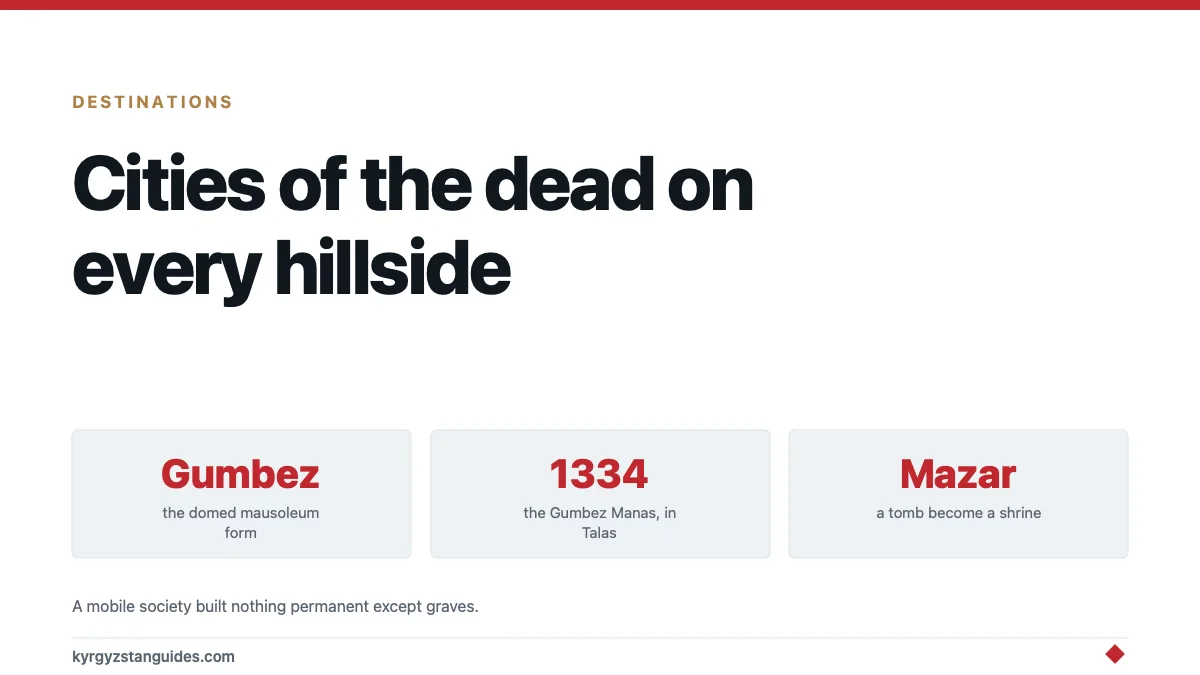
The structures have a general name (gumbez, from the word for dome) and they range enormously.
Mud-brick mausoleums. The classic form: a small square or domed structure of unfired brick, built over a grave. Historically these were for nobles, prominent warriors and holy men.
Fenced enclosures. Metal railings or low walls around a family plot, often with a decorative arch.
Tin-roofed domes and small minarets. Modern and very common, built in the same shapes but faster and cheaper.
Portrait headstones. Black granite or marble with an etched photographic likeness of the deceased — a Russian and Soviet convention adopted wholesale.
Yurt shapes. Circular forms, domes, and occasionally structures that are recognisably a yurt rendered in brick. The dead are given a house, and the house is the one this culture built.
Eurasianet described these cemeteries as a snapshot of the country's history, which is about right.
Why they're so elaborate
Because monumental burial is what happens when a society without permanent architecture starts building permanently.
A nomadic household built nothing that lasted. The yurt was designed to be dismantled. Wealth was in animals, which move, and in textiles, which wear out.
The grave was the exception. It was the one fixed point — a place a family would return to, at a spot on a migration route they used every year.
So the grave got the investment that a house would have received in a settled society. That logic then met Islamic funerary architecture arriving from the settled south, and the two combined: Islamic burial rites with mausoleum forms that a herding culture already had strong reasons to build.
Originally monuments were raised only for tribal leaders, khans, poets and saints. Over time they were built for anybody whose family could afford one — which is why a cemetery today reads as a record of who had money and when.
The un-Islamic parts
This is the interesting layer, and it is everywhere once you look.
Kyrgyz cemeteries carry a great deal that isn't Islamic in origin: motifs from animism and shamanism, ancestor veneration, and objects placed for reasons that have nothing to do with Islamic practice.
Horse imagery and, historically, the burial of a horse's skull or the display of a favoured animal's tail.
Tug poles (a pole with horsehair or cloth) at some graves.
Tied cloth, as at sacred springs and trees.
Mazars. Some tombs became shrines, visited for pilgrimage, intercession or healing. That is a practice orthodox Islamic authorities have often disapproved of, and it has continued anyway for a very long time.
The same syncretism is visible at Sulaiman-Too and in the müçöl protection customs. Kyrgyz religious practice layers rather than replaces, and a cemetery is where the layers are most visible in one place.
Why they are above the village
A practical observation that turns out to have several answers.
Land. Valley floor is irrigable and grazeable. A slope isn't, and a cemetery does not need water.
Drainage. Burial on a slope stays dry.
Visibility. A cemetery on a rise is seen from the whole valley, which is the point rather than a side effect.
Permanence. Villages moved: seasonally in the pastoral system, and again in the Soviet period when settlements were consolidated and people were relocated. The cemetery stayed. In some valleys the graves mark where a village used to be, and the living moved down the hill decades ago.
That last one is worth looking for. A large old cemetery with a small or absent settlement below it is telling you about a population that has left — for Bishkek's novostroiki, or for Russia, or into a consolidated village further down.
The University of Central Asia's project documenting the ancestral cemeteries of Kyrgyzstan recorded these sites as architecture in their own right, which they hadn't generally been treated as before.
The famous one
Gumbez Manas, in Talas region, is the outlier, a rare survival in burnt brick and carved terracotta rather than mud, square in plan, under a hipped dome.
It dates to around 1334, stands at the junction of the Kenkol and Talas valleys about 13 km north-east of Talas, and its walls carry Karakhanid patterning and Arabic inscription.
Tradition holds it as the tomb of Manas, hero of the national epic. The inscription says otherwise: it dedicates the tomb to Kenizek-Khatun, daughter of the Emir Abuka, a Chagatai ruler. The traditional explanation is that the dedication was a deliberate deception to keep enemies from desecrating the grave: and the detail usually offered in support is that the body recovered from it was a man roughly two metres tall.
Historians are more cautious about all of this. Archnet's record of the structure treats it as an architectural object rather than settling the identification.
Either way it's the country's most significant piece of medieval funerary architecture and the focus of the Manas Ordo complex in Talas.
How to behave around them
They are not attractions, and Kyrgyz people visit them regularly.
Photographing from a distance is fine. Walking in to photograph individual graves is not, unless you have a reason.
Do not enter during a funeral or a memorial visit. Gatherings at cemeteries are frequent — the fortieth day, the anniversary, and on certain days of the year.
Do not touch, move or take anything. Including stones.
Dress as you would for any burial ground.
Do not climb on the structures. This should not need saying and occasionally does.
If you are with a local family visiting a grave, follow them exactly. There will be a sequence: a prayer, hands raised and passed over the face at the end. Our funeral customs guide covers the practice.
What they tell you
Read a Kyrgyz cemetery as a document and it gives you the twentieth century.
Old mud-brick mausoleums, weathering back into the hillside. Soviet-era headstones with a red star and a portrait. Post-1991 graves with Arabic script and a crescent. Very recent ones in polished granite, sometimes extravagant, paid for by money earned in Russia.
And in some places, mass graves and memorials from 1916 and from 1938, the two traumas the country has not finished processing.
A hillside of domes above an ordinary village isn't decoration. It is the only continuous written record a mobile society kept.
FAQ
What is a gumbez?
A domed mausoleum, from the Central Asian word for dome. Kyrgyz cemeteries are full of them, ranging from old mud-brick structures to modern tin-roofed versions.
Why are Kyrgyz cemeteries so elaborate?
A nomadic society built nothing permanent except graves, so the grave received the investment a house would in a settled culture. That met Islamic funerary architecture and the two combined.
Are Kyrgyz cemeteries Islamic?
Islamic in rite, but they carry substantial pre-Islamic content: ancestor veneration, horse imagery, tied cloth, and tombs treated as shrines for pilgrimage.
What is a mazar?
A tomb or site treated as a shrine, visited for pilgrimage, intercession or healing. The practice predates Islam in the region and continues alongside it.
What is Gumbez Manas?
A medieval mausoleum in Talas region, built in burnt brick and carved terracotta, traditionally held to be the tomb of the epic hero Manas. It anchors the Manas Ordo complex.
Can tourists visit Kyrgyz cemeteries?
Photograph them from a distance rather than walking among the graves, avoid them during funerals or memorial gatherings, and touch or move nothing.