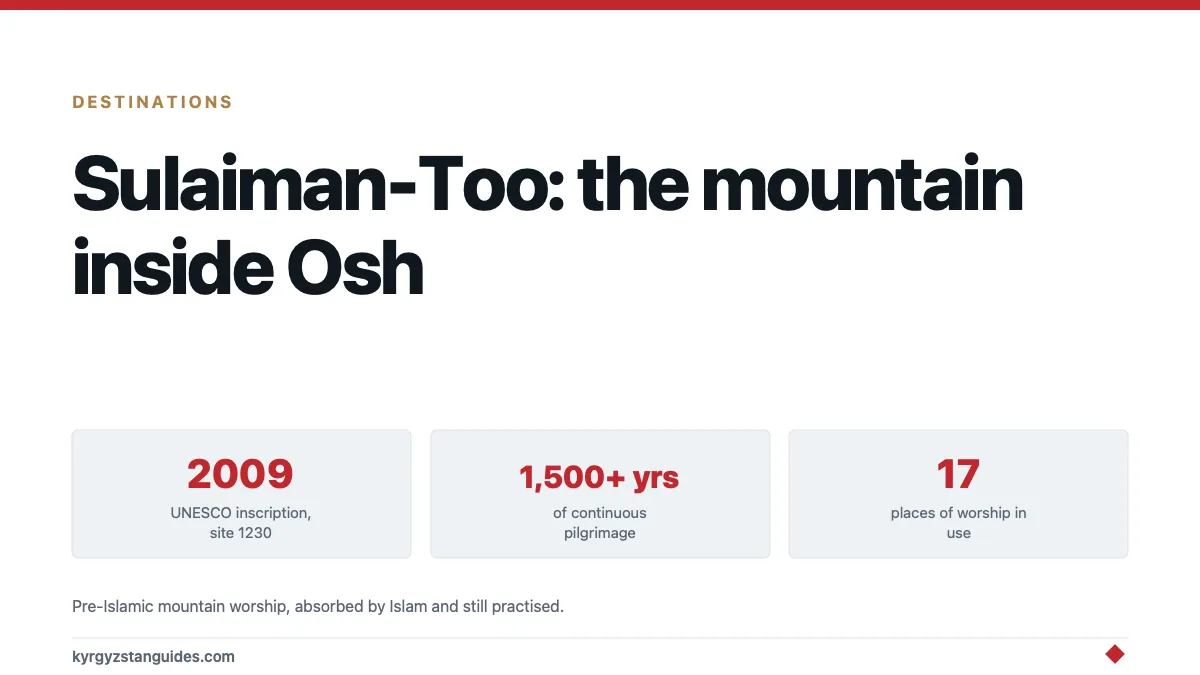
There is a limestone ridge with five peaks rising straight out of a city of 300,000 people. You can walk to the top in forty minutes. People have been climbing it for religious reasons for more than 1,500 years, and the practice hasn't stopped.
Sulaiman-Too was inscribed on the UNESCO World Heritage List in 2009 as site 1230, Kyrgyzstan's first — Eurasianet covered the announcement at the time. It's the country's most complete cultural site and one of the clearest examples anywhere of religious practice surviving a change of religion.
What is actually on it
More than the view, though the view is the reason most visitors go up.
Petroglyphs. Rock art in caves and on exposed surfaces, depicting people, animals and geometric patterns, from the Stone and Bronze Ages.
Settlement remains. Stone and Bronze Age occupation on and around the mountain.
Cult places. Numerous sites scattered across the slopes, each associated with a specific practice.
Islamic buildings. Two largely reconstructed 16th-century mosques, one of them associated with Babur, the founder of the Mughal dynasty, born in the Fergana valley, who's said to have built a cell here before going on to India.
Seventeen places of worship still in use. That is UNESCO's count, alongside many more that aren't, dispersed across the peaks and linked by footpaths.
The museum. Built into a cave in the rockface, with a concrete-and-glass frontage that's either brutal or magnificent depending on your taste. Inside is archaeology, ethnography and a natural history collection.
Our Osh guide covers the city; this is the thing in the middle of it.
Why UNESCO listed it
Not for any single monument. For the continuity.
The mountain was a site of pre-Islamic worship (mountain cult practice, with the specific rites attached to specific rocks and caves) for a very long time before Islam arrived in the Fergana valley. When Islam did arrive, those practices were not eliminated. They were absorbed.
The result is a working sacred site where Muslim pilgrims perform rituals of clearly pre-Islamic origin, and have done continuously for over a millennium. That is what UNESCO means by religious syncretism, and Sulaiman-Too is an unusually intact, unusually visible example.
It is also the only World Heritage Site located entirely within Kyrgyzstan. The country's other listings — Silk Road corridor sites and the Western Tien Shan. Are transnational, shared with neighbours. UNESCO's own inscription record sets out the criteria.
The practices you will see
This is what makes a visit different from a viewpoint climb, and it is why behaviour matters.
Rock slides. Smooth, polished chutes in the limestone, worn by centuries of use. People slide down them, most commonly women seeking help with fertility or back pain. The polish on the stone is the evidence of how long this has gone on.
Rubbing and touching. Specific rocks and surfaces associated with specific ailments.
Crawling through openings. Passing through a narrow gap in the rock, a widespread pre-Islamic purification motif.
Tying cloth. Strips of fabric tied at sacred spots, as at sacred springs and trees across the country.
Prayer. At the mosque, at the caves, and at unmarked places that regulars know.
Documentation of the site lists the individual cult places across the slopes, each with its own attached practice.
None of this is performed for visitors. There is no ticket to the rituals, no demonstration, no guide explaining it as a show. People come to the mountain for their own reasons, and you are walking through the middle of it.
How to visit without being a problem
Go early or late. Midday in summer in Osh is brutal and the climb has no shade. Sunrise and the hour before sunset are also when the light on the Fergana valley is worth it.
Dress as you would for a mosque. Covered shoulders and knees. This is a sacred site, not a hill.
Do not photograph people at prayer or at the rituals. This is the one that matters. Landscape, buildings and the view are fine. A woman sliding down a rock for a reason she hasn't shared with you is not.
Do not use the rock slides as a slide. They are worn smooth by people who believe something. Using one as playground equipment reads exactly as you would expect.
Go up the steps from the eastern side for the main route past the museum and the mosque. It is stepped most of the way and takes half an hour at a normal pace.
Take water. It is dry, exposed limestone in a hot city.
Babur, and why the mountain matters beyond Osh
Zahir-ud-din Muhammad Babur was born in Andijan in 1483, in the Fergana valley, about fifty kilometres from here. He inherited a small principality, lost it, spent years fighting for and losing cities in Central Asia, and eventually went south, taking Kabul, and then in 1526 defeating the Sultan of Delhi at Panipat and founding the Mughal Empire.
The small structure on Sulaiman-Too is associated with him. He wrote about this valley in the Baburnama, one of the great autobiographies of the pre-modern world, with an eye for landscape, fruit, melons and birds that's startlingly modern.
Which means that the mountain in the middle of Osh connects directly to the Taj Mahal, the Red Fort and four centuries of Indian history. Sulaiman-Too is on the 1,000 som note, alongside Yusuf Balasaguni — as our piece on the currency sets out, Kyrgyzstan put this mountain on its largest banknote.
Why it's worth the climb
Because it's the best half-day in Kyrgyzstan that does not require a vehicle.
From the top you see the whole Fergana valley, flat, green, intensively farmed, running away toward Uzbekistan, with Osh spread out below and the mountains behind. That single view explains more about the geography of this region, and about why the borders here have been so contested, than any map.
And you're standing on a mountain that people were climbing to pray on before Islam reached Central Asia, and are still climbing to pray on today.
FAQ
What is Sulaiman-Too?
A five-peaked limestone mountain rising directly out of the city of Osh in southern Kyrgyzstan, a sacred site used continuously for over 1,500 years and a UNESCO World Heritage Site since 2009.
Why is Sulaiman-Too a UNESCO site?
For its continuity of religious practice: pre-Islamic mountain worship absorbed into Islamic pilgrimage, alongside petroglyphs, Bronze Age remains, cult sites and Islamic buildings.
How long does it take to climb Sulaiman-Too?
Around 30 to 40 minutes on the stepped path from the eastern side, including the museum and the mosque near the top.
Is there a museum on Sulaiman-Too?
Yes, built into a cave in the rockface, holding archaeological, ethnographic and natural history collections.
What are the rock slides on Sulaiman-Too?
Limestone chutes polished smooth by centuries of use, associated with fertility and healing. They are used as part of active religious practice, not as an attraction.
What should I not do at Sulaiman-Too?
Do not photograph people performing rituals or praying, do not use the sacred slides recreationally, and dress as you would for a place of worship.