Every Kyrgyz child knows Manas. He is the warrior who united the forty tribes, the giant whose deeds fill an oral epic longer than the Iliad and the Odyssey combined, and the name attached to airports, universities, and a statue on Bishkek’s main square. And in a quiet valley in the country’s far northwest, there's a place that claims his grave.
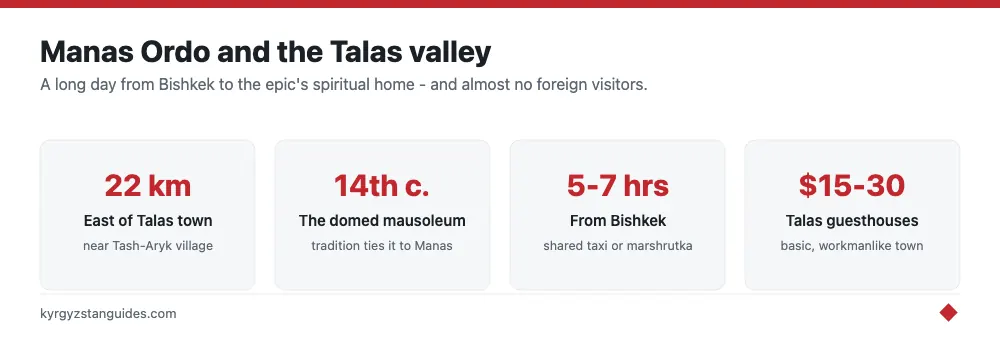
Manas Ordo is a memorial complex about 22 km east of Talas town, built around a 14th-century domed mausoleum that tradition holds to be the tomb of the epic hero Manas. It's one of Kyrgyzstan’s most important national and spiritual sites (part museum, part pilgrimage ground) set in the remote Talas valley, which is a long haul from anywhere and visited by far more Kyrgyz than foreign travelers.
That last point matters. Manas Ordo is not a polished tourist attraction; it is a living site of national identity, and understanding the epic first is what turns a modest brick tomb into something moving. So start with the story.
The Epic of Manas
The Epic of Manas is the cornerstone of Kyrgyz culture: a vast oral poem passed down for perhaps a thousand years by reciters called manaschy, who chant it from memory in a rhythmic, trance-like flood that can run for days. It tells of Manas, a hero born to lead the scattered Kyrgyz tribes, his campaigns against their enemies, his wife Kanykey, his son Semetey and grandson Seitek. The story continues down the generations in a trilogy of colossal length. UNESCO lists the epic and the tradition of reciting it as intangible cultural heritage, and a good manaschy is treated as a national treasure.
For the Kyrgyz, Manas is not merely a folk tale. He is the symbol of unity and independence, invoked at moments of national feeling, and the epic functions as a kind of encyclopedia of nomadic life: customs, genealogy, warfare, weddings, and funerals all preserved in verse. To grasp why a tomb in an out-of-the-way valley draws busloads of pilgrims, you have to grasp that Manas is the nation’s idea of itself. Our guide to Kyrgyz nomadic culture puts the epic in the wider context of yurts, horses, and the traditions it records.
The scale of the thing is hard to overstate. In its fullest recorded versions the trilogy runs to hundreds of thousands of lines. Orders of magnitude longer than most of the world’s other great epics: and no two manaschy recite it identically. Each performer improvises within a memorized framework, so the epic is less a fixed text than a living river that every generation re-channels. The greatest manaschy of the 20th century, Sayakbay Karalaev, could reportedly recite for days on end, and his recordings are still treated as a benchmark. When Kyrgyzstan marked what it called the epic’s 1,000th anniversary in 1995, it was a full-scale national event: a measure of how central this story is to the country’s sense of itself.
The Mausoleum and Its Legend
The centerpiece of the complex is the Gumbez Manasa — a compact, elegant mausoleum with a fluted conical dome and a carved terracotta portal, dated by an inscription to 1334. Here the legend gets interesting. The building’s inscription actually names a woman, said to be the daughter of a local ruler, as the person buried within. Tradition explains this neatly: Kanykey, Manas’s widow, supposedly had the tomb disguised with a false inscription so that enemies wouldn't desecrate her husband’s real resting place. Whether you read that as historical cunning or as folklore protecting a beloved site, it's exactly the kind of story the epic thrives on.
Whatever the archaeology says, the mausoleum is a genuine 14th-century monument and one of the finest surviving pieces of medieval architecture in northern Kyrgyzstan — the carved brickwork of its facade rewards a close look. Pilgrims walk around it, touch the walls, and offer prayers; visitors should follow their lead in treating it respectfully, keeping voices low and dressing modestly.
The Wider Complex
Manas Ordo is more than the tomb. The site spreads across a landscaped area at the foot of the hills, and a half-day here takes in several parts:
- The Gumbez Manasa mausoleum itself, the spiritual heart of the site.
- A museum devoted to the epic and to Manas, with exhibits on the manaschy tradition, weaponry, ethnography, and the history of the excavations, plus large modern murals depicting scenes from the poem.
- Aikol Manas and other monuments and statues added in the Soviet and independence eras, including a hilltop viewpoint over the valley.
- Grounds used for gatherings, recitations, and national celebrations. The site comes alive on holidays and during festivals, when manaschy perform and horse games are held.
Try to time a visit for a day when a manaschy is reciting or a festival is on; hearing the epic chanted on the ground it commemorates is the whole point. Even on a quiet day, ask at the museum whether a recitation is scheduled. If nomadic sport and epic performance interest you, the country’s flagship celebration of both is covered in our World Nomad Games guide.
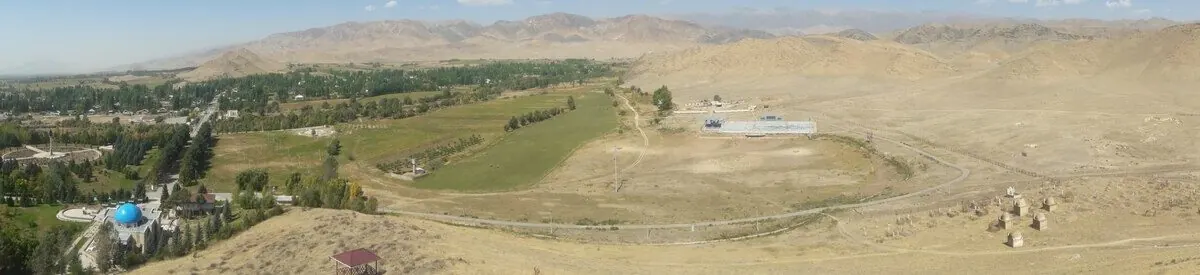
It's also worth walking the grounds slowly rather than beelining to the tomb and leaving. The site was landscaped as a place of contemplation, and the hillside behind it (sometimes called the Manas hill) gives a broad view over the valley that reframes the whole visit: you see how the mausoleum sits within its landscape, guarded by mountains, exactly the kind of setting the epic keeps returning to. Local families come here to picnic and pay respects, and simply watching how Kyrgyz visitors move through the space tells you more about what Manas means than any museum label.
The Talas Valley
Talas is Kyrgyzstan’s forgotten province, a broad agricultural valley in the northwest, cut off from the rest of the country by mountains and, for much of the year, only reachable by a road that loops through Kazakhstan or over a high pass. This isolation is exactly why it feels different: fewer visitors, a slower pace, and a strong sense of being somewhere off the standard circuit. It is bean-farming country (Talas beans are exported widely), rimmed by the Talas Ala-Too range, with trekking and horse routes for those who make the effort to get out here.
The valley also carries deep historical weight beyond the epic. The Battle of Talas in 751 AD — fought somewhere in this river basin between the forces of the Abbasid Caliphate and Tang China — was one of the pivotal encounters of the medieval world, checking Chinese expansion westward and, by tradition, sending the secret of papermaking onward into the Islamic world and eventually Europe. You won't find a battlefield to walk, but standing in the valley and knowing that history happened here adds a quiet resonance to the drive.
Talas town itself is small and workmanlike, with basic guesthouses and hotels in the $15-30 range and simple cafes serving the standard Kyrgyz menu. It is a base rather than an attraction. Most travelers who come this far do so specifically for Manas Ordo, sometimes combined with hiking in the surrounding valleys or a longer overland loop toward the Kazakh border.
Getting to Talas and the Complex
This is the hard part, and it's worth being clear-eyed about it. Talas is genuinely remote. From Bishkek, the shortest road runs west and crosses the Otmok or Too-Ashuu-area passes and, on the most common route, dips briefly through Kazakh territory. Which means the practical journey can involve border formalities, though a fully domestic mountain road also exists and is used when passes are open. Reckon on a long day: roughly 5-7 hours by shared taxi or marshrutka from Bishkek’s west-direction bus station on Frunze 209 in Bishkek, longer if the weather or the border slows things down.
Because of the routing, check the current situation before you commit: whether your specific service stays inside Kyrgyzstan or clips the Kazakh corner changes what documents you need, and conditions shift with the seasons and with border policy. Ask at Bishkek’s west-direction bus station on Frunze 209, carry your passport regardless, and do not assume a night crossing — travel this road in daylight. Shared taxis are faster and more comfortable than the marshrutka and only modestly more expensive; they leave when full, so arrive in the morning. For how this shared-transport system works across the country, see our guide to getting around Kyrgyzstan. If you are basing in the capital and weighing whether the detour is worth it, our roundup of things to do in Bishkek will help you decide how to spend the days you would otherwise give to Talas.
From Talas town, Manas Ordo is about 22 km east near the village of Tash-Aryk. There is no frequent public transport straight to the gate, so the simplest approach is to hire a taxi in town for a round trip with waiting time. A couple of hours on site is enough, which should cost only a few hundred som given the short distance. Agree the fare and the wait before setting off.
Practicalities and When to Go
The complex is open year-round, but the Talas valley is best from late spring through autumn; the mountain passes on the approach can close or turn treacherous in winter, and snow makes the overland trip risky. Summer is comfortable and green, and it coincides with the festival season when the site is most alive. Bring cash — there is little card infrastructure out here — and carry a warm layer even in summer, as the valley sits at altitude and evenings cool fast.
Entry to the grounds is free or nominal, with a small charge for the museum. Allow half a day on site, and treat the whole thing as a full-day round trip from Talas town or a two-day expedition from Bishkek. Modest dress is expected at the mausoleum, especially if pilgrims are present.
Is It Worth the Journey?
Be honest with yourself about what you're coming for. If you want dramatic scenery alone, Kyrgyzstan has closer and grander options, and Talas is a very long way to go for a modest brick tomb. But if you are the kind of traveler who wants to understand a country from the inside, its stories, its heroes, the thing it points to when it explains itself, then Manas Ordo is one of the most meaningful places in Kyrgyzstan, and the remoteness is part of what keeps it authentic. Read the epic first, come when a manaschy might be reciting, and the journey pays you back in a way that few sights on the tourist trail manage.
Manas Ordo lies near Talas, the oblast capital, which gets its own page: Talas town covers its bean economy and notes that the cheap road there runs through Kazakhstan.
FAQ
What is Manas Ordo?
A memorial complex about 22 kilometres east of Talas town, built around a 14th-century domed mausoleum that tradition holds to be the tomb of the epic hero Manas. It is part museum and part pilgrimage ground, and one of Kyrgyzstan's most important national and spiritual sites.
Who was Manas?
The warrior who united the forty tribes in the Kyrgyz national epic — a giant whose deeds fill an oral epic longer than the Iliad and the Odyssey combined. His name is attached to the country's main airport, to universities, and to a statue on Bishkek's main square.
Is Manas Ordo really his tomb?
Tradition holds that it is, and the mausoleum itself is 14th century. The site's importance rests on what it means to Kyrgyz visitors rather than on an archaeological claim, and it is treated as a pilgrimage place as much as a monument.
How do I get to Manas Ordo?
Via Talas town, about 22 kilometres west of the complex. Talas is reached from Bishkek by a bus routed through Kazakhstan, by a seasonal all-Kyrgyz service over the Otmok pass, or by a subsidised flight.
Is Manas Ordo worth the journey?
It is a long haul from anywhere, which is the honest caveat. It is worth it if the epic and its place in Kyrgyz identity interest you, and less so if you are looking for a monument to photograph.
How should I behave at Manas Ordo?
As at a pilgrimage site rather than a museum, because for most people there it is one. Dress modestly, follow what other visitors are doing, and do not treat people performing rituals as photographic subjects.