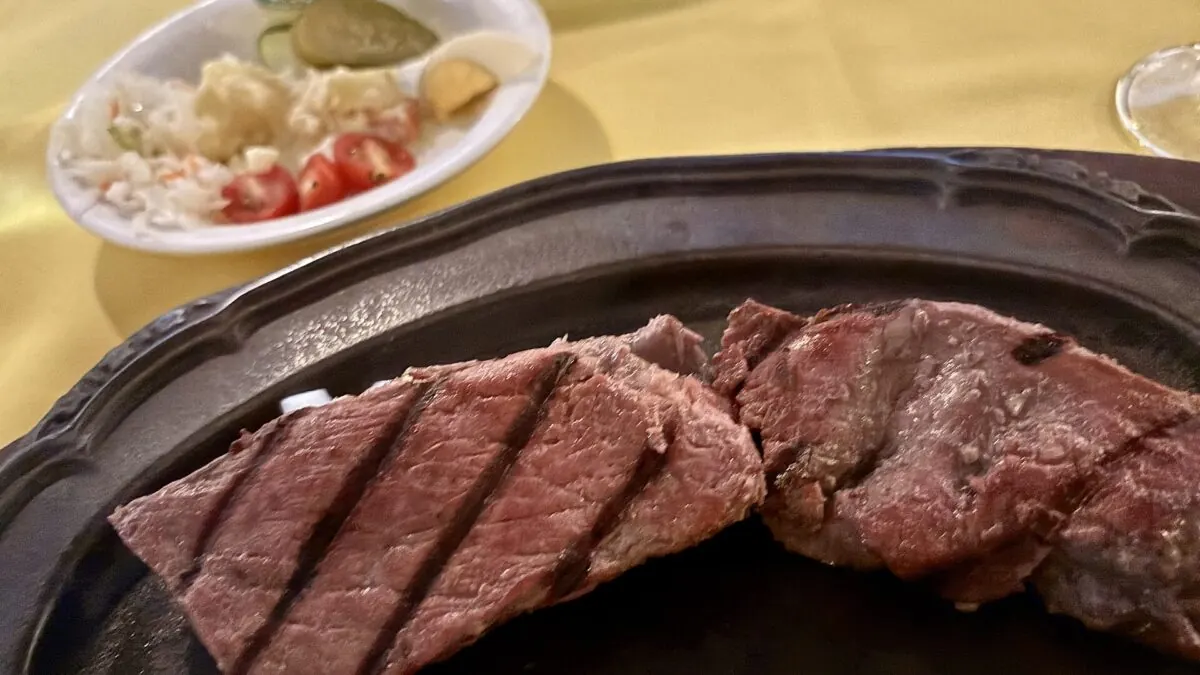
Muslim travelers, and a lot of Indian ones, ask the same question before booking Kyrgyzstan: can I eat here without worrying about what is in the meat? The short answer is yes, and more easily than in most places you have travelled.
Kyrgyzstan is a majority-Muslim country, and the overwhelming majority of meat sold and served — beef, mutton, horse, chicken — is halal by default, simply because that is how animals are slaughtered here. You don't need to hunt for certified halal restaurants the way you might in Europe or East Asia. Ordinary cafes, bazaars, and family kitchens serve halal meat as the norm, not the exception. The things actually worth watching are narrower and specific: alcohol is common and openly sold, pork shows up in particular Russian and Chinese settings, and formal ‘halal’ certification labels are rare here precisely because they're largely unnecessary.
Why the meat is halal by default
Around three-quarters of Kyrgyzstan’s population is Muslim, mostly Sunni, and Islam is woven into daily life more through food, hospitality, and life events than through strict public religiosity. For meat, the practical result is simple: butchers, bazaar stalls, and home cooks slaughter and prepare animals the halal way as a matter of course. A Kyrgyz family serving you mutton is not making a special accommodation; it's serving the only kind of meat they normally handle.
This is why you'll rarely see a ‘halal certified’ sticker on a Kyrgyz cafe. In a country where halal is the background assumption, certification would be labelling the obvious. That absence of a sticker unsettles some first-time visitors from countries where the label is the signal, so it's worth resetting the expectation: here, the default is halal, and the exceptions are what get flagged — usually by the presence of pork or a Russian-style menu, not by any labelling of the halal food itself. Beyond the meat, staples like bread (nan), rice, noodles, dairy, and the national dishes are all straightforwardly fine.
Where pork and alcohol actually show up
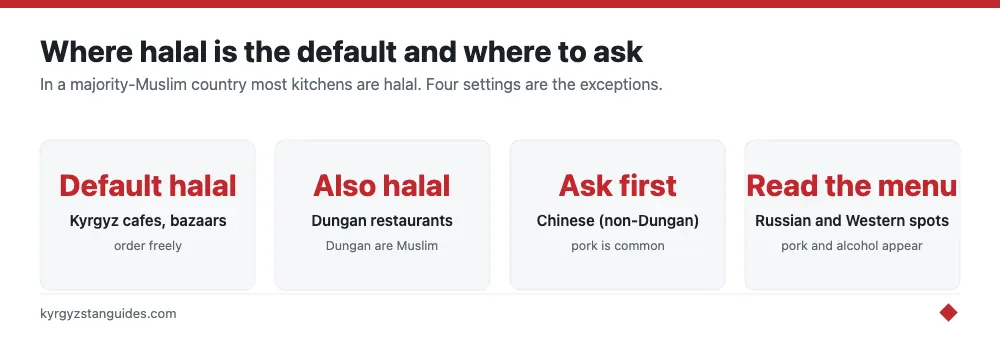
The honest exceptions matter more than the reassurance, so here's where to pay attention. Kyrgyzstan spent seventy years in the Soviet Union, and that left a Slavic, secular layer on top of the Muslim one — which is exactly where pork and alcohol enter the picture:
| Setting | Meat situation | What to do |
|---|---|---|
| Kyrgyz cafe / ashkana | Halal by default | Order freely |
| Bazaar and street food | Halal by default | Order freely |
| Russian / Slavic restaurant | May serve pork; alcohol common | Ask, or skip pork dishes on the menu |
| Dungan restaurant | Dungan are Muslim — food is halal | Fine; don’t confuse with Chinese spots |
| Chinese (non-Dungan) restaurant | Pork is common | Ask which dishes contain pork |
| Western cafe in Bishkek | Bacon, ham, pork on some menus | Read the menu before ordering |
One point deserves clearing up, because guides get it wrong. The Dungan are ethnic Chinese Muslims (Hui) who settled in Kyrgyzstan, and their food — famous around Karakol — is halal; their ashlan-fu and hand-pulled noodles are among the best cheap eats in the country. The pork risk sits with Russian and Slavic kitchens and with Chinese restaurants run by non-Muslim Chinese, which are a different thing entirely. If a place looks Russian or serves a broad Chinese menu, ask; if it's a Kyrgyz, Uzbek, Dungan, or Uyghur kitchen, you can relax.
Alcohol is the other half of the Soviet inheritance. Beer, vodka, and wine are sold openly in supermarkets and served in many cafes and restaurants, and drinking is socially normal for a large part of the population, especially in the Russified north and in Bishkek. It doesn't touch the halal status of the food, but if you would rather not eat surrounded by drinking, the quieter, more conservative south — around Osh and the Fergana valley fringe — feels noticeably different from the capital.
North and south are not the same
Kyrgyzstan isn't uniform, and it helps to know the split before you go. The north, including Bishkek, is more secular and more Russified: mixed menus, easy alcohol, a cosmopolitan cafe scene. The south, centred on Osh, is more visibly Muslim and more conservative, with more mosques, more modest dress, and Uzbek-influenced food. Neither is difficult for a Muslim traveler — the food is halal in both — but the atmosphere around alcohol and dress differs, and travelers who care about that will feel more at home in the south.
For Indian and South Asian travelers
Kyrgyzstan has become a genuinely popular destination for Indian travelers, and the food side is one of the easier parts of the trip. The meat is halal, the cooking leans on mutton and beef familiar from South Asian kitchens, and bread and rice are everywhere. What differs is spice and vegetables:
- Spice: Kyrgyz food is savoury and fatty rather than chilli-hot. If you need heat, carry your own or seek out Dungan and Uyghur places, which use more chilli and cumin.
- Vegetarians: this is the real challenge, not halal. Pure-veg options are limited outside salads, bread, dairy, and a few noodle and potato dishes; self-catering from bazaars helps a lot.
- Familiar ground: samsa (baked meat pastries), plov (pilaf), and grilled shashlik will all feel recognisable and are reliably halal.
- Cost: eating is cheap, which makes trial and error painless — a full cafe meal often lands under 400 KGS.
If you're still at the planning stage, it's worth pairing this with a look at what Kyrgyz food actually involves, so the mutton, horse meat, and dairy-heavy dishes are not a surprise at the table.
Ramadan, mosques, and everyday practice
Ramadan is observed, but Kyrgyzstan isn't a country where daytime life shuts down for it. In the more secular north, many cafes stay open and business continues much as usual; in the south, observance is more visible. Mosques are common everywhere and travelers are generally welcome to visit respectfully outside prayer times. Finding a place to pray, halal food to break a fast, or a butcher for Eid isn't a problem anywhere in the country. If you travel during Ramadan, expect a warmer, more communal evening food scene rather than a shut-down daytime one, particularly in southern towns.
Practical tips before you go
A short checklist covers almost everything a Muslim or halal-conscious traveler needs here:
- Assume Kyrgyz, Uzbek, Uyghur, and Dungan food is halal — it's the default, not a special request.
- Watch for pork only in Russian/Slavic, Western, and non-Dungan Chinese restaurants, and just ask if unsure.
- Learn one phrase: ‘choško eti’ is pork in Kyrgyz, and ‘svinina’ in Russian — enough to check a menu.
- Expect alcohol to be present and normal, especially in the north; it doesn't affect the food’s halal status.
- Vegetarians should plan harder than Muslims do — the constraint here is vegetables, not halal meat.
- For a smoother southern, more conservative atmosphere, weight your trip toward Osh over Bishkek if that matters to you.
The takeaway is reassuringly boring: for the vast majority of travelers who eat halal, Kyrgyzstan asks almost nothing extra of you. Order the mutton, enjoy the Dungan noodles, skip the clearly Russian pork dishes, and get on with the mountains. For a sense of the wider trip that food fits into, our guide to Bishkek is a good next stop.
Frequently Asked Questions
Is the food in Kyrgyzstan halal?
Yes. Kyrgyzstan is a majority-Muslim country and the great majority of meat — beef, mutton, horse, chicken — is halal by default, because that's how animals are slaughtered there. Kyrgyz, Uzbek, Uyghur, and Dungan food can be treated as halal without hunting for certification.
Where might I encounter pork in Kyrgyzstan?
Pork mainly appears in Russian and Slavic restaurants, in some Western cafes in Bishkek, and in Chinese restaurants run by non-Muslim Chinese. Dungan restaurants, despite being Chinese in origin, are Muslim-run and serve halal food. If a place looks Russian or has a broad Chinese menu, simply ask.
Is Kyrgyzstan a good destination for Muslim and Indian travelers?
Yes, and it has become popular with Indian visitors partly for this reason. Meat is halal, mutton and beef dishes feel familiar, and bread and rice are everywhere. The food is savoury rather than spicy, and strict vegetarians will find fewer options than meat-eaters, but halal itself is rarely a concern.
Is alcohol served in Kyrgyzstan?
Yes. Beer, vodka, and wine are sold openly and served in many cafes and restaurants, a legacy of the Soviet era, especially in the north and in Bishkek. It doesn't affect the halal status of the food, but travelers who prefer to avoid it will find the conservative south, around Osh, quieter.
On whether you are expected to drink, and on the bata that closes every meal, see toasts, bata and alcohol in Kyrgyzstan.