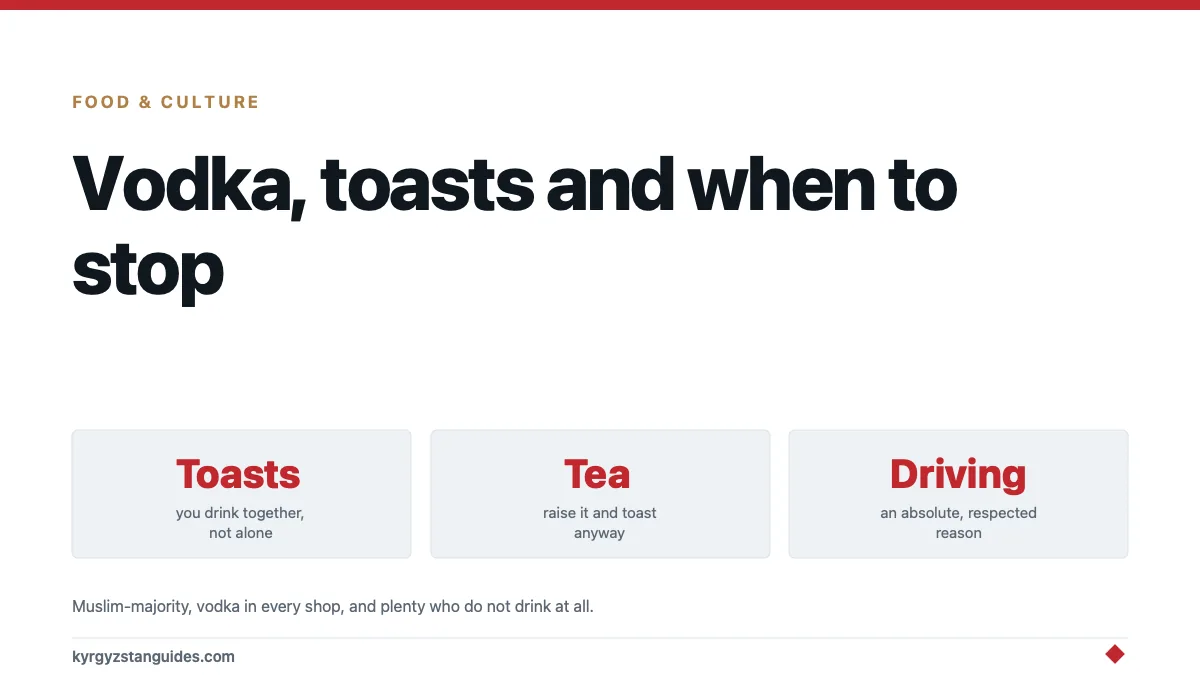
Kyrgyzstan is a Muslim-majority country where vodka is sold in every village shop, brandy is a respectable gift, and a wedding will involve a great deal of both.
It's also a country where plenty of families do not drink at all, and where the question of whether a good Muslim drinks is argued about at the same table.
Both of those are normal here. Knowing how to move between them is a genuinely useful travel skill.
What people drink
Vodka. The default. Kyrgyz and Russian brands, cheap, sold everywhere, and the centre of any celebration that involves drinking.
**Brandy — konyak.** Kyrgyz and Armenian, and a standard gift. Bringing a bottle to a household is a normal gesture.
Beer. Local brands and imports, widely drunk, and the low-commitment option.
Wine. Limited domestic production, mostly imported, and not the cultural default.
Kymyz. Fermented mare's milk is mildly alcoholic. Typically low single figures — and is a seasonal drink rather than an intoxicant. Nobody drinks kymyz to get drunk. FAO's work on fermented milk covers the microbiology, which is the same process behind everything in our dairy guide.
Bozo. A fermented grain drink, lightly alcoholic, traditional and seasonal.
Maksym and chalap are the non-alcoholic grain and dairy drinks, covered in our maksym guide, and are what you will be handed far more often.
How a drinking table works
If you end up at one, there's a structure, and it isn't improvised.
Toasts are compulsory and sequential. Somebody proposes, everyone drinks. You do not drink outside a toast, and you don't sip through one — the convention is to finish the glass, though nobody polices this with a guest.
There is an order. The eldest or the host first, then around the table. As a foreign guest you will be asked to toast, usually early, and it is expected.
What to say. Thank the host, praise the house, wish health to the family and long life to the elders. Length is welcomed; wit is optional. Doing it badly in your own language is entirely fine and will be appreciated more than not trying.
Someone pours for you. Pouring your own is poor form; keep an eye on your neighbour's glass as well.
Food throughout. Nobody drinks without eating, which is the main reason the evening is survivable.
Our etiquette guide covers the wider table conventions.
How to not drink
This is the part worth getting right, because it comes up more often than the drinking does.
"I don't drink" is accepted. It's a recognised category, applying to observant Muslims, drivers, people on medication and people who simply don't. Nobody will regard it as strange.
Say it early and once, at the start of the evening rather than after the third refusal.
Health or medication is the easiest reason if you want one, and nobody will interrogate it.
Driving is an absolute reason and is respected.
You can still toast. Raise tea, juice or water and give the toast anyway. This is the move: participating in the ritual matters far more than the contents of the glass.
Do not make it a statement about others. Declining is easy; commenting on other people's drinking is not.
Pressure exists but is soft. A host will offer several times because offering is hospitality. A clear, warm, repeated no works.
Where it goes wrong
Drink-driving is a real problem, particularly in the evening and at weekends, and it's the single most dangerous thing about the drinking culture here. WHO's road safety reporting puts the region's road death rates well above western European levels. As our hitchhiking guide and piece on the car fleet both note, do not get into a car with a driver who has been drinking.
Swimming and alcohol is the other reliable killer, covered in our Issyk-Kul water safety guide.
Altitude changes things. Alcohol at 3,000 m hits harder, worsens dehydration and interacts badly with acclimatisation. The first night at a high yurt camp is not the night for it.
Cold. Alcohol causes peripheral vasodilation, which feels warming and accelerates heat loss. It's exactly the wrong thing in a cold winter evening outdoors.
Pace. Toast sequences move faster than a Western drinking rhythm, because everyone drinks at once rather than sipping. A dozen toasts across an evening is not unusual, and the arithmetic catches people who are pacing themselves by habit rather than by count.
Counterfeit spirits exist at the very cheapest end of the market, as they do across the region. Buy from a shop rather than an informal seller, and be wary of unbranded bottles.
The public health picture
Worth stating because it is the context the drinking culture sits in, and it isn't a small problem.
Alcohol consumption across the former Soviet space has historically been high, and the pattern (spirits, drunk in large amounts on single occasions rather than spread out) is the one most strongly associated with harm. WHO's work on alcohol sets out why the drinking pattern matters as much as the volume.
In Kyrgyzstan the visible consequences are road deaths, winter exposure, drowning in summer, and the household costs that fall on families already stretched by the toi economy and migration.
This isn't a reason for a visitor to moralise. It's a reason to understand that when somebody at a table says they do not drink, they may be making a considered decision rather than a religious one, and it deserves the same easy acceptance either way.
The religious dimension
Worth understanding rather than navigating blindly.
Kyrgyzstan's religious practice layers Islam over Soviet secularism over older custom, and alcohol sits right on the seam. The mosque count went from 39 in 1991 to thousands, and one visible consequence is that abstention is more common and more socially comfortable than it was a generation ago.
You'll meet households where vodka is on the table as a matter of course, and households where it would be unthinkable, sometimes in the same village and occasionally in the same family.
The rule is simple: follow your host. Do not bring alcohol into a house unless you know it's welcome, and don't assume either way.
FAQ
Can you drink alcohol in Kyrgyzstan?
Yes. Alcohol is legal, widely sold and commonly drunk, despite the country being Muslim-majority. Many observant families abstain entirely.
What do people drink in Kyrgyzstan?
Vodka above all, along with brandy and beer. Kymyz and bozo are traditional lightly alcoholic drinks rather than intoxicants.
Is it rude to refuse alcohol in Kyrgyzstan?
No. Declining is well understood and respected, especially for reasons of religion, health or driving. Raise a glass of tea and give the toast anyway.
How do Kyrgyz drinking toasts work?
Toasts are proposed in sequence, starting with the host or eldest, and everyone drinks together. Guests are usually invited to toast early and it's expected that they will.
Should I bring alcohol as a gift?
Brandy is a standard gift where drinking is normal, but do not bring it unless you know the household drinks. If unsure, bring sweets, fruit or tea instead.
Is alcohol dangerous at altitude in Kyrgyzstan?
It worsens dehydration and interferes with acclimatisation, so avoid it on the first nights at altitude. It also accelerates heat loss in cold conditions.