Stand on a Bishkek street for five minutes and count the cars. A very large share will be Japanese, a decade or two old, and a surprising number will be the same model.
The Honda Fit is the country's default car. Toyota is everywhere. Almost nothing is new.
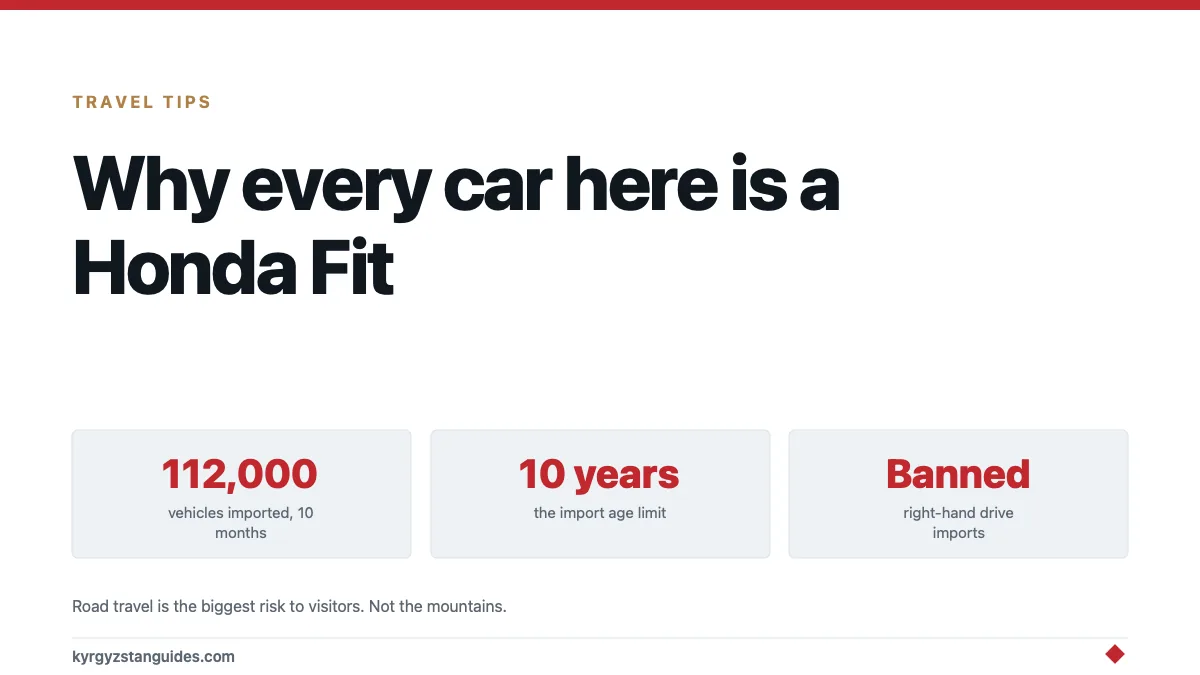
Between January and October 2024, Kyrgyzstan imported over 112,000 vehicles — in a country of around seven million people. China supplied more than 54,000 of them and South Korea more than 33,000.
This isn't a quirk. It's the same economic logic that built the bazaars, applied to cars, and it explains a lot about how you will get around here.
The re-export mechanism, again
Kyrgyzstan's position inside the Eurasian Economic Union, combined with a comparatively tolerant customs regime, made it a transit and re-export hub for used cars. Particularly Japanese vehicles heading onward into Russia.
The pattern is identical to the goods trade: import cheaply under a favourable regime, add logistics, move it into a larger and more protected market. Kyrgyzstan's product is the tariff position, not the car.
The visible consequence is an enormous domestic fleet of imported used vehicles and a set of very large car bazaars on the edges of Bishkek and Osh, which are worth seeing purely for the scale.
The right-hand drive problem
This is the part with real consequences and it is recent.
For years, Kyrgyzstan imported large numbers of right-hand drive cars from Japan, driven on roads that drive on the right. That combination is exactly as awkward as it sounds: overtaking on a two-lane mountain road with the driver on the wrong side is genuinely dangerous.
Kyrgyzstan moved to ban it. Parliament adopted a bill prohibiting the import, registration and operation of right-hand drive vehicles, with a narrow exception for foreign-plated cars brought in temporarily. An earlier measure had already banned right-hand drive taxis.
Current regulations permit left-hand drive vehicles under ten years old.
You'll still see right-hand drive cars on the road. Legacy vehicles don't vanish because a law passed.
Why this matters to a traveller
Overtaking on mountain roads. If your driver is in a right-hand drive car on a two-lane road, they can't see past the vehicle in front. Some will pull out anyway. This is the single most alarming thing you will experience on Kyrgyz roads and it's worth saying something about.
The fleet is old. A ten-year-old import is the new end of the market. Brakes, tyres and suspension on a car that has done a decade in Japan and then several years on Kyrgyz mountain roads are not what you are used to.
Seatbelts may be missing or buried. Rear belts are frequently tucked into the seat and unused. Dig them out and use them. Nobody will mind.
No child seats. Relevant if you're travelling with children; bring your own. The Japanese used-car trade's own guidance on Kyrgyz import rules gives a sense of how the supply side works.
Winter tyres are not universal. On high passes in winter, ask.
Our guides to renting a car, taxi apps and getting around cover the practical choices.
The car bazaar
Worth an hour if you have one, and nobody puts it on an itinerary.
Bishkek's car market, and Osh's equivalent. Is a field of several thousand vehicles, individually owned, with their papers under the windscreen and the owner sitting nearby. There is no dealership, no showroom and no finance. You walk the rows, you negotiate, you drive it away.
Two things make it interesting to look at.
The scale of the import trade is suddenly obvious. Rows of near-identical Japanese hatchbacks, many still carrying Japanese inspection stickers, Japanese sat-nav menus and occasionally the original owner's parking permit.
The inspection culture. Buyers bring a mechanic, or a knowledgeable relative, and go over a car in the open for an hour. It's the same transactional logic as the wholesale bazaars: the market provides the venue, the participants provide the expertise, and nobody provides a warranty.
You aren't going to buy a car. But if you want to see what the country's economy actually consists of, this is a more honest exhibit than most museums.
The road culture
Separate from the vehicles, and worth calibrating for.
Overtaking is aggressive. On the Bishkek–Osh road in particular. Drivers overtake into blind corners with a confidence that isn't statistically justified.
Speed on straights, caution on surfaces. Kyrgyz drivers are generally very good at reading a bad road surface and much less cautious about oncoming traffic.
Livestock on the road is normal. Sheep, cows and horses, at any hour, on any road including main highways. At night this is a serious hazard.
Hitching a ride is a normal transaction. Raising a hand at the roadside will stop a private car, and a small payment is expected. This is how a large share of rural Kyrgyzstan moves and it's entirely ordinary. See our getting around guide for the etiquette.
Speak up. If a driver is frightening you, saying so is acceptable and usually works. "Akyryn" — slowly. Is a useful word, and our phrases guide has more.
Road travel is, by a wide margin, the largest risk to visitors in this country. That is worth repeating because the mountains get all the attention and the road does the damage.
Why the cars tell you something
Because a country's vehicle fleet is an honest summary of its economy.
Kyrgyzstan can't manufacture cars and can't afford new ones, so it buys the world's second-hand ones. It sits between China, Japan, Korea and Russia, so it became a place where those cars change hands. Its tariff position was its only asset, so it monetised that, exactly as it did with Chinese consumer goods — and exactly as joining the EAEU in 2015 then complicated.
The Honda Fit on a mountain road at 3,000 metres, carrying five people and a sheep, is a genuinely good piece of engineering doing a job it was never designed for, in a country that could not otherwise have afforded to move anybody anywhere.
FAQ
Why are there so many Japanese cars in Kyrgyzstan?
Cheap used imports, a favourable customs position inside the Eurasian Economic Union, and a re-export trade that moves Japanese vehicles onward toward Russia.
How many cars does Kyrgyzstan import?
Over 112,000 vehicles between January and October 2024, with China supplying more than 54,000 and South Korea more than 33,000.
Are right-hand drive cars banned in Kyrgyzstan?
Parliament adopted a bill prohibiting their import, registration and operation, with a limited exception for temporarily imported foreign-plated vehicles. Existing right-hand drive cars are still on the roads.
What are the rules for importing a car to Kyrgyzstan?
Current regulations permit left-hand drive vehicles under ten years old.
Is driving in Kyrgyzstan safe?
Road travel is the largest risk to visitors. Overtaking is aggressive, the vehicle fleet is old, livestock is common on roads and winter tyres aren't universal.
Should I wear a seatbelt in a Kyrgyz taxi?
Yes. Rear belts are often tucked away and unused, but they exist in most vehicles. Pull them out and use them.