Should you rent a car and drive yourself around Kyrgyzstan? Our verdict, upfront: for a lot of trips, no — and we say that as people who love a self-drive holiday. A sedan is fine for the paved corridors, but the destinations that make Kyrgyzstan worth the flight sit at the end of gravel tracks and river fords that demand a high-clearance 4WD, cost $70-120 a day to rent, and punish inexperience. For those places, hiring a local driver with his own vehicle costs about the same, removes the risk, and often works out cheaper once you add fuel and insurance excess.
That isn't the whole story, though. Self-drive rental has boomed in Kyrgyzstan since around 2022, the freedom is real, and for a certain kind of confident gravel driver it is the best way to see the country. This guide lays out the honest trade-offs: what a 2WD can and can't reach, what the roads are actually like, real 2026 rental costs (1 USD is roughly 87-89 KGS), how police stops work, the permits you need, and the specific question of whether a driver beats a rental — with a verdict at the end rather than a shrug.
2WD or 4WD: The Decision That Shapes Your Trip
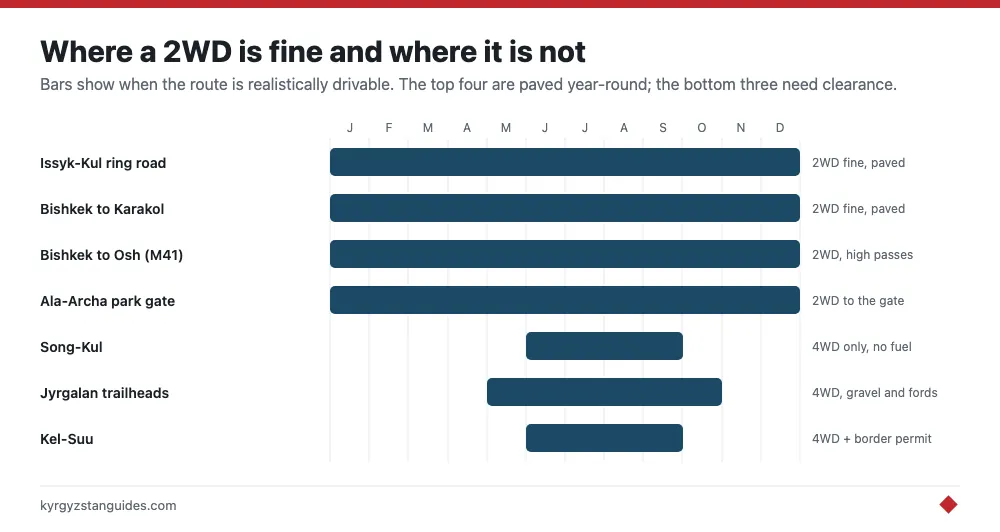
This is the first and most important question, because it decides where you can go. A 2WD sedan is perfectly adequate for the paved backbone: Bishkek to Karakol, the Issyk-Kul ring road, Bishkek to Osh on the M41, and the approaches to towns like Naryn and Cholpon-Ata. If your trip is city-hopping plus a few lakeshore stops, a sedan saves you real money and is the sensible pick.
The moment your list includes the country’s signature places, that changes. Song-Kul, Kel-Suu, the tracks up to Song-Kul’s passes, the fords into Jyrgalan, and most trailheads require a proper 4WD with high clearance, a rented sedan on those routes is a tow bill waiting to happen. And a tow bill is the cheap version of the problem; the expensive version is calling for help from a valley with no phone signal.
| Destination | 2WD sedan? | Notes |
|---|---|---|
| Issyk-Kul ring road, Cholpon-Ata | Yes | Fully paved |
| Bishkek → Karakol | Yes | Good paved road |
| Bishkek → Osh (M41) | Yes | Paved but high mountain passes |
| Ala-Archa National Park | Yes | Paved to the gate |
| Song-Kul | No | Rough passes over 3,000 m, no fuel |
| Kel-Suu | No | Serious off-road, border permit needed |
| Jyrgalan / most trailheads | No | Gravel, fords, high clearance essential |
What the Roads Are Actually Like
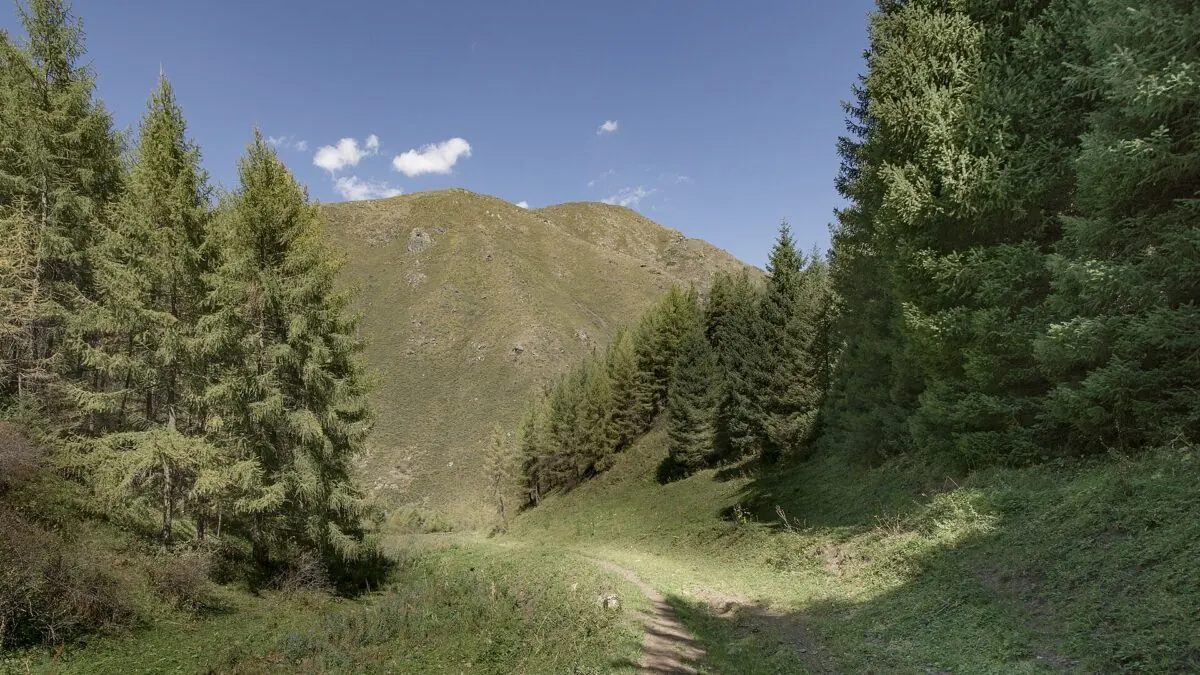
Kyrgyzstan has three categories of road, and they behave very differently. The main paved corridors are in better shape than most first-timers expect, and improving — smooth asphalt, painted lines, the occasional new tunnel. Once you leave them, you're on gravel and washboard, where a comfortable speed is 30-40 km/h and your fillings rattle. Beyond the gravel are the tracks: unbridged river crossings, mud, and rock, where local knowledge matters more than horsepower.
Two features of these roads catch first-timers out. River fords grow through the day, because snowmelt swells them from a trickle at dawn to a serious crossing by mid-afternoon — mountain tracks are safest driven early. The other surprise is that livestock owns the road: horses, sheep, and cows appear around every blind bend, and hitting one is both dangerous and expensive. Slow right down through herds and expect the unexpected on any rural stretch.
- Never drive rural roads at night. Potholes, unlit trucks, and animals make it genuinely dangerous
- Cross river fords early in the day and walk them first if you're unsure of the depth
- Download offline maps (Organic Maps or Maps.me) — they mark tracks Google doesn't, and signal vanishes fast
- Fuel up whenever you can; stations are sparse in Naryn province, and Gazprom stations have the most reliable quality
- Carry a physical spare, a working jack, and enough water and snacks to sit out a breakdown
Rental Costs and the Fine Print
Expect $35-50 a day for a sedan and $70-120 a day for a proper 4WD from Bishkek agencies — Iron Horse Nomads and Travel Land Kg are established names, and there are several newer outfits. Rates drop for week-plus rentals and climb in the July-August peak. On top of the daily rate, budget for a deposit (often held on a card or in cash), and read the insurance terms closely: the excess on a 4WD can be steep, and “off-road” or river-ford damage is frequently excluded, which matters enormously given where you'll actually drive.
Before you drive off the lot, do the walk-around properly. Photograph every existing dent and scratch and confirm they match the paperwork, check the spare and the jack are present and functional, and test that the 4WD actually engages. Ask explicitly what the insurance does and doesn't cover on gravel and in water, and get the answer in writing if you can. A few minutes here prevents the deposit dispute that is the single most common self-drive complaint.
| Vehicle | Daily rate | Good for | Watch out for |
|---|---|---|---|
| 2WD sedan | $35-50 | Paved corridors, Issyk-Kul | Useless off-tarmac |
| Compact 4WD / crossover | $55-80 | Light gravel, easier tracks | Limited clearance for deep fords |
| Full 4WD (Land Cruiser, Delica) | $70-120 | Song-Kul, Kel-Suu, trailheads | High excess; ford damage often excluded |
Police Stops and Checkpoints
Police stops at regional checkpoints are routine and nothing to be alarmed by. Carry your passport, your home license, your International Driving Permit, and the rental documents, all together and easy to reach. Stay calm and polite, and the overwhelming majority of stops end with a wave-through in under a minute. The vast majority of officers are simply doing their job.
The one thing to hold firm on: never pay an on-the-spot “fine” in cash without a written protocol. Genuine traffic fines in Kyrgyzstan are paid at a bank, an officer asking for roadside cash is asking for something else. If that happens, stay friendly, plead ignorance, ask for the written paperwork, and the situation almost always dissolves. Keeping your documents impeccable removes most pretexts before they start.
Permits and Paperwork
Carry an International Driving Permit alongside your national license. Strictly, Kyrgyz law accepts a foreign license that conforms to the 1968 Vienna Convention format on its own (the legal detail is below), but an IDP covers any license that does not, satisfies the UK Foreign Office’s 30-day rule, and is what rental agencies expect to see. Get it before you leave home, because you can't obtain one in Kyrgyzstan. Beyond that, most of the country needs no special permit to drive. The exception is border zones: areas near the China and Tajikistan frontiers, including Kel-Suu and parts of the far east and south, require a border-zone permit arranged in advance, usually through a tour operator or CBT office a week or more ahead.
If your route touches any of those sensitive areas, sort the permit well before you reach the checkpoint, since turning back for paperwork can cost you a full day. For the wider entry rules that get you into the country in the first place, our Kyrgyzstan visa guide covers who needs what.
The Case for Hiring a Driver Instead
Here is the option that ends up winning for most travelers. A private car with a local driver costs $50-80 per day including fuel for a 4WD, arranged through CBT offices, guesthouses, or Bishkek and Karakol tour operators. Compare that with $70-120 a day for a self-drive 4WD before you have bought a single liter of diesel, and the maths already leans toward the driver. Add that he knows which ford washed out last week, handles the police stops, and turns the river crossings from a gamble into a non-event, and the value becomes obvious.
Split between three or four passengers, $60-80 a day becomes $15-20 each, which is why solo travelers post in Kyrgyzstan backpacker groups on Facebook and Telegram to share vehicles, and why hostel noticeboards in Bishkek and Karakol function as ride-matching services every summer morning. Drivers rarely speak much English, but a translation app and a marked map cover almost every situation. If you want the fuller comparison against marshrutkas and shared taxis, our guide to getting around Kyrgyzstan puts every option side by side.
So when does self-drive win? When you are a confident gravel and ford driver, when total flexibility matters more than money, and when you actively enjoy the driving as part of the trip. For everyone else — especially first-time visitors to the region, a driver for the rough highlights and marshrutkas between towns is the smarter, cheaper, safer formula.
One last budgeting note that tips the decision for many people: fuel, the deposit hold, and the insurance excess add up faster than you expect, and a self-drive fortnight can end up costing more than you first assume. Running the numbers against the rest of your trip in our Kyrgyzstan travel budget guide is worth the ten minutes before you commit — for a lot of itineraries the money is better spent on a driver for the two or three rough highlights and marshrutkas everywhere else.
What the law actually requires of a foreign driver
The rental desk and the statute do not say quite the same thing, and it is worth knowing both.
The Kyrgyz position: Article 27 of the Law on Road Traffic Safety states that national and international driving licences complying with Kyrgyzstan’s international treaty obligations are valid on its territory. Kyrgyzstan acceded to the 1968 Vienna Convention on Road Traffic on 30 August 2006. So a foreign national licence that conforms to the Convention’s format is legally valid on its own. An International Driving Permit is required where your licence does not conform — for example, if it is not in Latin script or lacks the Convention’s categories.
The UK Foreign Office position: a UK photocard licence works for up to 30 days, after which you need the 1968 IDP and the licence together in the car.
The statute contains no 30-day cap. Rather than pick a side: carry a 1968 IDP and it satisfies both readings, and costs very little at home.
What you must be able to produce on demand, per the Traffic Rules: your licence, the vehicle registration documents, any required waybill and cargo papers, and the compulsory third-party motor liability insurance policy. Driving without insurance is a 30-index offence for an individual; driving with no right to drive at all is 150 indices; driving after disqualification, 200.
Alcohol, equipment, and a winter rule that does not exist
On drink-driving the penalties are severe and not in dispute. Driving while intoxicated carries a fine of 800 calculation indices, roughly 80,000 som, plus a two-year disqualification. Refusing a test is worse: 1,000 indices and three years. The vehicle is impounded.
On the legal limit, the sources genuinely disagree and it is better to know that than to trust a number. Kyrgyz reporting cites a permitted threshold of 0.3 promille applied through the medical examination rules. The UK Foreign Office implies zero tolerance. And the Traffic Rules themselves contain no figure at all — they simply forbid driving while intoxicated or under medication that impairs reaction. The safe reading is obvious: do not drink and drive here at all.
Equipment is specific and enforced. A car must carry a medical first-aid kit, a fire extinguisher and a warning triangle. Minimum tread depth is 1.6 mm for cars. You may not mix studded and non-studded tyres on the same axle, and a vehicle on studded tyres must display the "Ш" sign at the rear.
Now the useful negative. There is no winter tyre or snow chain mandate in Kyrgyz law. Neither the Traffic Rules nor the Basic Provisions on vehicle operation contains a seasonal tyre obligation or any date range — only the studded-tyre marking rule and the mixed-tyre prohibition. If a rental firm tells you winter tyres are legally required, that is their policy, not the law. It remains an excellent idea in a country where the passes close on weather.
If you have an accident
The Traffic Rules set out what you must do, and the sequence matters.
Stop immediately and do not move the vehicle. Switch on hazard lights and set out the warning triangle — at least 15 metres behind in a built-up area, 30 metres outside one. Do not move anything related to the incident.
Give pre-medical aid and call an ambulance. In a genuine emergency you may take casualties to the nearest medical facility in a passing vehicle or your own. Give your surname and registration number and present identity documents — which may now be shown digitally through the Tunduk app.
One rule people break without realising: after an accident, or after being stopped by police, you must not consume alcohol before testing or before being released from it. A calming drink afterwards is itself an offence.
Where damage is minor, the rules expressly allow drivers to settle by mutual agreement rather than have the incident formally recorded. For a rental car that is usually the wrong choice — your contract will almost certainly require a police report.
Insurance is compulsory, and foreign plates are fined harder
Third-party motor liability insurance, OSAGO, is compulsory in Kyrgyzstan under a law of 2015 whose enforcement was repeatedly postponed. It is enforced now.
The dates matter because they explain why older advice says it is optional. Liability for non-compliance began for foreign-registered vehicles on 1 April 2020, for companies and trucks in 2021, and for Kyrgyz-registered private cars in 2022. Fines on individuals then slipped again: the financial regulator says they began 1 January 2025, the insurers’ association says 1 July 2025. Either way it is live.
The amounts are not symmetrical. An individual driving without a policy is fined 3,000 som. A foreign-registered vehicle or a legal entity is fined 13,000 som, and that has applied since 1 April 2023. If you drive your own car in, this is the single most expensive thing to forget.
What it buys: a base premium from 1,680 som a year, adjusted for vehicle type, driver age and experience and region. Cover limits, set in 2022, run to 300,000 som for a death, up to 100,000 som of treatment costs for injury without disability, and 150,000 som per victim for property damage, capped at 450,000 for all victims in one accident.
Two caveats worth stating. The cover is territorially limited to Kyrgyzstan unless a treaty provides otherwise, so it does not follow you across a border. And without a policy the at-fault driver pays the entire damage personally — there is no insurer to fall back on.
A policy is bought at any licensed insurer, through agents, or in the MegaPay, MBANK and O! Bank apps. Bring your passport, licence and the vehicle registration certificate, plus a power of attorney if the car is registered outside Kyrgyzstan.
The roads are now partly tolled, and tourists pay more
This is new and almost nothing published in English mentions it. A Cabinet resolution of 25 February 2026 introduced tolls for the tunnels on the Bishkek-Osh highway and on the alternative North-South road.
The tariffs are tiered by vehicle, and they are tiered again by where the vehicle is registered. On the Bishkek-Osh tunnels, a local or EAEU car pays 50 som. On the Kok-Art tunnel on the North-South road, the same car pays 100 som.
A foreign-plated or transit car pays 200 som on either route — four times the local Bishkek-Osh rate. Minibuses and light trucks on foreign plates pay 1,000, vehicles over 12 tonnes 3,000, and oversize or trailered loads up to 5,000.
Collection is already running on Kok-Art. Since 9 July 2026 there has been a checkpoint at kilometre 318, and it is cashless only — QR code, bank card or other electronic payment. The tunnel is 3,890 m, the longest in the country, and open around the clock. Whether the Bishkek-Osh tunnel tolls have actually started being collected I could not confirm; only the tariff resolution is certain.
Ordinary roads outside the tunnels remain free.
What the road network is actually like
Two sets of official numbers give a fairer picture than any adjective.
Kyrgyzstan has about 34,000 km of road in total, of which 18,821 km are public roads and 17,072 km are paved. But of a 2,231 km stretch the transport ministry surveyed, only 502 km rated good and 1,346 km — sixty per cent — rated bad or very bad. Network wear was put at 80%, with over 70% needing capital repair. Those figures date from 2016 and are the most recent official ones published.
The ministry’s own framing of the consequence, from 2022: roads carry 98% of passenger and 96% of freight traffic, vehicle numbers rose 937% in twenty years, and poor surfaces raise transport costs by 20 to 25% and burn one and a half times more fuel per kilometre than in developed countries. You will feel all of that from the driver’s seat.
On fuel, prices are state-managed rather than market-set. Since July 2026 the state agrees prices with traders and compensates the difference when import costs exceed them, under a stabilisation package running to the end of 2026. In September 2026 that meant AI-92 at 87.90 som in Bishkek and Chuy, rising to 90.40 in the south and 91.40 in Batken, with diesel around 99.90 in the north. Branded fuel may exceed the base price by at most 1.50 som a litre.
Five companies cover about 90% of the market and most product is imported from Russia, which is why a price set in Bishkek is a political decision as much as a commercial one.
Frequently Asked Questions
Do I need a 4WD to drive in Kyrgyzstan?
Not for everything. A 2WD sedan handles the paved corridors — Bishkek to Karakol, the Issyk-Kul ring road, the M41 to Osh. But the signature destinations like Song-Kul, Kel-Suu, and most trailheads require a high-clearance 4WD because of gravel tracks and river fords. If those are on your list, rent the 4WD or hire a driver.
How much does it cost to rent a car in Kyrgyzstan?
Expect roughly $35-50 a day for a 2WD sedan and $70-120 a day for a proper 4WD from Bishkek agencies, before fuel and deposit. Rates fall for longer rentals and rise in the July-August peak. Check the insurance excess and whether off-road or river-ford damage is excluded, as it often is.
Is it safe to self-drive in Kyrgyzstan?
On the paved corridors, yes, with normal care. Off the tarmac it depends on your experience: river fords, washboard gravel, and free-roaming livestock demand confident driving. Never drive rural roads at night, cross fords early in the day, and carry offline maps. Nervous drivers are better off hiring a local driver.
Do I need an International Driving Permit?
Carry one. Kyrgyz law accepts a foreign national license that conforms to the 1968 Vienna Convention format, but an IDP is required if yours does not conform, the UK Foreign Office says UK licenses need one after 30 days, and rental agencies and police checkpoints both expect to see it. You must obtain it in your home country before travel, so carry it together with your passport and rental documents.
Is hiring a driver cheaper than renting?
Often, yes. A driver with a 4WD costs $50-80 a day including fuel, while a self-drive 4WD rental is $70-120 a day before fuel and insurance excess. Split among three or four passengers, a driver works out to $15-20 each and removes the risk of ford or gravel damage — which is why many travelers choose it.
Why do river fords in Kyrgyzstan get worse in the afternoon?
Snowmelt swells them through the day: a crossing that is a trickle at dawn can be a serious ford by late afternoon. That is why experienced drivers time unbridged crossings for the morning — and why a rented sedan on routes like Song-Kul's passes or the Jyrgalan fords is a tow bill waiting to happen, with the expensive version being a breakdown in a valley with no phone signal.