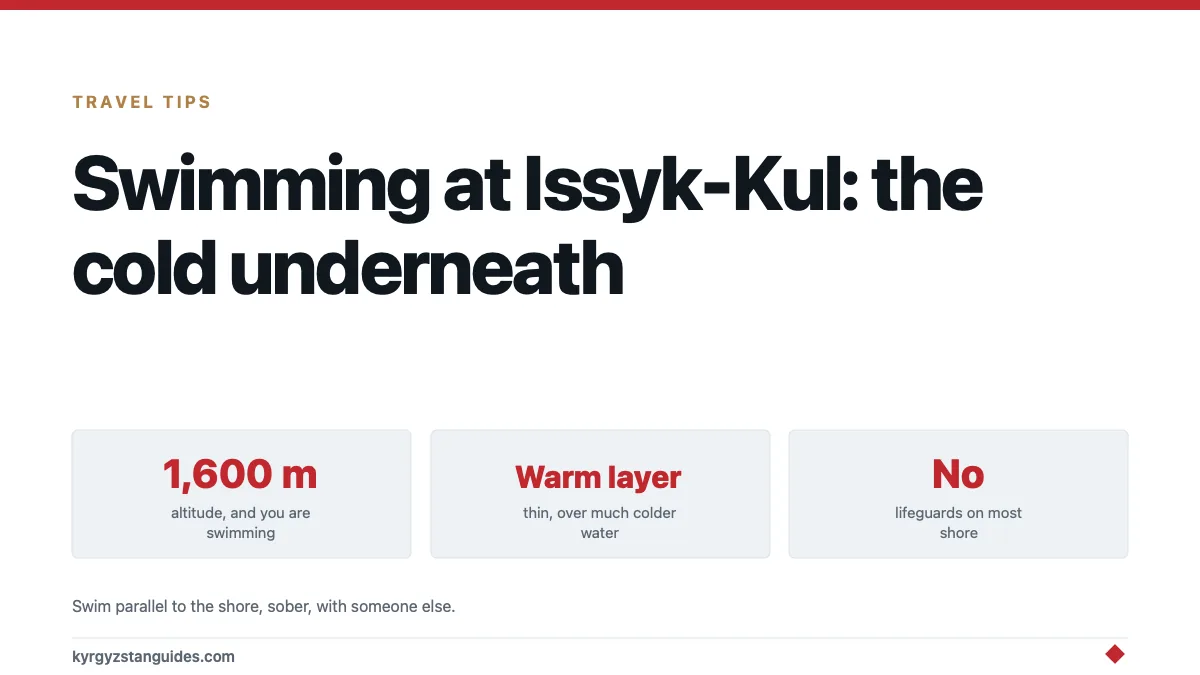
Issyk-Kul is one of very few places in Kyrgyzstan where you can swim, and in July and August the north shore is full of people doing it.
It is also a large, cold, deep lake at 1,600 metres, with almost no lifeguarding, strong afternoon winds, and a local drinking culture that overlaps with the beach.
The water is warm enough. The lake is not benign. Those two things are both true and only one of them is on the brochure.
Why the water is warmer than it should be
Issyk-Kul means hot lake, and the name is an observation rather than a boast.
It does not freeze, at 1,600 m, in a country that reaches -30°C. The reasons are its volume, its depth (over 600 metres) and its slight salinity, which lowers the freezing point. Our Issyk-Kul guide covers the lake's properties.
In July and August the surface reaches temperatures people happily swim in, in the low twenties. That is the warm layer and it's thin.
The specific hazards
Cold below the surface. Sun-warmed surface water sits over much colder water beneath. Swim out, dive down, or hit a colder patch, and the temperature change is abrupt. Cold water shock (involuntary gasp, hyperventilation, loss of breathing control) happens fast and it's what drowns strong swimmers.
Altitude. You are exerting yourself at 1,600 m. Breathlessness comes sooner than you expect and it's easy to misread as panic.
Afternoon wind. The lake generates strong afternoon winds and short steep waves. A calm morning isn't a forecast.
Distance is deceptive. It's a big lake with clear air. The far point you think you can swim to is much further away than it looks.
Almost no lifeguards. Some resort beaches have supervision. Most of the shoreline has none, and there is no organised water rescue.
Alcohol. The combination of drinking and swimming at a beach resort is a leading cause of drowning worldwide, and it is present here. WHO's drowning fact sheet identifies alcohol and absent supervision as two of the principal risk factors globally.
Sudden drop-offs. The shelf on parts of the shore falls away steeply and without warning.
What to actually do
Swim parallel to the shore, not away from it. This is the single most useful habit at any open-water location and it applies here more than most.
Enter slowly. Give yourself thirty seconds in the water before committing. That is how you find out what the temperature is actually doing.
Do not swim alone. There is nobody watching.
Do not swim after drinking. Including "just a beer with lunch".
Watch children continuously. No lifeguards, drop-offs, wind. Our family travel guide covers Issyk-Kul as a good children's destination, which it's, with supervision.
Get out when you start shivering, not when you feel cold. Shivering is already the second stage.
Inflatables blow offshore. Every year, everywhere. The afternoon wind here's strong and offshore in places.
Know where you're. If something goes wrong, our emergency numbers guide is the starting point, and medical facilities outside Bishkek are limited.
What "cold water" actually means
The numbers are worth carrying, because "the water was warm" and "the water was dangerous" aren't contradictory.
Cold water shock begins at around 15°C and below, and its effects are involuntary: a gasp reflex, rapid breathing you cannot control, and a spike in heart rate. It peaks within the first minute or two.
That matters here for a specific reason. A surface layer at 22°C sitting over water at 12°C is a warm lake with a cold one underneath it. You do not gradually notice; you cross a boundary.
Swim failure follows, typically within ten to thirty minutes in genuinely cold water: the limbs stop working properly before the body core is in any danger. People drown at this stage, conscious and unable to swim.
Hypothermia comes later still, which is why it's the least useful thing to be watching for.
The National Weather Service's cold water guidance sets out the sequence, and it applies to an alpine lake in July exactly as it does to the sea in March.
The practical translation: judge the water by how far you're from the shore, not by how pleasant it felt on entry.
Where to swim
Cholpon-Ata and the north shore. The developed side, with resorts, supervised beaches at some hotels, and crowds in July and August — which is itself a form of safety, because someone will notice.
Bokonbaevo, Tamga and the south shore. Quieter, emptier, colder, and with nobody around. More pleasant and less forgiving.
Balykchy at the western end, where the lake is shallower.
Rivers and mountain lakes: no. Glacier-fed water is close to freezing regardless of air temperature, and mountain rivers are fast, opaque and full of rocks. Wading a crossing isn't swimming. Our mountain weather guide covers why rivers rise through the afternoon.
The water quality question
Issyk-Kul is a closed lake with no outflow. Everything that enters it stays.
Our piece on litter and waste covers the cleanups (tonnes recovered from beaches, hundreds of kilograms from the water at Cholpon-Ata) and the plastic bag ban coming in 2027.
For swimming specifically: the water is large, cold and well-mixed, and the lake isn't in a state that makes swimming inadvisable. Avoid swimming immediately next to storm drains or river mouths after heavy rain, which is ordinary advice anywhere.
And don't drink it. It is slightly saline, and our tap water guide covers the general position.
Why this is worth a whole guide
Because Issyk-Kul is where Central Asia goes on holiday, and holiday drownings are the most preventable category of travel death there is.
The country's mountains get an entire safety literature — altitude, weather, rescue. A warm lake at 1,600 m with no lifeguards gets nothing, because it doesn't look like a hazard.
Swim. Just swim parallel to the shore, sober, with someone else, and get out when you shiver.
FAQ
Can you swim in Issyk-Kul?
Yes. In July and August the surface reaches comfortable swimming temperatures, and the north shore is a major regional beach destination.
Why doesn't Issyk-Kul freeze?
Its great depth, large volume and slight salinity keep it liquid through winters that reach -30°C in the surrounding region. Its name means "hot lake".
Is swimming in Issyk-Kul dangerous?
It carries real risks: cold water below the warm surface layer, exertion at 1,600 m, strong afternoon winds, sudden drop-offs and almost no lifeguarding.
Are there lifeguards at Issyk-Kul?
Some resort beaches have supervision. Most of the shoreline has none, and there's no organised water rescue service.
Where is the best place to swim at Issyk-Kul?
The north shore around Cholpon-Ata is developed and busy, which means more supervision. The south shore is quieter, colder and emptier, which means less help if something goes wrong.
Can I swim in Kyrgyz rivers and mountain lakes?
Not advisedly. Glacier-fed water is close to freezing whatever the air temperature, and mountain rivers are fast, cold and opaque.
Before you fish anywhere here, read the fishing rules: a three-year moratorium on commercial catch in Issyk-Kul and Son-Kul runs to July 2029, and two Red Book species carry criminal liability.