Stand at the edge of a road in rural Kyrgyzstan, hold your arm out low with the palm down, and within a few minutes a car will stop.
This is not hitchhiking in the Western sense. It's a functioning informal transport system that the country runs on, and almost every vehicle on a rural road is potentially a taxi. The driver will take you and will expect a small payment.
Understanding the difference between the two things is the whole of this guide.
How it actually works
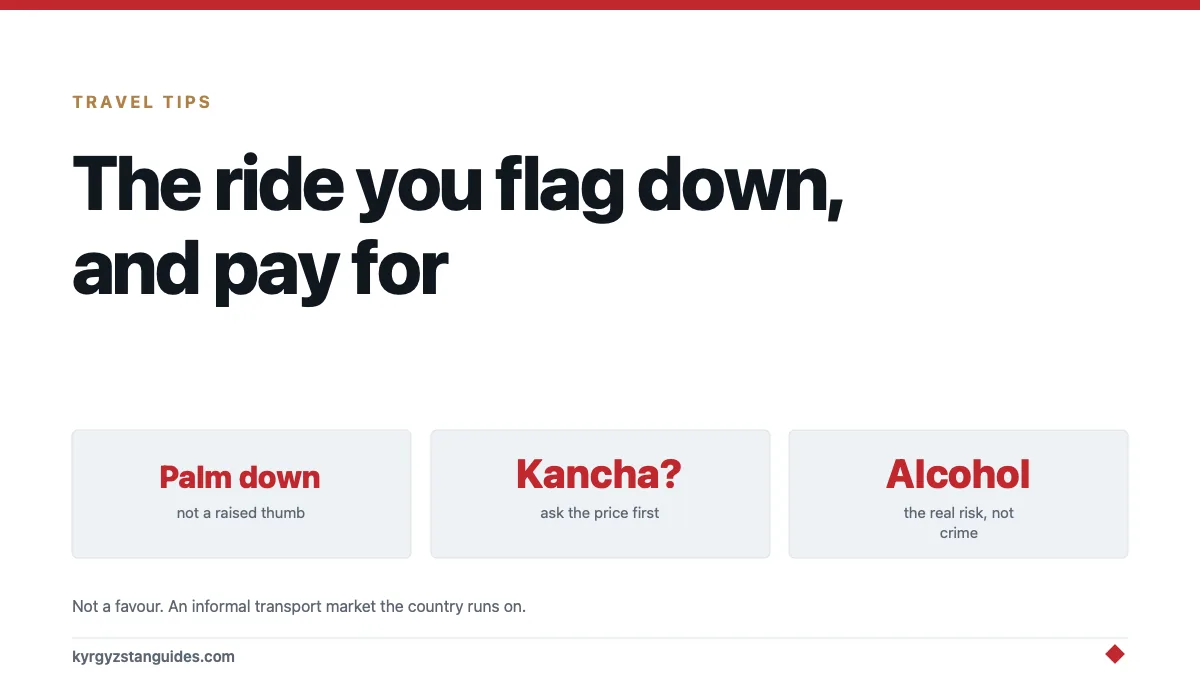
The gesture. Arm out, roughly waist height, palm down, a slight downward motion. Not a raised thumb, which reads as either foreign or rude depending on who sees it.
Anyone may stop. A private car with a family in it, a truck, a marshrutka with space, a shared taxi looking for a fourth passenger.
Payment is normal and expected. This is the key point. Kyrgyzstan's official transport statistics count only the formal sector, which is part of why the informal one is invisible in any planning document while being how a large share of rural journeys actually happen. You're not being done a favour in the way a Western hitchhiker is; you're participating in an informal market where drivers offset fuel costs. Offering nothing is the rude option.
The amount is modest. A rough guide is somewhere near the marshrutka fare for the same distance. Ask "kancha?", how much, before getting in, or hand over something at the end and let the driver adjust.
Some drivers refuse payment. If someone genuinely won't take money, do not force it. It happens, particularly with older people and on short hops.
Our guides to getting around and to marshrutkas cover the formal end of the same system, and there's much less difference between them than you would expect.
Where it works well
Rural roads with no scheduled transport. Side valleys, roads to trailheads, anywhere a marshrutka doesn't run. This is where it isn't merely viable but standard.
Between villages. Short hops, near-instant.
On main routes during the day. The Bishkek–Osh road, around Issyk-Kul, the roads to Naryn and Karakol.
Out of trailheads at the end of a trek. Frequently the only realistic option.
Where it does not
Late in the day. Traffic stops. A road that carried a car every five minutes at noon can be empty at seven, and you may be standing at altitude in the cold.
High passes and remote stretches. Sometimes hours between vehicles.
Winter. See our winter guide — reduced traffic, closed passes, and standing still in -20°C is a genuine hazard rather than an inconvenience.
Border zones. Vehicles are stopped and checked, drivers are cautious about unregistered passengers, and this isn't a place to improvise.
Out of Bishkek. City traffic makes stopping awkward. Get to the edge of town first.
Practical notes
Learn the numbers. Negotiating a price in Kyrgyz or Russian is far easier than miming. Our phrases guide has them.
Carry small notes. Nobody has change for a 5,000, as our paying guide explains.
Know your destination's name as locals say it. And ideally as it is spelled locally. Our place names guide covers why the same village has three spellings.
Say the price out loud before departing. Most disputes are misunderstandings rather than exploitation.
Sit in the back with a seatbelt. As our piece on the car fleet sets out, rear belts are often buried but usually present. Road travel is the largest risk to visitors in this country by a wide margin.
Have a fallback. Know how far you're from a village, and be willing to walk. Do not rely on a lift to get you somewhere before dark.
Tell someone your plan. Particularly if you are heading into a valley with no signal.
Safety, honestly
Kyrgyzstan is a low-crime country and this practice is entirely normal for locals, including women travelling alone within their own region. Check your own government's current advice — the UK FCDO and equivalent services publish country pages that are updated when conditions change.
That said:
Solo women travellers should be more cautious than the general advice implies. Our solo female travel guide covers the wider picture; on lifts specifically, preferring vehicles with women or families in them, and marshrutkas over private cars, is a reasonable filter.
Trust your read on a driver. Declining a stopped car costs you nothing and another will come.
Alcohol is the real risk. Drink-driving is not rare, particularly in the evening and at weekends. If a driver has been drinking, don't get in. This is a much more likely problem than anything else on this list, and the WHO's road safety data puts the region's road death rates well above western European levels.
Overtaking is the second risk. A driver in a hurry on a mountain road, in an old right-hand drive import, is the scenario that frightens experienced travellers here.
Note the plate. Message it to someone if you're going far.
The line between a lift and a taxi
Worth spelling out, because the categories blur here in a way visitors find confusing.
A marshrutka is a scheduled minibus on a fixed route with a fixed fare. Formal.
A shared taxi is a car that leaves when it is full, on a known route, at a known per-seat price. Semi-formal, and the backbone of intercity travel.
A taxi app works in Bishkek and Osh, as our taxi apps guide covers. Formal.
A private car you flag down is the informal end of the same continuum. It may be a family going your way who will take something for fuel, or it may be someone who does this as work and will quote you a taxi price.
The ambiguity is the point. There is no bright line, and the driver who stops doesn't necessarily know which of these they are being at the moment they pull over. Asking the price resolves it immediately and without awkwardness, and the answer tells you which conversation you're in.
One useful consequence: if you are somewhere with no transport and you need to get out, you're not stuck. You are in a country where every passing vehicle is a potential solution, which is a genuinely different situation from being stranded.
Why it is worth doing
Not to save money, though it does.
It's the most direct access to ordinary people available to a visitor. A driver who picks you up on the road to Naryn isn't in the tourism business, has no script, and will ask you questions rather than answer them. You'll end up drinking tea in someone's house more often than you expect.
It is also, in a practical sense, how a large part of the country moves. Using it isn't roughing it or being adventurous. It's the normal thing, and being unable to do it is closer to the restriction.
FAQ
Can you hitchhike in Kyrgyzstan?
Yes, and it is standard practice. Hold your arm out at waist height with the palm down; a raised thumb isn't the local gesture.
Do you pay for a lift in Kyrgyzstan?
Usually yes. Most drivers expect a modest payment roughly comparable to the marshrutka fare. Agree it before getting in, and accept it if someone genuinely refuses money.
Is hitchhiking safe in Kyrgyzstan?
It's common and the country is low-crime. The main risks are drink-driving and aggressive overtaking on mountain roads rather than anything involving the passenger.
Where does hitchhiking work best?
On rural roads with no scheduled transport, between villages, at trailheads, and along main routes during daylight hours.
When should I avoid hitchhiking?
Late in the day, in winter, on remote high passes, in border zones and inside Bishkek. Traffic thins quickly and standing still at altitude in the cold is a real hazard.
How much should I pay for a lift?
Roughly what a marshrutka would charge for the same distance. Ask "kancha?" before departing to avoid any misunderstanding at the end.