Every summer, small barrels under beach umbrellas appear on street corners across Kyrgyzstan, staffed by women pouring cloudy drinks into plastic cups. The barrels usually say Shoro, the brand that industrialized the country’s traditional drinks, and the cloudy liquids are maksym, jarma, and chalap — fermented grain and yogurt drinks that Kyrgyz people down by the liter in hot weather.
Here is the short version for the curious: maksym is a lightly fizzy, sour, grainy drink made from fermented cereals; jarma is its thicker, maltier cousin; chalap is salty, lightly fizzy fermented milk thinned with water. None of them will taste like anything you grew up with, all of them are cheap to try, and one small cup on a hot Bishkek afternoon is a legitimate cultural experience for less than a dollar.
Why there's a barrel on every corner
The Shoro company, founded by the Egemberdiev family in the early 1990s, took maksym, until then a homemade village drink, and turned it into a national bottled product. Its street-barrel network became a summer institution: from roughly May to September, hundreds of branded stands operate across Bishkek, Osh, and smaller towns, selling by the cup or filling 1.5-liter bottles for families. Competitors like Enesay play the same game, and supermarkets carry the bottled versions year-round. The barrels are genuinely popular with locals, not a tourist show; on a 35°C day you may see a short queue of office workers, taxi drivers, and grandmothers, all there for cold sour grain water.
The drinks, one by one
Maksym
The flagship. Made from talkan. Roasted, ground wheat, barley, or corn: fermented briefly with water and a little flour and fat. The result is pale brown, faintly fizzy, sour like weak sourdough starter, with a distinct toasted-grain aftertaste and a slightly gritty body that settles if the cup sits. Kyrgyz people credit it with everything from aiding digestion to curing hangovers; we will only promise that it is cold, mildly probiotic, and unlike anything else you'll drink this year.
Jarma
Jarma is built on the same roasted-grain base but is usually thicker and less aggressively sour, sometimes blended with ayran (yogurt). Think of it as maksym’s mellower sibling, closer to a thin, tangy liquid porridge. Many first-timers actually find jarma easier than maksym because the sourness is rounder and the malty flavor dominates.
Chalap / Tan
Chalap is diluted sour yogurt with salt, often lightly carbonated in its commercial form (sold as Tan). If you have had Turkish ayran or Indian salted chaas, you already know the family. Chalap is simply the fizzy Central Asian branch of it, and it's far and away the easiest entry point of the three. On a hot day it's refreshing rather than merely interesting.
Bozo, for completeness
Winter brings bozo, a thicker fermented millet drink with a gentle alcoholic kick — usually low single digits in strength, closer to kvass-plus than to beer. You will find it at bazaars and in homes rather than at Shoro barrels. Treat it as mildly alcoholic, because it's.
An honest taste verdict
We won't pretend maksym is an instant crowd-pleaser. Most foreign first-timers wince at the first sip: the sourness arrives before the toasty grain flavor does, and the texture takes a moment of adjustment. The trick is to drink it very cold and give it three sips before judging, the second and third are noticeably better than the first. Chalap converts people fastest, jarma second, maksym last; but maksym is also the one people end up craving on their second trip. At these prices, ordering all three over a couple of days costs less than one coffee back home, which fits neatly into any Kyrgyzstan budget.
How to try them
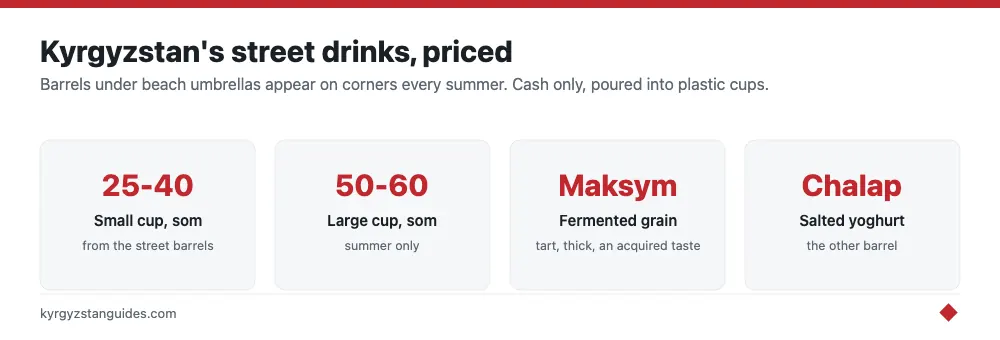
- At a barrel: point at the tap you want and say “kichine” (small) for a half cup. Small cups typically run 25–40 som, larger 50–60.
- Shake or stir maksym gently if it has settled. The grain sludge at the bottom is normal and flavorful.
- From a supermarket: bottled Shoro or Enesay maksym and Tan are everywhere, cold, and a fine low-commitment first taste.
- In the south, look for market stalls around Osh selling homemade versions alongside kymyz (fermented mare’s milk) — a different, wilder branch of the same tradition covered in our Kyrgyz food guide.
- Pair with hot weather. All three drinks make dramatically more sense at 33°C than at 15°C.
UNESCO listed maksym in 2025
This stopped being street refreshment and became protected heritage very recently. "Traditional knowledge and cultural contexts of making Maksym, a traditional Kyrgyz beverage" was inscribed on UNESCO's Representative List in 2025, at the 20th session of the committee, reference 02123.
UNESCO's own description of the process is more specific than most recipes you will find: flour of wheat, barley or corn, roasted in sheep fat, mixed with water and salt, then fermented for several hours with natural cultures. The sheep fat is the detail that tends to get quietly dropped from tourist-facing explanations, and it is a large part of why the drink tastes the way it does.
What is actually in the barrel
Shoro publishes its ingredient lists, which settles several arguments. Maksym Shoro is confined ground water, barley, corn, wheat, melted butter, wheat flour, salt, yeast, at 24 kcal per 100 g, with a 30-day shelf life at 2-6 °C.
Jarma is not simply thicker maksym, which is how it is usually described. It is a milk-containing drink: spring water, cow's milk, wheat, corn, oat flakes, salt, lactic-acid bacteria and probiotic cultures, at 12.2 kcal per 100 g. Chalap is not a grain drink at all. It is fermented skimmed cow's milk with spring water and lactic-acid cultures, 29.3 kcal per 100 g. The traditional version is süzmö, strained soured milk, thinned with water and salted, which puts it in the same family as ayran.
Are they alcoholic? The honest answer is that nobody publishes a figure for maksym or jarma, so do not trust anyone who tells you it is zero. What is documented is bozo, the winter cousin, which Shoro declares at 2.5-4.5% alcohol by mass. In February 2020 the Muslim Spiritual Administration of Kyrgyzstan put long-fermented bozo at 4-6% and declared it impermissible; the deputy director of the national Narcology Centre publicly disagreed, saying you would need to drink a bucket to feel it. That argument is a useful marker of where the line sits: bozo is the one people debate, and nobody debates maksym.
On the probiotic claims, there is at least real measurement behind the marketing. A 2023 study in the MANAS Journal of Engineering found lactic acid bacteria at 9.36 log cfu/mL and yeast at 9.46 log cfu/mL at production, both falling about two log units after 21 days of cold storage. That is a genuinely live culture. It is not evidence of any health outcome, and no clinical study on maksym exists.
Shoro, and what the price tells you
The company was founded in 1992 by the brothers Taabaldy and Jumadyl Egemberdiev. The first batch was about 90 litres and sold out in a day. Bottled water followed in 2000, kurut in 2008, bozo in 2012.
The street price is the most useful number for a visitor, and it has moved sharply. In a table Shoro supplied to the Antimonopoly Service in April 2024, the draught price per unit ran 60 som in 2019, 2020 and 2021, then 80, then 90, then 120 som in 2024. The company attributed the rise to grain costs up 42-55% and to 539 million som of plant modernisation. A small cup went from 12 som in 2021 to 16 som in 2022.
Season matters. The barrels are a warm-weather institution, appearing from spring to the end of summer, and in 2022 the street season opened on 30 March. If you arrive in November, you will not find them, and that is not bad luck.
FAQ
Is maksym alcoholic?
Effectively no. Fermentation leaves only trace amounts, well under 1%, and it's drunk freely by children and observant Muslims. Bozo, the thicker winter millet drink, is the exception, it is mildly alcoholic and treated as such.
Are the street barrels safe to drink from?
The branded barrels (Shoro, Enesay) are commercially produced, chilled, and served in disposable cups, and problems are rare. Sensitive stomachs should start with a small cup or the bottled supermarket version rather than a full liter on day one.
Which drink should a first-timer order?
Chalap or Tan if you want refreshing and easy; maksym if you want the full national experience. Order the smallest size of each and decide for yourself — the total experiment costs under a dollar.
Is maksym UNESCO heritage?
Yes. "Traditional knowledge and cultural contexts of making Maksym, a traditional Kyrgyz beverage" was inscribed on UNESCO's Representative List in 2025, reference 02123.
Is maksym alcoholic?
No producer or laboratory figure has been published for maksym or jarma, so nobody can honestly tell you it is zero. The drink in this family that is measurably alcoholic is bozo, which Shoro declares at 2.5-4.5% by mass.
What is the difference between maksym and jarma?
Maksym is a grain drink: barley, corn, wheat, melted butter, salt and yeast. Jarma contains milk as well, along with oat flakes and probiotic cultures. Jarma is also lighter, at 12.2 kcal per 100 g against maksym's 24.
What is chalap?
Fermented skimmed milk thinned with water and salted, not a grain drink. The traditional version uses süzmö, strained soured milk, which makes it a relative of ayran rather than of maksym.
How much does maksym cost?
A small cup was 16 som in 2022. Shoro's own draught price per unit was 120 som in 2024, up from 60 som in 2021. Expect it to have moved again.
When can you buy maksym on the street?
Spring to the end of summer. The 2022 street season opened on 30 March. The barrels disappear in cold weather, so an autumn or winter visit will not find them.