If you travel here and start noticing surnames, you will find communities that have no obvious reason to be in the Tien Shan. Chechens. Karachays. Meskhetian Turks. Kurds from the Caucasus.
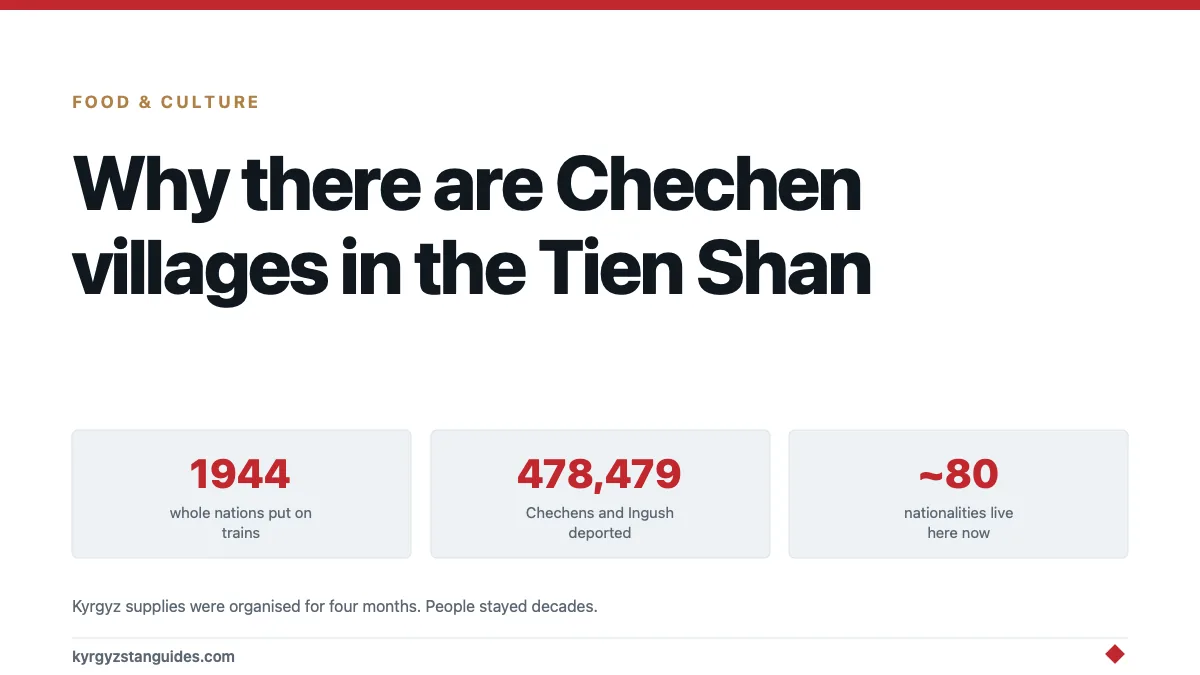
They are here because in 1944 the Soviet state loaded entire nations onto trains and sent them to Central Asia.
This is the least-discussed layer of Kyrgyzstan's ethnic map, and it is the reason a country of seven million contains something like eighty nationalities.
What happened in 1944
The deportations were collective and they were fast. Entire ethnic groups were declared disloyal, given hours' notice, loaded into freight cars and moved thousands of kilometres east.
The documented scale:
| Group | Deported | When |
|---|---|---|
| Chechens and Ingush | 478,479 — 387,229 Chechen, 91,250 Ingush | February–March 1944 |
| Karachays | 68,327, to Kazakhstan and Kyrgyzstan | 20–27 October 1943 |
| Meskhetian Turks, Kurds, Hemshins | 91,095, to Kazakhstan, Uzbekistan and Kyrgyzstan | 15–25 November 1944 |
Across the North Caucasus roughly 650,000 people were deported in 1943–44; the demographer Dalkhat Ediev puts the figure above 724,000. A survey of the Transcaucasian deportations sets out how the operations were sequenced by group.
The legal mechanism was a decree of the Supreme Soviet Presidium, group by group. The charge was collaboration with German forces, applied collectively to populations including infants, the elderly and serving Red Army soldiers.
The Map of Memory project's record of the wartime deportations documents the decrees and the numbers, and an account of the November 1944 operation from southern Georgia covers the Meskhetian Turk, Kurdish and Hemshin deportations specifically.
What "special settler" meant
The deportees arrived with a legal status: spetsposelenets, special settler.
That meant registration with the local commandant, a prohibition on leaving the assigned district without permission, and criminal penalties for doing so. It wasn't imprisonment and it wasn't freedom. It lasted, for most groups, until the mid-1950s, and the right to return home came later still or, for the Meskhetian Turks, effectively never.
The receiving end mattered enormously. Kyrgyz and Kazakh local authorities were given essentially no resources to absorb these arrivals — in Kyrgyzstan, supplies were organised for about four months.
Mortality in the first two years was appalling, from cold, hunger and disease.
What is consistently recorded by the deported communities themselves, and is worth stating, is that local Kyrgyz and Kazakh families took people in. That happened in a republic that was itself impoverished, during a war, under a regime that punished helping special settlers. It is one of the few things in this history that reflects well on anybody.
Who came, and who stayed
Chechens and Ingush. Most returned to the Caucasus after 1957, when the deportation was formally reversed. Some stayed, and Chechen families remain in Kyrgyzstan.
Karachays and Balkars. Also largely returned after rehabilitation, with a residual community here.
Meskhetian Turks. The hardest case. They were not permitted to return to Georgia. Many remained in Central Asia, and after violence in Uzbekistan's Fergana valley in 1989 large numbers moved again — to Russia, Azerbaijan, Turkey and the United States. A community remains in Kyrgyzstan.
Kurds from the Caucasus. Small communities persist.
They joined groups already here for other reasons: Koreans deported in 1937, German Mennonite and settler villages dating from the nineteenth century and reinforced by wartime deportation of Volga Germans, the Dungan who arrived in 1877, Uyghurs from across the Chinese border, and Russians and Ukrainians from tsarist and Soviet settlement.
Why Central Asia
A deliberate choice, not a logistical accident.
It was far. Distance was the point — from the Caucasus, from Europe, from any border a deported population might cross back over.
It had absorptive capacity on paper. Central Asia was thinly populated relative to its area, and the planners treated it as somewhere people could be put.
It needed labour. Cotton, construction, mines. Special settlers were a labour supply that could be directed.
It had precedent. The 1937 Korean deportation had established the mechanism seven years earlier. By 1944 this was a tested administrative procedure.
Kyrgyzstan's population was reshaped by decisions made about other people in other places. Our history overview covers the broader arc.
The 1989 aftershock
One episode is worth separating out, because it shows that a deportation doesn't end when the trains stop.
In June 1989, violence broke out against Meskhetian Turks in the Fergana valley of Uzbekistan. Homes were burned, people were killed, and effectively the entire community was evacuated out of the region.
They had been there for forty-five years, placed there by a state that no longer had any interest in them, unable to return to Georgia, and now unable to stay where they had been put. Tens of thousands were moved again, to Russia, Azerbaijan, Turkey, Ukraine and later the United States under a refugee programme.
It's one of the more complete illustrations of what the deportations actually did. A population is uprooted, held in place under a legal regime, released from that regime without being allowed home, and then finds that the place it was put no longer wants it either.
The Fergana valley, where this happened, is the same dense, multi-ethnic, politically flammable region that produced the 2010 violence in Osh twenty-one years later, and the same one the Kyrgyz–Tajik border settlement was finally negotiated across in 2025.
What a traveller notices
Names. Caucasian and Turkish surnames in places that are otherwise entirely Kyrgyz.
Food. Regional dishes turning up a long way from where they belong.
Mosques and cemeteries. Distinct from Kyrgyz ones in style and inscription.
Nobody makes a performance of it. This is a matter-of-fact part of local history, not a heritage attraction. There is no museum. You will find out because somebody mentions it.
If it comes up:
Ask about the family, not the category. "How did your family come here?" is a good question. "Are you a deported people?" is not.
Understand that returning was not simple. Homes were occupied, regions had been administratively dissolved, and for some groups return was never permitted. Staying wasn't always a choice.
Do not treat it as a curiosity. These are ordinary Kyrgyzstani citizens whose grandparents survived something.
Why it matters for understanding the country
Because it explains the thing visitors notice first: Kyrgyzstan is much more mixed than a country of its size and remoteness should be.
Almost every one of those communities arrived under compulsion or duress. Deportation, flight, colonisation, revolt. The multi-ethnic character that reads as cosmopolitan is the residue of a century of people being moved, and of 1916 and 2010 as the two occasions when that settlement broke down violently.
It also explains a certain steadiness in how Kyrgyzstanis discuss ethnicity. In a place where everybody's grandparents came from somewhere under circumstances nobody chose, the subject is handled with less heat than outsiders expect.
FAQ
Why are there Chechens in Kyrgyzstan?
They were deported en masse from the North Caucasus in February–March 1944, along with the Ingush, under a Soviet decree accusing them collectively of collaboration. Most returned after 1957; some families remained.
How many people were deported to Central Asia in 1944?
Around 650,000 from the North Caucasus in 1943–44, with some estimates above 724,000, including 478,479 Chechens and Ingush and 68,327 Karachays.
What were "special settlers"?
Deportees held under a legal regime requiring registration with a local commandant and prohibiting movement outside an assigned district, with criminal penalties for leaving. It lasted into the mid-1950s.
Who are the Meskhetian Turks?
A Turkish-speaking Muslim population deported from southern Georgia in November 1944 along with Kurds and Hemshins. They were never permitted to return to Georgia, and communities remain across Central Asia.
Why were people deported to Central Asia specifically?
Distance from home regions and borders, perceived capacity to absorb population, demand for directed labour, and an administrative precedent set by the 1937 Korean deportation.
How many ethnic groups live in Kyrgyzstan?
Around eighty nationalities are represented, a diversity produced largely by deportation, colonisation and cross-border migration rather than by voluntary settlement.
The administrative sequence behind all of this — oblast, ASSR, union republic — is set out in how the Kyrgyz SSR was formed.
One in four inhabitants went to the Second World War, and 137,000 people were deported into the republic in the same years: see Kyrgyzstan in the Second World War.