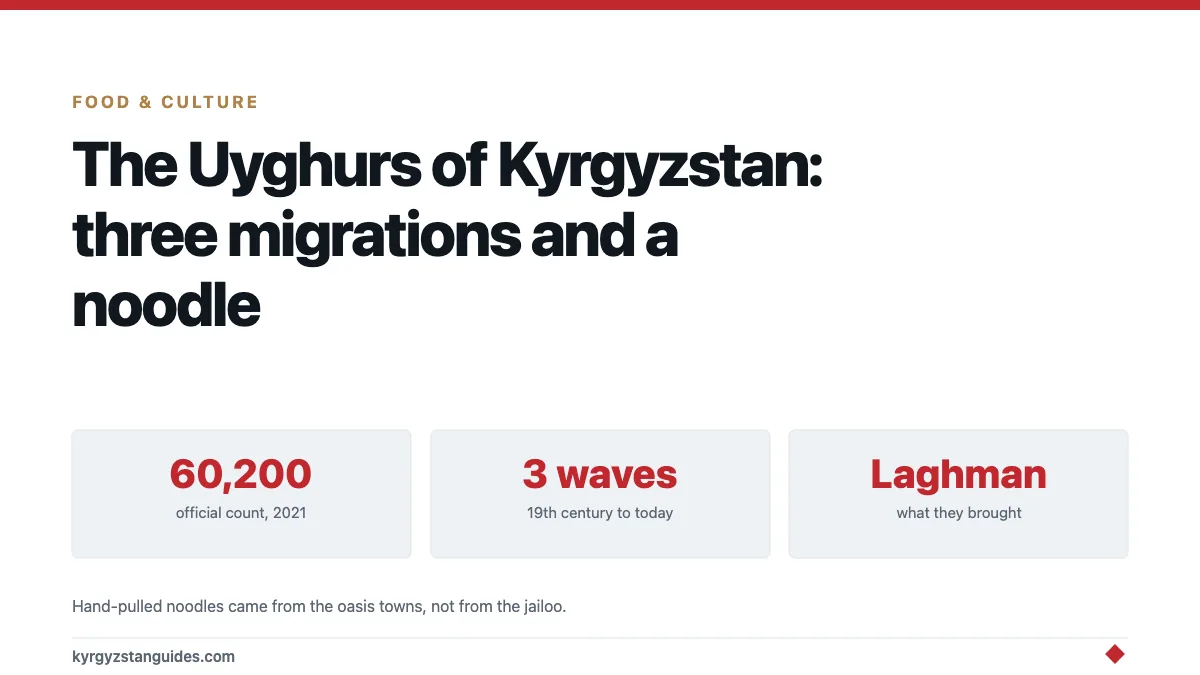
If you have eaten laghman in Kyrgyzstan, and you'll. You have eaten a dish that arrived with Uyghurs from what's now Xinjiang. Official figures from the National Statistical Committee put the Uyghur population at 60,210 at the start of 2021 — roughly 0.9% of the country. Unofficial estimates run considerably higher, from 100,000 to 200,000, and the gap between those numbers is itself part of the story.
They came in three distinct waves across two centuries, and the third one is still arriving.
Who they're
Uyghurs are a Turkic people whose historic homeland lies across the mountains to the east, in the Tarim basin and the oases of what China administers as Xinjiang. The language is southeastern Turkic and closely related to Uzbek, close enough that an Uyghur and an Uzbek can make themselves understood without much difficulty. The community is predominantly Sunni Muslim.
In Kyrgyzstan they are concentrated in two places: the south around Osh, where the Fergana valley's settled, Persianate, trading culture has always been the natural home for them, and in Bishkek.
The three waves
Late nineteenth century. The first arrivals came as the Qing empire reasserted control over the Tarim basin after the revolts of the 1860s and 1870s. The same upheaval that sent the Dungan over the Tien Shan in the winter of 1877. Uyghurs and Dungans were fleeing the same collapse by different routes, which is why both communities end up in the same country with quite different profiles.
The Soviet century. Movement continued across a border that was porous in some decades and sealed in others, with periods of substantial migration west into Soviet Central Asia.
Now. The third wave is traders. PRC citizens of Uyghur and other backgrounds who take up temporary residence in Bishkek to do business, often around the bazaars and the China trade that runs through Dordoi. They are not settlers in the way the earlier arrivals were, and the official population count doesn't really capture them: which is part of why the estimates diverge so widely.
What they brought to the table, literally
Uyghur cooking is one of the three foreign strands that made Kyrgyz restaurant food what it is, alongside Uzbek and Dungan.
Laghman is the headline. Hand-pulled wheat noodles with a stir-fried topping of lamb and vegetables, served in broth or fried dry. It is on every menu in this country and it's Uyghur in origin, our laghman guide covers the varieties and where to eat it.
Naan baked in a clay oven, often with cumin, is Uyghur bread as much as anyone's, and it sits alongside the Uzbek lepyoshka on the same bakery shelves.
Samsa from a tandyr, which our samsy guide covers, belongs to the same settled-oven tradition.
Polu, pilaf with mutton and carrots, overlaps with Uzbek plov to the point where arguing about ownership is a waste of a good lunch. Our plov guide takes the Kyrgyz version.
The through-line in all of it: this is oven-and-noodle food from settled oasis towns, which is exactly what a nomadic herding culture does not produce. Most of what visitors think of as Kyrgyz restaurant cuisine arrived from the Fergana valley and the Silk Road oases, and Uyghur cooks are a large part of why.
Why the food travelled further than the people
A community of perhaps 60,000 in a country of seven million has put its noodles on every menu in the country. That's worth a moment.
Part of it is that the food fills a real gap. Nomadic Kyrgyz cooking is built on meat, dough, dairy and onions, and it's excellent at what it does. But it produces nothing like a bowl of fresh hand-pulled noodles in broth, because you cannot run a noodle kitchen from a yurt that moves twice a year. When settled towns grew, somebody had to cook for them.
Part of it is trade. These dishes moved along the same routes as everything else, and a cuisine that works in a caravanserai, fast, hot, filling, made to order from stored ingredients, travels well by definition. The Michelin guide's primer on Uyghur food makes the Silk Road point at length.
And part of it is simply that pulling noodles by hand is a skill worth paying someone for. It takes years to do well, it cannot be faked, and a family that has it has a business anywhere.
Where you'll encounter it
In restaurants, mostly, and without labels.
A laghman place in Osh or Bishkek may be run by an Uyghur family and may not advertise it. Bazaar food stalls, bakeries and noodle counters throughout the south have Uyghur hands behind a good deal of them. There's no quarter, no signposted heritage, no cultural centre on the tourist map.
Cultural associations exist and there are mosques with predominantly Uyghur congregations, but this is not a community that presents itself to visitors, and there is no reason it should.
If you want a concrete encounter, eat a proper laghman and watch the noodles being pulled. That is a live technique, done by hand in front of you in the better places, and it's the single most visible piece of Uyghur culture in the country.
The part that isn't a travel subject
Uyghurs in Kyrgyzstan exist in a difficult position, and any honest page has to say so rather than leave a gap.
The situation of Uyghurs inside China has been the subject of serious international concern for years. Kyrgyzstan borders China, depends on it economically, and has a Uyghur minority with family across that border. Those facts pull in different directions, and the community here lives with the consequences.
That is a matter for journalists and governments rather than a travel guide, and we aren't going to summarise a contested subject in a paragraph and call it balance. What a visitor should take from it is simply this: the politics are live, they're not abstract for the people you're talking to, and this isn't a topic to raise casually with a stranger in a restaurant.
FAQ
How many Uyghurs live in Kyrgyzstan?
Official figures give around 60,200 as of 2021, about 0.2% of the population. Unofficial estimates range from 100,000 to 200,000, partly because temporary traders from China aren't captured in the census.
Where do Uyghurs live in Kyrgyzstan?
Mainly in the south around Osh, in the Fergana valley, with a significant community in Bishkek. There's no defined Uyghur quarter in either city.
Is laghman Uyghur or Kyrgyz?
Uyghur in origin. Hand-pulled noodles with a lamb and vegetable topping came from the oasis towns to the east and became a staple across Kyrgyzstan, where it's now on essentially every menu.
What language do Uyghurs speak?
A southeastern Turkic language closely related to Uzbek, close enough for mutual comprehension. Most Uyghurs in Kyrgyzstan also speak Russian, and many speak Kyrgyz or Uzbek.
When did Uyghurs come to Kyrgyzstan?
In three waves: from the late nineteenth century following upheaval in the Tarim basin, through the Soviet period, and currently as traders from China taking temporary residence in Bishkek.
Can I visit Uyghur cultural sites in Kyrgyzstan?
There's nothing set up for visitors — no museum or heritage trail. The realistic encounter is through food, particularly a laghman restaurant where the noodles are pulled by hand in front of you.