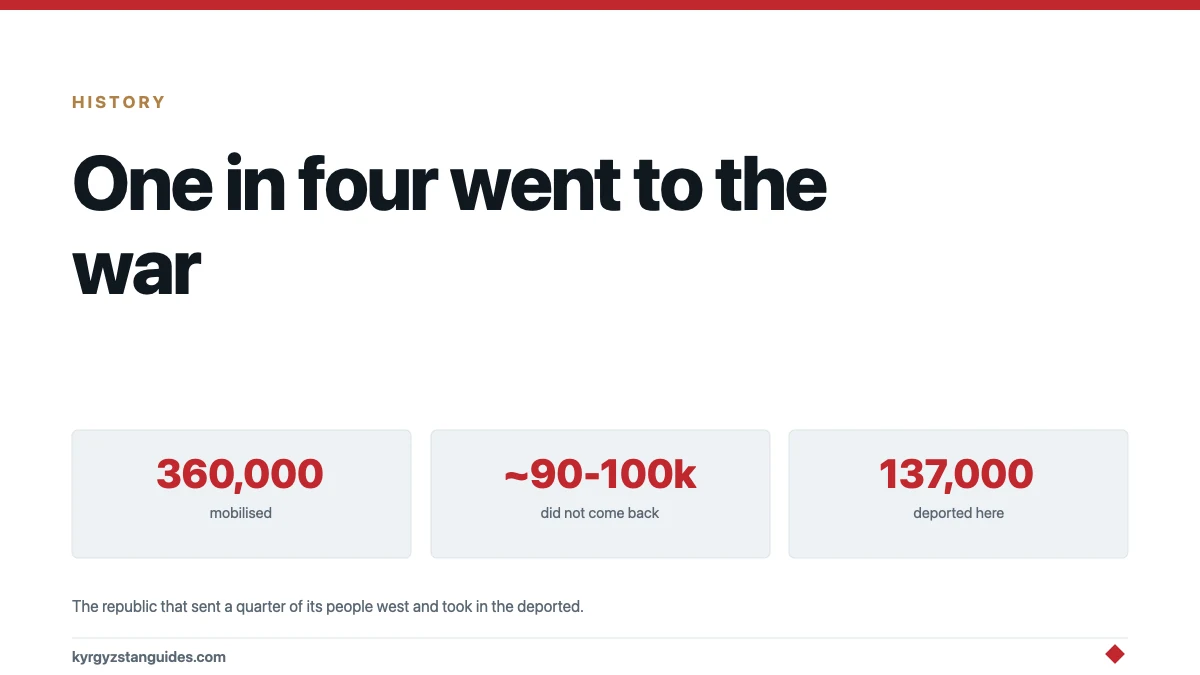
More than 360,000 Kyrgyzstanis fought in the Second World War — "every fourth inhabitant of the republic." Between ninety and a hundred thousand did not come back.
At the same time the republic was receiving people: more than 300,000 evacuees, and, on a separate and darker account, more than 137,000 people deported here on ethnic grounds.
Both halves happened at once, and most accounts of Kyrgyzstan's war carry only the first.
The numbers
| Mobilised | more than 360,000, about one in four inhabitants |
| Killed | around 100,000 per the state archive; "more than 90,000" in other accounts |
| Heroes of the Soviet Union | 74 per the state archive; 73 in several other sources |
| Decorated with orders and medals | more than 150,000 |
| Full cavaliers of the Order of Glory | more than 20 |
We cannot resolve the 73-versus-74 discrepancy or the 90,000-versus-100,000 one, and we are printing both.
They served at Moscow, Leningrad, Stalingrad and Kursk, on the Ukrainian and Belorussian fronts, and into the Baltics, Poland, Romania, Hungary, Czechoslovakia and Germany.
The Panfilov division
The 316th Rifle Division, later the 8th Guards, was formed in Kyrgyzstan and Kazakhstan under Major-General Ivan Panfilov, who had been the military commissar of the Kirghiz SSR before the war.
Six Kyrgyzstanis from the division were made Heroes of the Soviet Union posthumously for the battle for Moscow: Duishenkul Shopokov, Nikolai Ananyev, Grigory Konkin, Ivan Moskalenko, Grigory Shemyakin and Grigory Petrenko.
Other names: Cholponbai Tuleberdiev, who covered an enemy pillbox embrasure with his body on the Don on 6 August 1942. Dair Asanov, Hero of the Soviet Union. Talgat Begeldinov, twice Hero of the Soviet Union, with 305 combat sorties.
The factories that arrived
This is the part with real consequences for what Kyrgyzstan became.
Plants were evacuated ahead of the German advance from occupied Ukraine, Russia and Belorussia. The figures differ by definition: the state archive says more than 30 large industrial enterprises were restored or built in Kyrgyzstan over the war, while press accounts give 66 plants and factories — 28 in 1941 and 38 in 1942 — arriving with around 160,000 specialists and their families.
Named cases:
The Berdyansk agricultural machinery plant — equipment reached Frunze in October 1941 and was operational in forty days, installed in the halls of the Intergelpo cooperative.
The Frunze plant in the capital, making mines, grenades and shells.
Lugansk plant No. 60, making cartridges.
Odessa's leather and glue works and its hemp-jute factory, making boots and underwear for the front. A Kharkov knitwear factory.
Most went to Frunze city and oblast, but Osh and Talas received plants too.
What happened to them: they became the seed of Kyrgyzstan's Soviet industrial base and survived as the republic's machine-building and light-industry core into the 1980s. Then they collapsed. Bishkek's industrial output fell fourfold between 1991 and 1995, and the city's share of national industrial output fell from 31 per cent in 1991 to 20.7 per cent in 1996. Hay-baler production went from 20,000 units in 1991 to barely 200 in 1996.
That arc — evacuated in forty days in 1941, gone by the mid-1990s — is the shape of industrial Kyrgyzstan. See Kara-Balta and the Soviet farm collapse.
What the rear produced
Over the war, per the state archive: 7 million tonnes of coal; 1.3 million pairs of leather footwear; 8.6 million sewn and knitted items; 1,239,300 metres of silk and woollen cloth; 94.4 million tins of meat; 177,000 tonnes of sugar; 839,000 tonnes of grain; 128,600 tonnes of meat. Plus lead from Ak-Tyuz and mercury and antimony from Khaidarkan and Kadamjai.
Contributions to the defence fund: 189 million roubles in cash, 964 million in bonds, and 59 kilograms of silver.
The people who were sent here
Across the USSR, 3,600,000 people of more than forty nationalities were deported on ethnic grounds between 1936 and 1951, according to security-ministry data cited by Kyrgyzstan's national library. More than 137,000 of them were deported to Kyrgyzstan; almost 1.2 million to Kazakhstan.
Ten peoples were deported in their entirety: Koreans, Germans, Ingrian Finns, Karachais, Kalmyks, Chechens, Ingush, Balkars, Crimean Tatars and Meskhetian Turks. Seven of them also lost their national autonomies.
Operation "Lentil", February 1944. The mass deportation of Chechens and Ingush began on the morning of 23 February 1944; trains left Grozny around the 27th; more than 450,000 people were sent to Kazakhstan and the Central Asian republics.
November 1944. More than 89,000 Meskhetian Turks were deported, a large share of them to Kyrgyzstan, where the community organisation still exists today.
Late 1930s. 172,000 Koreans deported from the Far East.
The state archive's own framing counts these people among the "more than 300,000 evacuees" the republic received, alongside citizens from occupied areas and Polish citizens of Jewish nationality — commonly including 16,000 residents of besieged Leningrad, about 3,500 of them children. Those last figures we could not verify directly.
Fuller detail is in Soviet deportations to Kyrgyzstan.
Where you can see it
The war is more visible in Kyrgyzstan than most of its other history, because the Soviet Union commemorated it comprehensively and independent Kyrgyzstan did not take the monuments down.
Victory Square in Bishkek, from 1985, is the central memorial — see the Soviet architecture walk.
Almost every village has an obelisk with the names of its dead. In a country of small settlements the lists are short and the surnames repeat, which tells you more about what one in four meant than any national figure does.
Street names carry the Heroes: Shopokov, Tuleberdiev and others appear across Bishkek and the oblast centres. If a Kyrgyz street is named after a person you have not heard of, the war is the likeliest reason.
And the factories are the least obvious monument. Industrial buildings in Bishkek, Osh and Talas that look like ordinary Soviet plants are, in several cases, machinery that arrived on trains from Ukraine in 1941 and never went home.
A note on the figures
Everything above comes from the Kyrgyz state archive's own war portal, the national library, and Kyrgyz press reporting, and the numbers do not all reconcile.
Heroes of the Soviet Union: 73 or 74. War dead: about 90,000 or about 100,000. Evacuated enterprises: more than 30, or 66. In each case we have printed both and named where they come from, because picking one silently is how a round number becomes a fact.
Some of the deportation breakdown in circulation — a detailed 1944 tally by nationality and destination republic — we reached only through search summaries rather than a document we could open, so we have not printed those figures at all.
Why both halves belong together
A republic of about a million and a half people sent 360,000 of them west and lost most of a hundred thousand. In the same years it absorbed hundreds of thousands of strangers — some fleeing, some delivered under guard — and a wave of factories that rebuilt its economy.
The Kyrgyzstan that existed in 1945 was not the one that existed in 1941. Its industry, its cities and its ethnic composition had all been rearranged by the same war, from opposite directions.
FAQ
How many Kyrgyzstanis fought in the Second World War?
More than 360,000 — described by the state archive as every fourth inhabitant of the republic. Between about 90,000 and 100,000 did not return, with the archive giving the higher figure.
How many Heroes of the Soviet Union came from Kyrgyzstan?
74 according to the state archive, though several other Kyrgyz sources say 73. More than 150,000 Kyrgyzstanis were decorated with orders and medals and over 20 became full cavaliers of the Order of Glory.
What was the Panfilov division's connection to Kyrgyzstan?
The 316th Rifle Division was formed in Kyrgyzstan and Kazakhstan under Major-General Ivan Panfilov, who had been the military commissar of the Kirghiz SSR before the war. Six Kyrgyzstanis from the division were made Heroes of the Soviet Union posthumously for the battle for Moscow.
What industry was evacuated to Kyrgyzstan in the war?
Between 30 and 66 enterprises depending on how they are counted, arriving from occupied Ukraine, Russia and Belorussia with around 160,000 specialists and their families. The Berdyansk agricultural machinery plant reached Frunze in October 1941 and was running within forty days.
How many people were deported to Kyrgyzstan?
More than 137,000 between 1936 and 1951, out of 3.6 million deported on ethnic grounds across the USSR. Ten peoples were deported in their entirety, including Chechens and Ingush in February 1944 and more than 89,000 Meskhetian Turks in November 1944.
What happened to Kyrgyzstan's wartime factories?
They became the republic's industrial base and lasted into the 1980s, then collapsed. Bishkek's industrial output fell fourfold between 1991 and 1995 and the city's share of national industry dropped from 31 per cent to 20.7 per cent by 1996.