In the Batken region of southern Kyrgyzstan, at about 2,000 metres on the northern slope of the Alay range, there is a town of roughly 12,000 people that exists because of a single substance. Khaidarkan — Aydarken on modern maps. Has been the world's last primary mercury mine known to export to the global market.
Not one of the last. The last.
You'll not go there on holiday, and this guide isn't suggesting you should. But if you travel through Batken, or take the road toward Osh, you are in the region of a place that has a claim to being the most quietly extraordinary industrial site in Central Asia — and one that the world has spent fifteen years trying to shut down without wrecking the town attached to it.
What the mine is
The Khaidarkan deposit is an antimony-mercury system. Cinnabar (mercury sulphide) is roasted to drive off metallic mercury, and antimony is recovered alongside it.
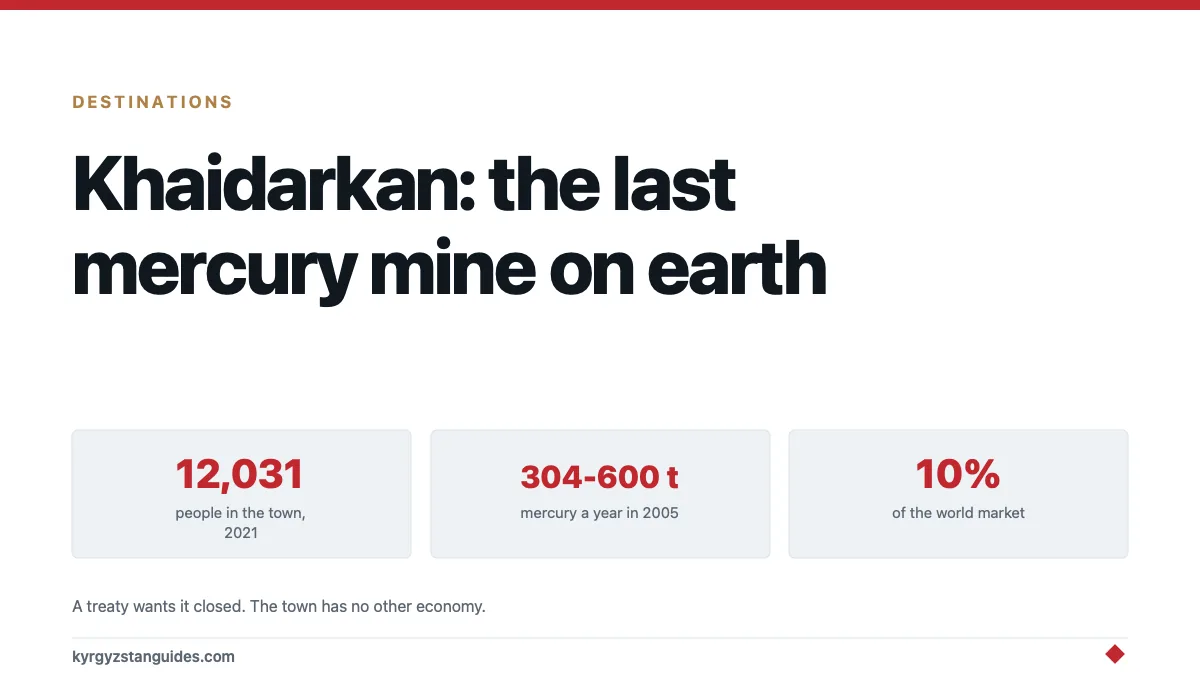
At its peak, this wasn't a marginal operation. In 2005 the Aydarken Mercury Plant produced somewhere between 304 and 600 tonnes of mercury a year, making it the third-largest primary mercury producer in the world that year, and supplying on the order of 10% of the global mercury market.
Primary mercury mining means mining rock specifically to extract mercury, as opposed to recovering mercury as a by-product of other processing, or recycling it from old products. It's the least preferred source of mercury by a wide margin, because it puts new mercury into circulation that was previously locked in rock.
The town's population has grown, not shrunk — 9,148 in 1999, 12,031 by 2021: which is the first clue that closing the mine is a harder problem than it sounds.
Why the world wants it closed
Mercury is a potent neurotoxin. It doesn't degrade. Released into air or water it travels globally, converts to methylmercury in aquatic systems, and accumulates up the food chain — which is why the seafood advisories in countries thousands of kilometres from any mercury mine exist.
The Minamata Convention on Mercury, named after the Japanese city where industrial mercury poisoning killed and disabled thousands from the 1950s onward, contains provisions to eliminate primary mercury mining. Getting Khaidarkan to stop was identified as a priority before the Convention was even finalised.
UNEP's report on Khaidarkan mercury lays out the case and the options, and a dedicated Kyrgyz Primary Mercury Mine Project has worked on the transition for years.
Why it hasn't simply closed
Because a mine is not just a mine here. It is the town.
Khaidarkan was built as a single-industry Soviet settlement. Housing, schools, clinic, heating, employment, all attached to one enterprise. That model produced dozens of towns across the USSR and left every one of them with the same problem after 1991: no alternative economy, and no easy way to build one at 2,000 metres in a landlocked country.
Tell 12,000 people the thing their town is for is being abolished by an international treaty, and offer no replacement, and you have a political problem rather than an environmental solution. Every serious proposal for Khaidarkan has therefore been a conversion proposal. Antimony, other minerals, something that keeps the plant and the payroll while ending mercury production.
Progress has been slow and uneven. RFE/RL's reporting from inside the mine described an operation producing a fraction of its former output, with shafts that were flooded and out of service from 2009 to 2019.
That is the current reality: not a clean closure, not a functioning phase-out, but a diminished operation in a town still waiting for the thing that comes next.
The mineral named after the town
A small footnote that says something about how unusual this rock is.
Khaidarkan is the type locality for several minerals, the place where they were first identified and described. One of them is called khaidarkanite, named after the deposit. The site also yields getchellite and a set of rare mercury and arsenic arsenates that turn up in very few other places on earth.
Type localities are how mineralogy records geography. There is a version of this town's significance that has nothing to do with industry or treaties: a geological formation unusual enough that the international naming system for minerals carries its name permanently, whatever happens to the mine.
The health picture
Honest answer: incompletely documented, and that is itself part of the story.
Mercury exposure in a mining and smelting town comes through several routes — occupational exposure to vapour during roasting, contaminated dust, tailings, and local food and water. Concerns about all of these have been raised repeatedly in the international assessments. Systematic long-term health surveillance of the population isn't something this town has had.
Nobody should read that as reassurance. Absence of a study is not absence of harm, and the international attention this place has received exists precisely because the risks aren't in doubt.
What a traveller should do with this
Not visit, first of all. It's a working industrial site with a security perimeter, and there's nothing to see that justifies showing up.
What it's useful for is context.
Batken is the most overlooked region in Kyrgyzstan, best known outside the country for border complications with the Tajik enclaves and inside it for apricots. It's also the region that carries the industrial residue of a system that put heavy plants wherever the ore happened to be, without much thought about what would happen to the people afterwards.
The same pattern runs the length of this country. It produced Kumtor's glacier damage in the east and the uranium legacy at Mailuu-Suu in the south. Khaidarkan is the extreme case, because it's the one where the substance being mined is banned by a global treaty, and the town still needs it.
That is worth knowing when somebody tells you Kyrgyzstan is untouched.
FAQ
Where is the Khaidarkan mercury mine?
In Batken region, southern Kyrgyzstan, at roughly 2,000 m on the northern slopes of the Alay range. The town is called Aydarken on most current maps.
Is Khaidarkan the world's last mercury mine?
It's the last primary mercury mine known to export mercury to the global market. Mercury is still recovered elsewhere as a by-product and from recycling, but mining rock specifically for mercury has essentially ended everywhere else.
How much mercury did Khaidarkan produce?
In 2005 it produced between 304 and 600 tonnes a year, around 10% of world supply, making it the third-largest primary producer that year. Output today is a small fraction of that.
Why is primary mercury mining banned?
Mercury is a persistent neurotoxin that accumulates in food chains. The Minamata Convention targets primary mining because it introduces new mercury into global circulation rather than managing what already exists.
Why hasn't the mine been closed?
Khaidarkan is a single-industry town of about 12,000 people with no alternative local economy. Closure without a replacement industry would be economically devastating, so international efforts have focused on converting the operation rather than shutting it.
Can you visit Khaidarkan?
No, not meaningfully. It's a working industrial facility with restricted access, and there's no visitor provision.
Further west again is Sulukta, a coal town mining 600 metres beneath its own houses, with a narrow-gauge railway running into Tajikistan.