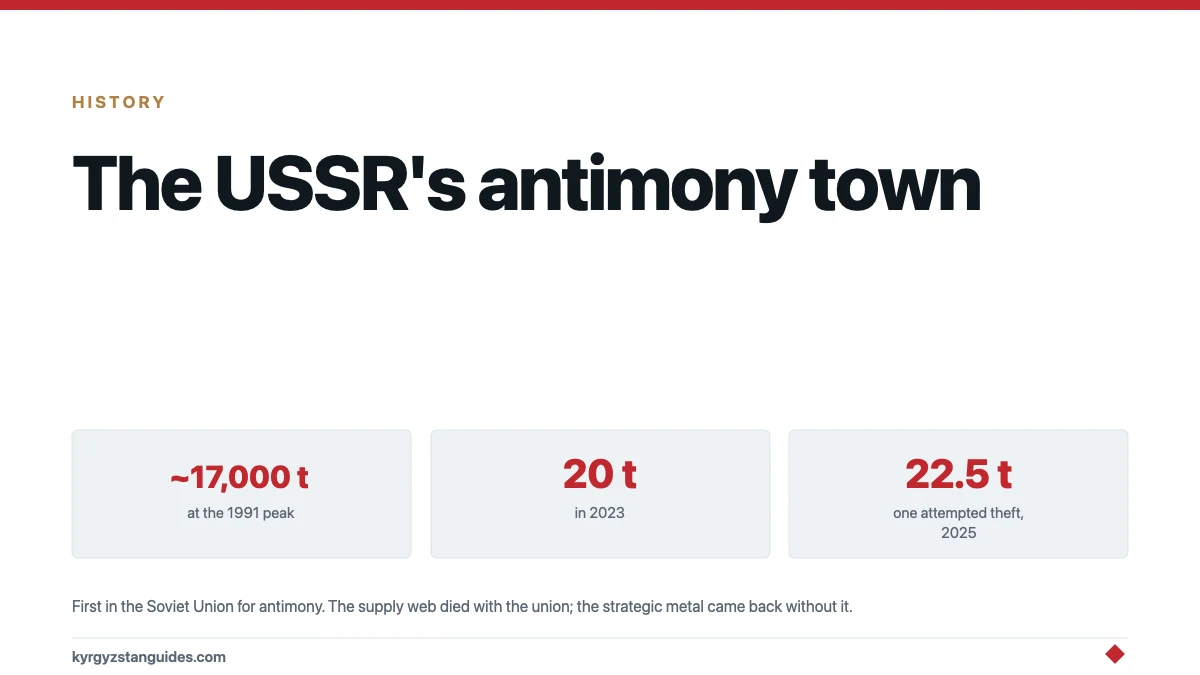
For half a century, if a Soviet product contained antimony — flame retardant, battery alloy, ammunition primer — the odds were it passed through one town in Kyrgyzstan's Batken region. Kyrgyz accounts rank the Kadamjay combine first in the USSR for antimony, putting its peak at around 17,000 tonnes a year — roughly a tenth of world output — reached in 1991, the last year the country it supplied existed.
What happened since is a long fall with a strange 2022 twist, and the whole story sits in sources nobody assembles: US Geological Survey yearbooks, bankruptcy rulings, and Kyrgyz business press. Antimony has meanwhile become one of the minerals Western governments lose sleep over, which makes the state of its old Soviet capital more than local history.
What the combine was
The plant went into operation in 1936, working a deposit dug since 1934, and grew into the union's antimony centre. The design figures in the USGS record describe capacity above 18,000 tonnes a year across metal and compounds — fourteen distinct products — fed by two mines, Kadamjay itself and Tereksay.
The detail that explains everything afterwards: the smelter's appetite outgrew its own mines decades ago. Concentrate came in from Yakutia in Russia, from Kazakhstan, and from Tajikistan — Khaidarkan's output moved through here too, the mercury–antimony twin towns of the Fergana rim working as one system. Our post on Khaidarkan covers the mercury half. A smelter dependent on four countries' feedstock was an asset precisely as long as those countries were one country.
What the plant actually made
“Antimony producer” flattens what was really a chemical works. The combine's fourteen products split into two families: metallic antimony — the 8,000–8,500-tonne line, sold as regulus for alloying into battery plates, bearings and shot — and about 10,000 tonnes of compounds, above all antimony trioxide, the white powder that makes plastics, textiles and cable sheathing resist fire. The trioxide is where antimony quietly touches ordinary life: a Soviet television casing or aircraft interior that refused to burn owed it to Batken.
The site also ran a mercury furnace fed with Tajik concentrate — a reminder that Kadamjay and Khaidarkan were less two plants than one metallurgical district spread along the Fergana rim, swapping intermediate products across what were then internal borders. Every one of those border crossings became an international customs post in 1991, which is the quiet second reason the system died: the chemistry still worked, the geography suddenly did not.
Recent reporting notes the mothballed site undergoing ecological modernisation — housekeeping for a plant whose second act, if it comes, will be audited by buyers the Soviet version never had to please.
The fall, in dated steps
| Year | What the record shows |
|---|---|
| 1991 | Peak output around 17,000 t — first in the USSR, by Kyrgyz accounts |
| 1997–2000 | Privatisation attempt; ore mining falls from 108,000 t to 42,000 t |
| ~2013–14 | Production effectively stops — drained workings, 7 per cent of plan in 2014 |
| 2017 | USGS records no antimony produced; halt attributed to lack of raw materials and finance |
| 16 June 2020 | Supreme Court declares the combine bankrupt, with 542 million som owed |
A date of 2 December 2013 circulates for the final stop; I could not verify it, and the sources support only "around 2013–14". The pattern needs no precision to be legible: the feedstock network died with the USSR, a decade of decline, a decade of standstill, then the courts.
The 2022 restart, described carefully
In 2022 production resumed — modestly — under a joint venture the USGS yearbook records as Duvastash Co. Ltd.: 60 per cent held by a Turkish company, 40 per cent by the Kyrgyz government. Output in 2023: about 20 tonnes, enough to put Kyrgyzstan fourteenth in the world, which says as much about how concentrated the antimony world is as about Kadamjay.
Twenty tonnes against a 17,000-tonne memory is not a revival; it is a pilot light. And the Kyrgyz reporting around it counsels against optimism: the investor had not delivered the promised $50 million by 2023, and in 2025 police stopped a theft of more than 22.5 tonnes of antimony concentrate from the site — a single attempted theft larger than the year's entire legal production.
Why anyone outside Batken should care now
Because antimony changed category. It hardens lead for batteries and ammunition, makes plastics fire-resistant, and sits in semiconductor chemistry — and its supply is dominated by China, with Russia and Tajikistan next. Western critical-minerals lists all carry it, and when China restricted antimony exports in 2024, prices moved the way strategic prices move.
Kyrgyzstan, meanwhile, sits on reserves put at about 270,000 tonnes of contained antimony in 16 million tonnes of ore, plus a mothballed smelter town with the only deep institutional memory of the metal between China and Europe. That is why Kyrgyz press reports multiple countries circling the bankrupt combine, and why a Russian company's support for a restart was being reported in 2026. Whether anything comes of it, the asset's meaning has flipped: what died as a Soviet redundancy is being revalued as a Western shortage.
The town itself
Kadamjay the place is a Fergana-rim industrial town of the recognisable type — the combine, the housing it built, apricot country around it, Batken region's border complications over the hills. It is not set up for visitors and sees essentially none; the traveller's version of this story is the view from the Osh–Batken road, where the south's industrial archaeology — mercury, antimony, tobacco sheds — passes the window unlabelled.
If the restart ever becomes real, Kadamjay would be worth a detour as the last working piece of the Fergana rim's metallurgical century. For now it is the clearest single monument to what the end of the USSR did to single-industry towns: the ore was still there, the skills were still there, and the country the plant was built to supply was not.
What I could not establish
The exact final-stop date, as above. Whether the Russian-backed restart reported in 2026 has produced anything — reporting describes support for a resumption from March 2026, with no output figures since. Current employment at the site, which no source gives. And the fate of the fourteen-product compounds line: whether the 2022 restart smelts metal only or has revived any chemistry, the USGS entries do not say.
FAQ
What was the Kadamjay antimony combine?
The Soviet Union's premier antimony producer, operating from 1936 in Kyrgyzstan's Batken region, with capacity above 18,000 tonnes a year across fourteen products and a peak Kyrgyz accounts put at about 17,000 tonnes in 1991 — roughly a tenth of world output at the time.
Why did Kadamjay collapse?
Its feedstock network was the USSR itself: concentrate came from Yakutia, Kazakhstan and Tajikistan as well as its own two mines. When the union ended, the supply web and the single market went with it. Ore mining fell from 108,000 tonnes in 1997 to 42,000 in 2000, production effectively stopped around 2013-14, and the Supreme Court declared the combine bankrupt on 16 June 2020 with 542 million som owed.
Is Kadamjay producing antimony again?
Barely, and describe it carefully: a 2022 restart under Duvastash Co. — 60 per cent Turkish, 40 per cent state — produced about 20 tonnes in 2023, enough for fourteenth place in the world. The promised $50 million investment had not arrived by 2023, and in 2025 police stopped a theft of 22.5 tonnes of concentrate, more than the year's legal output.
Why does antimony matter strategically?
It hardens lead for batteries and ammunition, fireproofs plastics and features in semiconductor chemistry, while supply is dominated by China with Russia and Tajikistan following. It sits on Western critical-minerals lists, and China's 2024 export restrictions sharpened the point.
How much antimony does Kyrgyzstan have left?
Reserves are put at about 270,000 tonnes of contained antimony in 16 million tonnes of ore — one reason Kyrgyz press describes several countries showing interest in the bankrupt combine, and a Russian-backed restart effort being reported in 2026.
Can you visit Kadamjay?
There is nothing arranged to visit — it is a working-age industrial town without tourism, in a border region with its own access considerations. The realistic encounter is from the Osh-Batken road, where the Fergana rim's industrial past passes by unlabelled.
Where did Kadamjay's concentrate come from?
From its own Kadamjay and Tereksay mines, and — the larger share as the decades passed — from Yakutia in Russia, from Kazakhstan, and from Tajikistan, with Khaidarkan's antimony moving through the same system. The dependence on a four-country supply web is precisely what made the plant unviable alone.