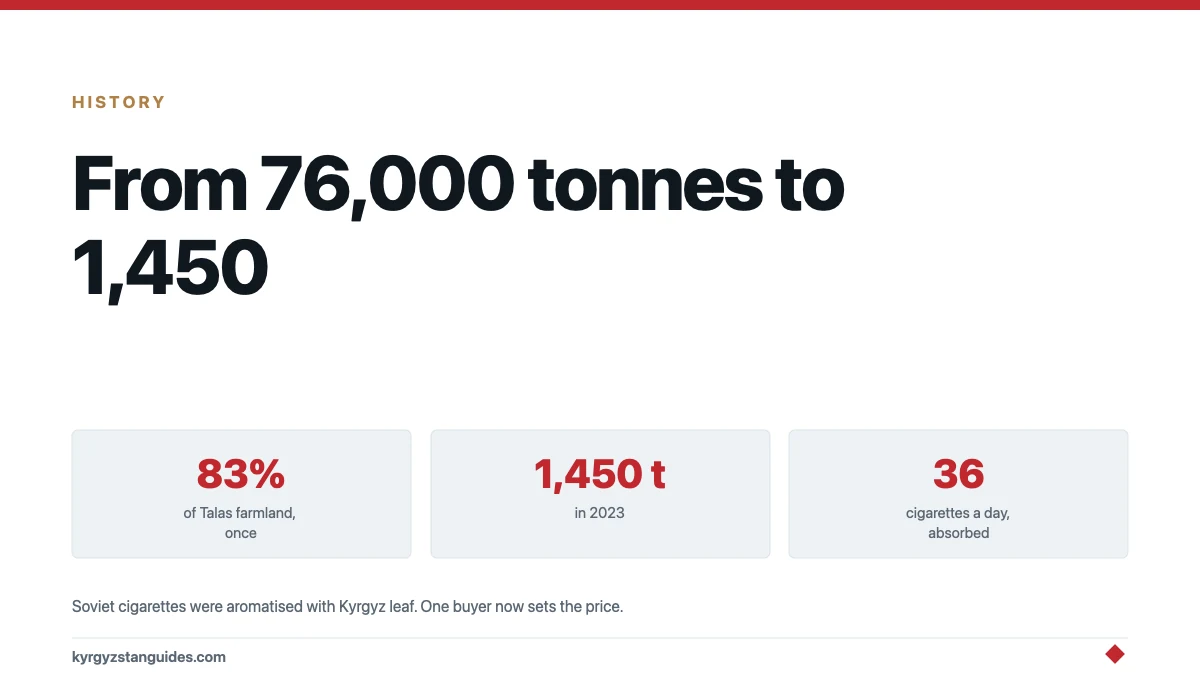
In 2023 Kyrgyzstan officially produced 1,450 tonnes of tobacco on 521 hectares. At the Soviet peak it produced somewhere between 70,000 and 76,000 tonnes a year. That is a fall of more than 98 per cent, and it happened inside one working lifetime.
Kyrgyz tobacco was not filler. It was Oriental aromatic leaf of the Dubek type, used specifically for natural aromatisation in Soviet cigarette manufacturing — the good stuff, grown in the Talas valley and the Osh region, processed in four fermentation plants inside the republic.
This post is about what happened to that, and about cotton, the other southern cash crop, which survived rather better but is running into a water problem. It is a decline story in both cases, and I would rather say that at the top than build to it.
What the Soviet system had here
The industry began in 1931 with the first tobacco sovkhoz, called "Kyrgyziya". It grew into something enormous relative to the size of the republic: by the late 1980s tobacco occupied 83 per cent of cultivated land on farms in the Talas valley and the Osh region.
The processing was here too. The Kyzylkiya fermentation plant, built in 1963, handled over 6,000 tonnes of raw leaf a year on its own, and it was one of four.
The growing districts were Nookat and Uzgen in Osh region, and they still are — at a fraction of the scale.
The collapse, in three numbers
| Year | Production |
|---|---|
| Soviet peak | 70,000–76,000 tonnes (sources differ) |
| 2010 | 9,000 tonnes from 3,600 ha |
| 2011 | over 10,000 tonnes from ~4,000 ha |
| 2023 | 1,450 tonnes from 521 ha |
By 2012 the two remaining tobacco factories were running at 30 per cent capacity, producing about a billion cigarettes against an expected three billion.
The first cause is the obvious one: the Soviet market and its guaranteed procurement vanished, exactly as it did for wool and for the collective farm system generally.
The second cause is more specific and more interesting. Since the 2000s a single foreign buyer, the German firm Reemtsma-Kyrgyzstan, became effectively the monopoly purchaser of Kyrgyz tobacco leaf. Farmers say the prices it pays are what drove them off the crop. An agricultural expert quoted in Kyrgyz media, Ulan Adamaliev, expects continued decline over the next ten to twenty years, naming monopoly pricing, brutal manual labour and global anti-tobacco campaigns.
A crop with one buyer is not a market. It is a price the buyer names.
What the work does to people
This deserves stating plainly because tobacco is not a neutral crop to grow.
An ILO figure cited in reporting on the sector says more than 40 per cent of Kyrgyzstan's population lives in tobacco-growing areas and is engaged in tobacco production in some form. A Human Rights Watch investigation found that workers handling wet tobacco leaves absorb nicotine through the skin equivalent to smoking 36 cigarettes a day — green tobacco sickness — with children especially vulnerable.
The money against that: a typical farming household earned roughly 40,000 som a year, about $1,000, in labour wages, with raw leaf selling around 100 som (about $2) a kilogram in 2012, on a typical family harvest of about twenty bales of twenty kilograms.
Whatever you think about tobacco as a product, that exchange — a year of hand labour, nicotine absorbed through the skin, $1,000 — explains the abandonment of the crop better than any commodity chart.
The revival attempt
The government is trying, through a support programme branded "30+20+10", and the export figures are moving from a very low base:
In 2024 Kyrgyzstan exported 99.2 tonnes of tobacco to Greece, 60.3 tonnes to Vietnam, and 477 tonnes of tobacco waste to Russia. In the first nine months of 2025 it was 288 tonnes to Greece, 187 tonnes of waste to Russia, and 18 tonnes to Kazakhstan. Total tobacco-product output for January to September 2025 was valued at 25.68 million som.
Twenty-five million som is about $290,000. For an entire national industry, over nine months. That is the scale we are dealing with now.
Cotton, which is doing better
Cotton grows in the three southern regions — Osh, Jalal-Abad and Batken — which together account for roughly 80 per cent of national production. In the 2025 spring season the split ran Osh 49 per cent, Jalal-Abad 34 per cent, Batken 16 per cent.
Cotton and wool are close to the only agricultural products Kyrgyzstan exports in meaningful volume, and both mostly leave unprocessed, going to China and Kazakhstan as raw fibre. Kyrgyz cotton yarn does appear among the country's exports, so some value is added domestically, but the pattern is familiar: the country's own garment industry runs largely on imported Chinese fabric rather than on domestic cotton, because local fabric quality has not kept up.
The organic cotton experiment
The one genuinely interesting thing in Kyrgyz cotton is a Swiss project that has now been running for over twenty years.
Helvetas, funded by the Swiss development agency and the World Bank, launched an organic cotton conversion programme in Jalal-Abad in 2003, aiming to convert about 300 farmers to an expected 400 tonnes a year of organic cotton, taught through farmer field schools covering composting and crop rotation. European organic certification required at least three years of conversion.
The honest part is the economics. The Swiss trading firm Paul Reinhart was the initial buyer and described the trade openly as loss-making, continuing it for environmental and farmer-welfare reasons. Migros and Switcher declined and sourced their organic cotton from Africa instead. Since 2005 nearly all the certified organic cotton has gone to the German company Cotonea.
So: a real, long-running, certified organic supply chain, kept alive by buyers who are not making money on it. That is a more useful thing to know than a press release about sustainable cotton.
The water constraint
Cotton in the south is grown in the Fergana valley irrigation system, shared between Kyrgyzstan, Tajikistan and Uzbekistan. Measured field-application efficiency there has been as low as 49 per cent — half the water applied does not reach the crop.
Water scarcity is already forcing farmers across all three countries to cut irrigation and drop water-hungry crops, and Helvetas now runs a separate Fergana Valley irrigation partnerships project aimed at more efficient technology in water-constrained southern Kyrgyzstan. Our post on Kyrgyz farmland covers the canal network's condition, and Toktogul covers who upstream controls the water.
Cotton is a thirsty crop in a basin that is running short. That is the constraint that will decide its future, not the price.
What you actually see
Travel the Osh to Batken road in autumn and you will pass garlands of tobacco leaves hung to dry on rooftops and fences, particularly in the villages of Nookat district. It is one of the more distinctive sights in southern Kyrgyzstan and almost nobody photographing it knows they are looking at the remnant of a 76,000-tonne industry.
Cotton fields are in the same southern regions, harvested in autumn. Both crops belong to the Fergana fringe rather than to the mountains most visitors come for, which is part of why they go unnoticed.
FAQ
How much tobacco does Kyrgyzstan produce now?
About 1,450 tonnes on 521 hectares as of 2023, against a Soviet-era peak of 70,000 to 76,000 tonnes a year. That is a decline of more than 98 per cent, and total tobacco-product output for January to September 2025 was valued at just 25.68 million som.
Why did the Kyrgyz tobacco industry collapse?
Two reasons. The Soviet market and its guaranteed procurement disappeared after 1991, and since the 2000s a single foreign buyer, Reemtsma-Kyrgyzstan, has been effectively the only purchaser of Kyrgyz leaf. Farmers attribute the abandonment of the crop to the prices that monopoly pays.
Is growing tobacco dangerous?
Workers handling wet tobacco leaves absorb nicotine through the skin equivalent to smoking 36 cigarettes a day, a condition known as green tobacco sickness, with children particularly vulnerable according to Human Rights Watch. A typical farming household earned around 40,000 som a year, about $1,000, from the work.
Where is cotton grown in Kyrgyzstan?
In the three southern regions — Osh, Jalal-Abad and Batken — which together account for roughly 80 per cent of national production. In the 2025 spring season Osh accounted for 49 per cent, Jalal-Abad 34 per cent and Batken 16 per cent.
Does Kyrgyzstan produce organic cotton?
Yes. Helvetas launched a conversion programme in Jalal-Abad in 2003 with Swiss and World Bank funding, targeting about 300 farmers and 400 tonnes a year. The trade has been described by its own initial buyer, Paul Reinhart, as loss-making and continued for environmental reasons; since 2005 nearly all of it has gone to the German firm Cotonea.
Does Kyrgyzstan's clothing industry use Kyrgyz cotton?
Mostly not. Cotton and wool leave the country largely unprocessed for China and Kazakhstan, while the garment workshops around Bishkek run on imported Chinese fabric because domestic fabric quality has not kept pace. Kyrgyz cotton yarn does appear among exports, so some processing happens.
Can I see tobacco or cotton growing in Kyrgyzstan?
Yes, in the south in autumn. Garlands of tobacco leaves hang drying on rooftops and fences along the Osh to Batken road, especially in Nookat district, and cotton fields are in the same southern regions. Neither is anywhere near the mountain areas most visitors travel for.