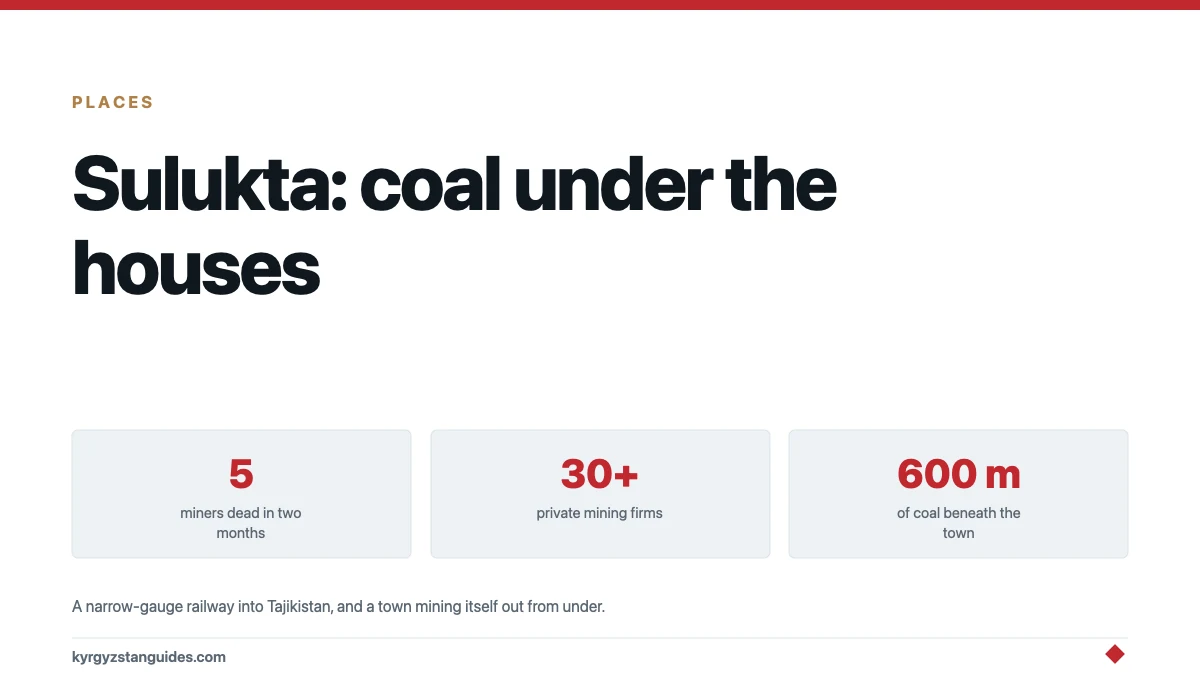
Five miners died in Sulukta in two months. Two from gas poisoning, three in cave-ins. Four of the five were young men.
That was reported in June 2026, and it is the most honest single fact about the place. Sulukta is a coal town in the far western salient of Batken oblast, surrounded on three sides by Tajikistan, and coal is not a heritage industry here. It is what is happening right now, at a cost.
Where it is, and why nobody goes
Sulukta sits in the northern spurs of the Turkestan range, in the Leylek salient — the thin western arm of Kyrgyzstan that pushes into Tajikistan. It is one of the most isolated inhabited places in the country.
Population is 25,500 at the start of 2025, up from about 18,300 in 2010. That is roughly 38 per cent growth in fifteen years, which is not what the town's reputation would lead you to expect.
We are not going to give you an altitude or a road distance from Batken. The figures in circulation — around 1,380 metres, about 150 kilometres — come from sources this site does not use, and we could not confirm them from anything official.
The coal
Industrial mining started either in 1868 or around 1900, depending which account you take; state enterprises took over in 1918. City status came in 1938 or 1940 — also unresolved, and both dates appear in reputable local history.
The deposit has eleven coal seams with reserves put at about 191.4 million tonnes as of 2008.
The archaeology goes much further back. Ancient workings survive as caves in the area, including Kan-i-Gut — the "mine of perdition" — worked in the Davan period, two thousand years ago. If you are going to Sulukta for something other than the present day, that is what you are going for.
What is happening now
More than thirty private coal-mining companies operate in the town, according to the head of the local underground mining association. An earlier count gave around twenty. The number is rising.
The problems, as raised by residents and reported in June 2026:
Many mines have no gas-monitoring equipment. Safety requirements are not adequately enforced. Officials promised comprehensive inspections and the suspension of mines lacking required gear.
The mining is undercutting the town. Companies compensate households whose houses sit directly over the workings but not their neighbours, which is the main source of local disputes. And the town cannot simply expand away from the problem: coal lies more than 600 metres beneath the 558 hectares allocated for development. The town is sitting on the resource.
Heavy trucks are destroying the roads. Residents want the coal companies' bases moved outside the city and an alternative haul road built. The cost is around one billion som and it needs Cabinet approval.
A deputy has alleged that a Chinese company is mining beneath residential houses in Sulukta. We could not establish whether that allegation was substantiated, and we are reporting it as an allegation.
Where the coal goes is its own story: Sulukta coal is being trucked to Afghanistan via Uzbekistan and Tajikistan in heavy goods vehicles, which is the direct cause of the road damage residents are complaining about.
Current production: the Sulukta-11 deposit has 560 metres of underground workings built and a 2026 plan of 80,000 tonnes. The Tegene deposit is put at 57 million tonnes.
The company town problem, stated plainly
It is worth setting out why Sulukta's situation is structurally hard rather than just badly managed, because the two get confused.
A coal town built on top of its own seam has no good options. Expanding the city limits does not help when the resource is underneath the existing houses. Moving the mining out of town does not help when the coal is where the town is. Closing the mines removes the only economy. And thirty-odd small private operators are far harder to regulate than one large state enterprise was, because each has thin margins, few staff, and no capacity to absorb the cost of gas monitoring.
That is the shape of it. The compensation disputes — one household paid because its house is directly over a working, the next-door neighbour not — are a symptom of the same thing: there is no clean line between the mine and the town.
The Soviet arrangement was not safer because it was kinder. It was one employer, with an inspectorate, a single haul route and housing built by the same body that dug the coal. What replaced it is more people mining more places with less oversight, which is why the fatality reporting reads the way it does.
We are not offering a solution. We are saying that if you read about Sulukta and conclude someone is simply being negligent, the geology is doing more of the work than the negligence is.
What the 1990s did
The other half of the story is the collapse.
After 1991 demand for Sulukta's coal fell away with the Soviet industrial customers that had taken it, and the town's infrastructure deteriorated severely. Market reform has since revived extraction, and the town now does cross-border trade with Tajikistan and Uzbekistan as well.
So the sequence is: a planned Soviet industrial settlement built for a mixed workforce of Kyrgyz, Tatars, Russians, Uzbeks and Tajiks after the 1924 creation of the Kara-Kyrgyz autonomous oblast, with housing, hospitals and schools; then thirty years of decline; then a privatised revival that has put the population back up by nearly forty per cent and put five men in the ground in two months.
Both halves of that are true at once, and a visitor who sees only the second half will misread the place.
The railway
Here is the thing that makes Sulukta genuinely remarkable rather than merely bleak.
The town is connected by a 47-kilometre narrow-gauge railway to Proletarsk station in Tajikistan — 38 kilometres of it on Kyrgyz territory and 9 on Tajik. The line dates from the opening of the Chernyayevo–Kokand railway in 1898.
Before it existed, coal went to the station by horse. In 1927 a cable ropeway opened connecting the mines to Koltso station.
Do not plan to ride it. Coal haulage on the line was reported temporarily suspended as of April 2000, and we found no source confirming it runs today. What remains is the infrastructure: the alignment, Koltso station, the ropeway route. For an industrial-archaeology traveller that is the draw.
There is also a border question hanging over it. Under the March 2025 treaty, Tajikistan received parcels in Leylek raion including land at Proletarsk — the railway's terminus. Whether the 38/9 kilometre split still holds, we do not know.
The border, and what changed in 2025
Sulukta's isolation is a border artefact, so the March 2025 settlement matters here.
On 13 March 2025 the presidents of Kyrgyzstan and Tajikistan signed the Treaty on the State Border, closing roughly 23 years of negotiation. Kyrgyzstan ratified it on 25 March.
In Leylek raion specifically, Kyrgyzstan received 155 hectares at Kairagach plus the 35-hectare Kairagach enclave; Tajikistan received about 90 hectares across Sada, Razakov, Selkan, Maity, Proletarsk, Ulak-Zhae and Ak-Aryk.
For the wider picture, including the 2022 fighting, see our Batken guide and Kyrgyzstan border crossings.
Getting there
There is no published fare to Sulukta in the transport ministry's official timetable.
The nearest listed service is Osh to Isfana, 500 som, departing 07:00, 09:00 and 16:00 from Osh bus station. Isfana is the Leylek district centre; you continue from there. Alternatively Osh to Batken is 307 som and you work west.
The single road is the Osh–Batken–Isfana highway, which has been progressively rebuilt specifically to keep it inside Kyrgyzstan — the Pulgon–Burgondu–Batken stage, 92 to 97 kilometres, exists to route traffic around the Uzbek Sokh enclave.
Should you go
Honestly: only if the industrial and border geography is the point.
There is no museum, no monument and no mosque we could confirm from any acceptable source, and we are not going to invent one. There is no municipal website. What there is: pit heads, coal trucks, a nineteenth-century narrow-gauge line running into another country, ancient mine caves in the hills, and a town of twenty-five thousand people living on top of a coal seam while private companies dig it out.
That is a real place and a serious one. It is not a day out.
FAQ
Where is Sulukta?
In the far western Leylek salient of Batken oblast, in the northern spurs of the Turkestan range, surrounded on three sides by Tajikistan. It is one of the most isolated towns in Kyrgyzstan, reached by the Osh–Batken–Isfana highway.
Why does Sulukta exist?
Coal. Industrial mining began in either 1868 or around 1900 and passed to state enterprises in 1918; the town received city status in 1938 or 1940. The deposit has eleven seams with reserves put at about 191.4 million tonnes as of 2008, and coal remains the entire basis of the local economy.
Is mining in Sulukta safe?
No. Five miners were killed in two months in 2026, two by gas poisoning and three in cave-ins, and reporting at the time found that many of the more than thirty private mining companies operating in the town had no gas-monitoring equipment and that safety rules were not adequately enforced.
Can I ride the Sulukta narrow-gauge railway?
Almost certainly not. The 47-kilometre line runs to Proletarsk in Tajikistan, with 38 kilometres on the Kyrgyz side, and coal haulage was reported suspended as of April 2000. No source confirms it operates today. The infrastructure survives and is the town's most remarkable feature.
How do I get to Sulukta?
There is no published fare or scheduled service to Sulukta itself. Take the Osh to Isfana bus, 500 som, departing 07:00, 09:00 or 16:00 from Osh bus station, and continue from the district centre; or reach Batken, 307 som from Osh, and work west.
How big is Sulukta?
About 25,500 people at the start of 2025, up from roughly 18,300 in 2010 — around 38 per cent growth in fifteen years, which runs against the expectation that a remote coal town must be emptying.