Kyrgyzstan's statehood has a precise administrative genealogy, and it is worth knowing before you stand in front of anything old here.
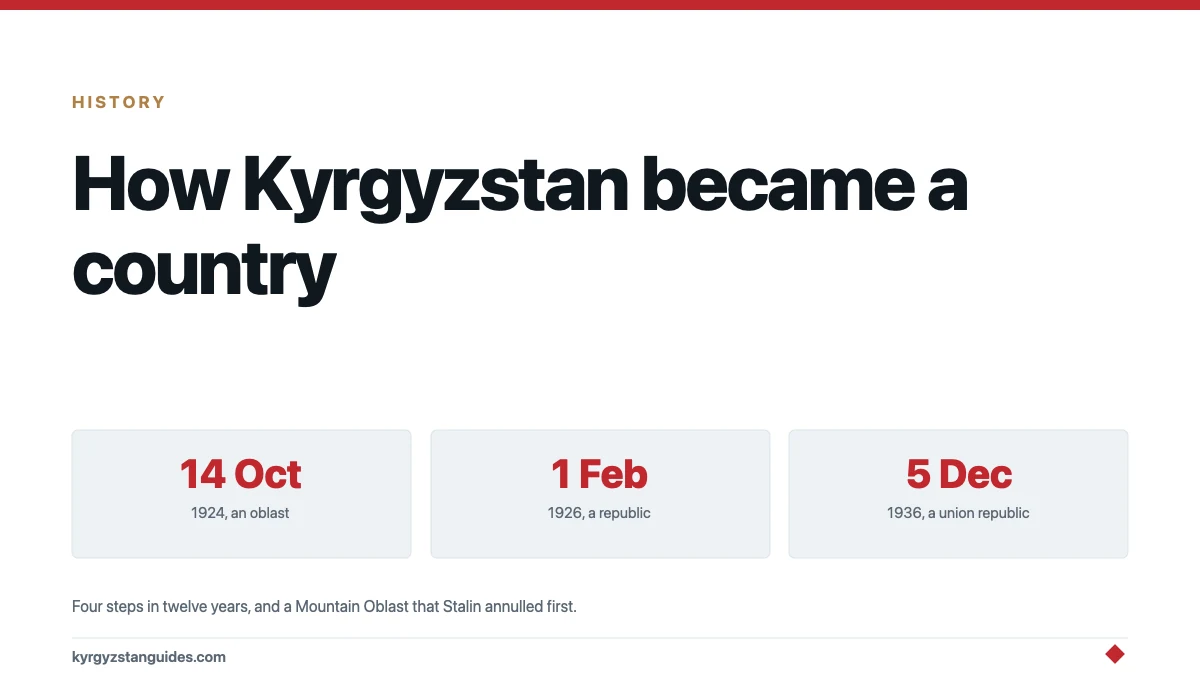
14 October 1924 — an autonomous oblast. 25 May 1925 — renamed. 1 February 1926 — an autonomous republic. 5 December 1936 — a union republic of the USSR.
Each step changed something specific. And there was an attempt before all of them that was annulled on Stalin's order.
The attempt that was cancelled
In March 1922 the Communist Party of Turkestan resolved to create a Mountain Kyrgyz Oblast inside the Turkestan ASSR. An organising committee formed in April under Abdykerim Sydykov.
On 4 June 1922 the founding congress met and declared the oblast established. The paperwork was annulled shortly afterwards, reportedly on Stalin's personal order.
By December 1922 the party's Central Committee had declared all the congress's documents illegal and charged the organisers with bourgeois nationalism and counter-revolution. Sydykov, Imanaly Aidarbekov and Ishenaaly Arabaev were reprimanded.
Sydykov was born in 1889 and died in 1938. The dates tell you what happened to most of that generation.
The 1924 delimitation
The borders of modern Central Asia were drawn in 1924, and not by anyone living inside them.
The sequence: a Turkestan congress took up the question in January; a delimitation conference met on 10 March; the Central Asian Bureau of the party issued its decree on 24 April; and the extraordinary session of the Turkestan Central Executive Committee, sitting in a Tashkent theatre in mid-September, passed the resolution. Sources give 15, 16 or 15–17 September — the session ran across those dates and accounts differ on which day the vote fell.
The actual line-drawing was done by a commission on national-state delimitation meeting in Tashkent. It carved up the Turkestan ASSR and the Bukharan and Khorezmian People's Republics into new national units.
What went into the Kyrgyz unit: nearly all of the Pishpek, Karakol and Naryn districts of Jetysuu; part of the Aulie-Ata district of Syr-Darya oblast; the Osh district and parts of the Andijan, Namangan and Kokand districts of Fergana oblast; and the Eastern Pamir region.
That last list is the origin of everything difficult about the southern border today. See Batken and Kyrgyzstan's border crossings.
Step 1: the Kara-Kyrgyz Autonomous Oblast, 14 October 1924
The All-Russian Central Executive Committee formed the Kara-Kyrgyz Autonomous Oblast within the RSFSR. The state archive holds the extract.
What it changed: the Kyrgyz could leave the Turkestan ASSR and have their own territorial-administrative unit inside Russia — with an executive, but not a republic and not a constitution.
At formation: 195,740 square kilometres, population 737,000 — Kyrgyz 63.5 per cent, Russians 16.8, Uzbeks 15.4.
Administrative centre: Pishpek.
The machinery moved fast. On 21 October the presidium confirmed the revolutionary committee's composition; on 1 November Izvestia published the formation decree; on 12 November the committee held its first plenary session. The first oblast party conference met in Pishpek on 23 March 1925, and on 29 April 1925 state business was required to be conducted in Kyrgyz.
Step 2: dropping "Kara", 25 May 1925
A decree renamed it the Kyrgyz Autonomous Oblast.
What it changed: nothing but the name — and the name mattered. In Russian imperial usage "Kirgiz" had meant the Kazakhs, and "Kara-Kirgiz", literally "Black Kyrgyz", the Kyrgyz proper. Dropping the prefix was a terminological correction, not a change of status or borders.
Step 3: the Kyrgyz ASSR, 1 February 1926
The oblast became an Autonomous Soviet Socialist Republic within the RSFSR, with Pishpek as its capital.
What it changed: an ASSR had its own Council of People's Commissars, its own Central Executive Committee, its own congress of soviets, and in time its own constitution — rather than an oblast executive committee answering upward.
The founding congress of soviets met in March 1927. A constitution followed in 1929.
Three months after this step, on 12 May 1926, Pishpek was renamed Frunze. See Bishkek's renaming history.
Step 4: the Kyrgyz SSR, 5 December 1936
The new Constitution of the USSR, adopted by the extraordinary eighth All-Union Congress of Soviets, lifted the Kyrgyz ASSR out of the RSFSR and made it a union republic — the Kirghiz Soviet Socialist Republic, a direct constituent of the Soviet Union.
What it changed: formal sovereignty within the Union, direct rather than Russia-mediated subordination, representation in the Soviet of Nationalities, a nominal right of secession, and its own Supreme Soviet.
The republic's own constitution followed at an extraordinary congress of 291 delegates in Frunze, adopted on 23 March 1937. It stood for over forty years, until 1978.
Fifty-five years after that, the same republic became independent.
What the Kyrgyz gained and lost at each step
A blunter reading, since the administrative language hides it.
1924 gave them a name on a map. Before that there was no Kyrgyz territorial unit of any kind — the Kyrgyz were a population spread across districts of Turkestan and Jetysuu. An autonomous oblast is a thin thing constitutionally, but it established that there was a place called Kyrgyz somewhere, with a border and an executive.
1925 gave them the right word. Trivial-sounding and not. A people who had spent a century being called by another people's name in official documents got their own back.
1926 gave them institutions. A government, a legislature, and the beginnings of a bureaucracy staffed locally. That is when the state apparatus that still runs the country was built.
1936 gave them standing. A union republic was, on paper, a nation-state in a federation. The paper was mostly fiction while the Union held — but it was the paper that became real in 1991, because independence came to exactly the units the 1936 constitution had created, with exactly the borders drawn in 1924.
What was lost runs alongside. The 1922 attempt was annulled and its organisers denounced. Abdykerim Sydykov, who chaired the first organising committee, died in 1938. The generation that argued for Kyrgyz autonomy before Moscow was ready for it did not survive to see the republic.
Why this matters on the ground
Because almost everything old you will see here belongs to one of those layers, and they look similar until you know the sequence.
A 1920s building in Bishkek belongs to an oblast capital. A 1930s one belongs to a republic capital. The monumental 1970s and 1980s work belongs to a union republic with a budget — see the Soviet architecture walk.
And the borders you cross in the south were drawn by a commission in Tashkent in 1924, which is why they run through villages.
A note on the sources
We could not read a single one of the founding decrees. The government's legal database refused access throughout, so what is above rests on the state archive's catalogue of documents, the Bishkek mayoralty's history page and the Kyrgyz Encyclopedia — all of which agree on the four dates.
Decree numbers are missing for all four steps, and we are not going to supply plausible-looking ones. The best single source for closing that gap is a scanned 1924–1945 administrative-division volume held by the state archive, which has no text layer and would need optical character recognition.
FAQ
When was the Kyrgyz SSR formed?
On 5 December 1936, when the new Soviet constitution made the Kyrgyz ASSR a union republic in its own right. That was the last of four steps beginning with the Kara-Kyrgyz Autonomous Oblast on 14 October 1924.
What was the Kara-Kyrgyz Autonomous Oblast?
The first Kyrgyz territorial unit, created within the Russian Federation on 14 October 1924, covering 195,740 square kilometres with a population of 737,000 — 63.5 per cent Kyrgyz, 16.8 per cent Russian, 15.4 per cent Uzbek. Its centre was Pishpek.
Why was "Kara" dropped from the name?
Because it was a correction of imperial terminology. In Russian usage "Kirgiz" had meant the Kazakhs and "Kara-Kirgiz" the Kyrgyz. A decree of 25 May 1925 dropped the prefix, changing the name but not the status or the borders.
Who drew Central Asia's borders?
A commission on national-state delimitation sitting in Tashkent in 1924, working from party decisions taken earlier that year. It carved the Turkestan ASSR and the Bukharan and Khorezmian republics into new national units, which is why some borders run through villages rather than between them.
What was the Mountain Kyrgyz Oblast?
An earlier attempt at Kyrgyz autonomy, declared at a founding congress on 4 June 1922. The paperwork was annulled shortly afterwards, reportedly on Stalin's personal order, and by December 1922 its organisers had been charged with bourgeois nationalism.
What is the difference between an autonomous oblast, an ASSR and an SSR?
An autonomous oblast had an executive but no republican institutions. An ASSR had its own government, central executive committee and eventually a constitution, but sat inside Russia. An SSR was a union republic — a direct constituent of the USSR with its own Supreme Soviet and a nominal right of secession.