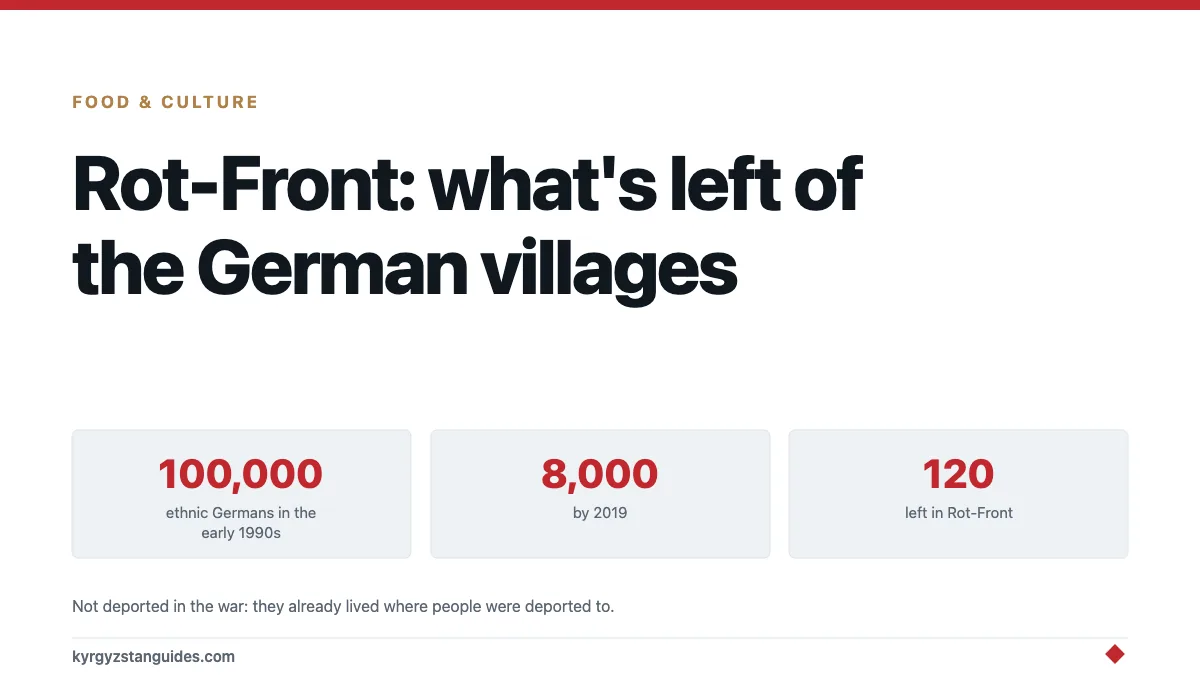
There is a village in the Chuy valley an hour from Bishkek where the older residents speak a Low German dialect that has been out of Germany for two centuries. It's called Rot-Front, it was founded as Bergtal in 1927, and around 120 people are left of a community that once filled it. Kyrgyzstan had roughly 100,000 ethnic Germans in the early 1990s. By 2019 the figure was closer to 8,000.
This is the fourth of the migrations that made northern Kyrgyzstan what it's, and the only one that has almost entirely left.
Who they were
Mennonites and Baptists, originally from East Frisia, who had moved east across Europe over generations to escape conscription — pacifism being the thing that kept putting them on the move.
They reached the Russian Empire, and when land pressure and military service caught up with them there too, some went further. German-speaking settlers arrived in Central Asia at the end of the nineteenth century looking for land, and found it in the Chuy valley: flat, watered, and by the standards of this country extraordinarily fertile.
Villages went up through the 1880s. Bergtal was founded in 1927 by families from those earlier settlements who had no land of their own, and Soviet authorities renamed it Rot-Front soon afterwards — a name it still carries, which is its own small joke about a pacifist Mennonite village.
The same Chuy valley farmland drew Russian and Ukrainian settlers in the same decades, for the same reason.
The war
Ethnic Germans across the Soviet Union were deported en masse after 1941 — the Volga German republic was dissolved and its population moved to Siberia and Kazakhstan.
The Kyrgyzstan Germans avoided that particular fate for a bleak reason: they were already living in a place people were deported to. There was nowhere further to send them.
What happened instead was the Trudarmee: the labour army. Men were conscripted into forced labour brigades, and a University of Tübingen research project on the village records that it cost many members of the community their lives. Published figures for the men taken from Bergtal vary, and the ones in circulation disagree with each other — what is not in dispute is that a large share of them did not come back. That is a village-scale catastrophe, and it happened to a community whose entire religious identity was built on refusing to fight.
The leaving
The exodus came with glasnost and then independence.
Germany's law of return offered citizenship to ethnic Germans from the former Soviet Union, and through the late 1980s and 1990s people took it, in numbers that emptied villages within a few years. From about 100,000 in Kyrgyzstan in the early 1990s to roughly 8,000 by 2019.
Rot-Front went from being almost entirely German Mennonite to having around 120 German residents left. Eurasianet has reported on what remains — an older population, a church still functioning, a dialect still spoken at home, and very few young people.
The pattern rhymes with the Russian departure our Russians in Kyrgyzstan guide covers, but it was faster and more complete, because there was a specific country actively offering to take them.
The language that outlived the country
The dialect is the part that stops people short.
What older Rot-Front residents speak at home is Plautdietsch — Mennonite Low German, a West Prussian variety carried out of northern Europe in the eighteenth century and preserved by communities that kept to themselves through Russia, Central Asia, and later Canada, Mexico and Paraguay.
It isn't modern German. A visitor from Berlin will catch some of it and miss plenty. What it is, is a language that has survived by moving. The same property that kept the community together also kept its speech in something close to its eighteenth-century form, while the German spoken in Germany carried on changing.
Researchers have followed those networks across continents; a University of Tübingen project traces the transnational links of Mennonites from Central Asia specifically.
The irony is not subtle. The families who went to Germany in the 1990s found that the language they had protected for two hundred years was not the one spoken there.
Visiting, and whether you should
Rot-Front is about an hour from Bishkek in the Chuy valley, and you can drive there. Whether you ought to is a fair question.
There is no museum, no visitor centre, no tour. It's a working village of ordinary houses where a small elderly community lives, and it isn't set up to receive anybody. Turning up to photograph the last German-speakers of Kyrgyzstan isn't a good look, and it isn't what the place is for.
If you go, go as you would to any village: quietly, briefly, buying something if there is something to buy, and not photographing people without asking. The church is the focal point of what community remains. The houses are recognisably not Kyrgyz — brick, steep-roofed, with gardens arranged the way a north European farmer arranges a garden.
Kant, a larger town in the same valley, also has German roots in its name and history and is easier to visit without imposing on anyone.
Why the story matters anyway
Because it finishes a picture.
This site now has guides to four communities who arrived in northern Kyrgyzstan within a few decades of each other and stayed for very different lengths of time: the Dungan who walked over the mountains from China in 1877 and are still here; the Russians who came with an empire and have mostly gone; the Koreans who were deported here in 1937 and stayed; and the Germans, who came for land and left when another country opened a door.
What determined who remained was rarely anything about the place itself. It was whether anywhere else would have them.
Our history for travellers sets out the sequence, and the nomadic culture guide covers the Kyrgyz side of the same century.
What's left in the landscape
More than you'd expect, if you know to look.
Brick farmhouses with pitched roofs in Chuy valley villages, quite unlike the flat-roofed clay construction further south. Orchards and fenced kitchen gardens laid out in rows. Occasional German surnames on shop signs and gravestones. A Baptist or Mennonite church in a town where you would not expect one.
None of it is signposted. It is simply there, the way the Soviet mosaics and the Orthodox churches are there, in a valley that has absorbed four or five different ideas about how a village should look.
FAQ
Are there still Germans in Kyrgyzstan?
Yes, but few. The ethnic German population fell from around 100,000 in the early 1990s to roughly 8,000 by 2019, after Germany's law of return made emigration possible. Rot-Front, the best-known German village, has around 120 German residents left.
What is Rot-Front?
A village in the Chuy valley about an hour from Bishkek, founded as Bergtal in 1927 by landless Mennonite and Baptist families from older German settlements, and renamed Rot-Front by Soviet authorities. It was almost entirely German until the 1990s.
Why did Germans settle in Kyrgyzstan?
Mennonite and Baptist communities had moved east across Europe for generations to escape conscription. German-speaking settlers reached Central Asia at the end of the nineteenth century looking for farmland, and the Chuy valley had it.
Were Kyrgyzstan's Germans deported during the war?
Not in the way Volga Germans were. They already lived in a deportation destination. Instead, men were taken into the Trudarmee forced labour brigades, and more than a third of those conscripted from Bergtal died.
Can tourists visit Rot-Front?
You can drive there, but there's nothing set up for visitors — no museum, no tour, just a working village with a small elderly community. Go quietly if you go, and don't photograph people without asking.
Why did so many leave in the 1990s?
Germany offered citizenship to ethnic Germans from the former Soviet Union under its law of return. With the USSR collapsing and the economy with it, most took it, and villages emptied within a few years.