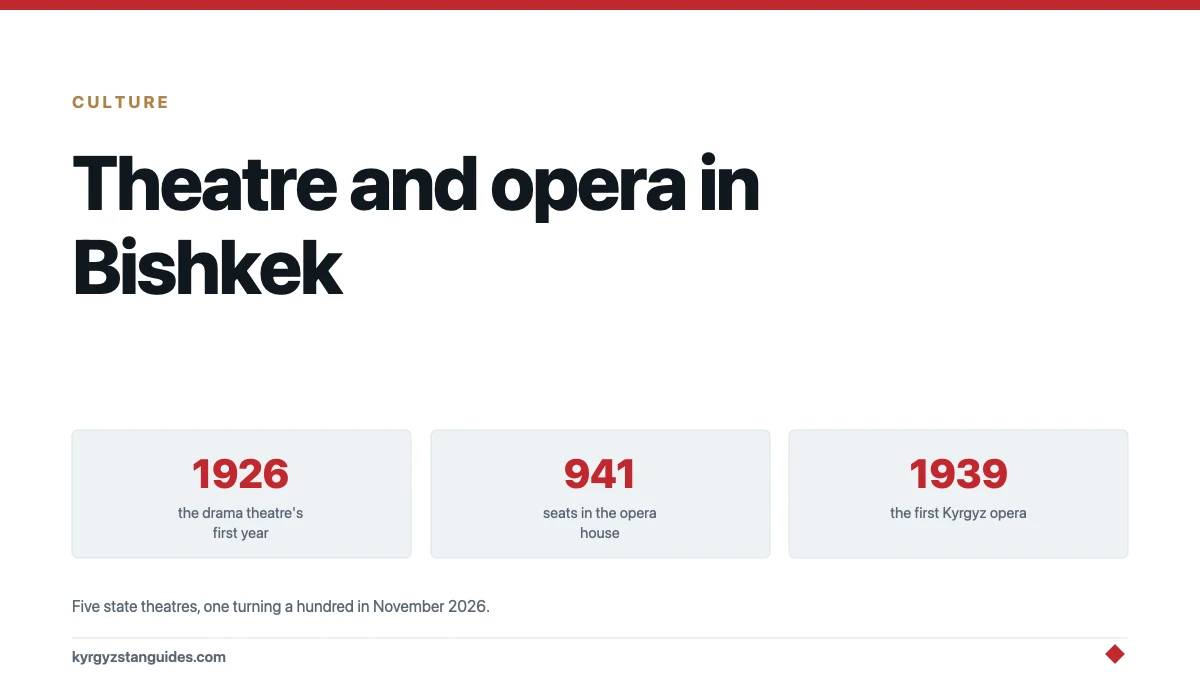
Ballet and opera at Bishkek's national opera house start at 300 som. That is the cheapest seat for Swan Lake, Don Quixote, Eugene Onegin or the Kyrgyz ballet Cholpon — checked on the national ticketing site on 23 September 2026.
Three hundred som is roughly what a bowl of soup costs. For that you get a live orchestra in a 1955 auditorium seating around 941. Almost no visitor does this, because the theatres here do not market to tourists and nothing is published in English.
The opera house
The Kyrgyz National Academic Opera and Ballet Theatre, named after Abdylas Maldybaev, is at Abdrakhmanov Street 167. The number listed by the ticketing operator is +996 312 62-16-19. It has no working website; tickets go through ticket.kg or the box office.
Its history runs through several institutions rather than one founding. A music-and-drama studio opened in Frunze in 1926. The Kyrgyz State Theatre was established on that base in 1930. In 1937 it opened as the Musical-Dramatic Theatre, and the first Kyrgyz musical drama, Altyn Kyz, "Golden Girl", premiered that year. It became the Opera and Ballet Theatre proper in 1942, was awarded the Order of Lenin in 1939 after the Kyrgyz Decade of Art and Literature in Moscow, and received academic status in 1959.
The building was begun before the war and finished in 1955, credited to the architect L. Laburenko with P. Ivanov, then chief architect of Frunze, participating. Performances run in Kyrgyz and Russian.
### What it actually costs
From the ticketing operator on 23 September 2026, cheapest-seat prices:
| Production | From |
|---|---|
| Ballet Cholpon | 300 som |
| Opera Eugene Onegin | 300 som |
| Ballet Swan Lake | 300 som |
| Ballet Don Quixote | 300 som |
| Ak-Möör | 300 som |
| Opera soloists' concert | 300 som |
| "Masterpieces of world classics" | 500 som |
| Michael Jackson brass tribute | 700 som |
| Neoclassical night | 800 som |
| Classical concert | 1,200 som |
| Visiting Swiss wind orchestra | 2,000 som |
The pattern is clear and useful: the house's own opera and ballet is 300 som, and anything hired into the hall costs more. If you want the thing you came for, book the 300-som nights.
These are cheapest-seat figures on one date. Confirm at the window.
The first Kyrgyz opera, and who wrote it
Aichürök — the name means moon-beauty — premiered on 12 April 1939 and was staged at the Bolshoi's branch theatre in Moscow the following month, where Pravda and Izvestia reviewed it. It was written by three people working together: V. A. Vlasov, A. M. Maldybaev and V. G. Fere.
That trio is the origin of Kyrgyz professional music. They also wrote the operas Patriots (1941), Manas (1946) and Toktogul (1958), and the music of the anthem of the Kirghiz SSR in 1946.
Other names worth knowing: M. Raukhverger, who wrote the opera Kökül (1942), the first Kyrgyz ballet-era work Cholpon (December 1944) and Jamila (1961) after Aitmatov's novella; and M. Abdraev, who wrote Young Hearts (1953) and Oljobay and Kishimjan (1965). The first Kyrgyz ballet, Anar, was by Vlasov and Fere in 1940.
Maldybaev himself was born in 1906 and died in 1978. He was a tenor and an actor as well as a composer, largely self-taught, formalising his training at the Moscow Conservatory's national department only in 1940–41 and 1947–50. He was made a People's Artist of the USSR in 1939. His portrait has been on the 1 som banknote since 11 April 1994, so you are probably carrying him.
The drama theatre that just turned one hundred
The Kyrgyz National Academic Drama Theatre, named after the playwright Toktobolot Abdumomunov, opened its 100th season on 22 September 2026 with Tölgö, on Manas's son Semetey, directed by N. Mendebairov with music by Murataly Begaliev.
Address: Abdumomunov Street 230, at the corner of Pushkin. Box office +996 312 66-40-85, open Tuesday and Wednesday 12:00 to 18:00, Thursday and Friday 12:00 to 19:00, and weekends 10:00 to 19:00. Closed Monday. The main stage seats 628 and opened in 1960; there is a 150-seat small stage. Tickets from 500 som.
A caution on its age. The theatre's own news pages celebrate a centenary in 2026, implying 1926, and independent sources give 1 or 2 November 1926. But the theatre's own "about" page says it dates itself from 6 November 1935. That page also contradicts the site's own news, describes Abdumomunov as an actor and director when he was Kyrgyzstan's first professional playwright, and uses a date that happens to be the Russian Drama Theatre's opening night. We think 1926 is right and the "about" page is filler, but we are not going to hide that the theatre publishes two answers.
The Russian Drama Theatre is the busiest stage in the city
Named after Chingiz Aitmatov, at Tynystanov Street 122, box office +996 312 66-20-32.
It was founded in 1935 and gave its first performance, a play called The Capital, on 6 November 1935. It took Krupskaya's name in 1939, received the Order of Friendship of Peoples in 1976, became academic in 1988, was granted national status by presidential decree on 2 August 2007, and took Aitmatov's name in 2008.
The building is older than any of that: it is the former Edison cinema, built in 1914, renamed Progress after the revolution. You will see it dated 1972 elsewhere; the theatre's own history says 1914, and we would take the theatre's word.
By volume of listings it runs more nights than anywhere else in Bishkek, and prices are the widest: Evenings on a Farm near Dikanka from 250 som, The Master and Margarita and Dead Souls from 500, a visiting production from 1,500, and some matinees free. If your Russian is decent, start here.
The other three
The Bishkek City Drama Theatre, named after Arsen Umuraliev, at Chuy Avenue 28. Established by a decision of the Frunze City Council on 10 April 1991 — its own site says 1991, secondary sources often say 1993 — by the People's Artist Arsen Umuraliev and the critic Aigul Umuralieva, explicitly as an alternative to the academic style of the state theatres. It took its co-founder's name in 2003. This is the one to try if you want something less formal.
The Youth and Children's Theatre, named after Baken Kydykeyeva, was created in 1929 under Otunchu Sarbagishev, closed in 1943 during the war and reconstituted in 1989.
The State Puppet Theatre opened on 23 September 1939, founded by Maria Volkova, with Victor Schwemberger arriving in 1945 as director and dramaturge. Around 400 productions have been made there. Post-Soviet puppet theatre is not only for children, and it is the one stage that works fully without language.
Practical notes
Finding the programme. There is no official English listings site. The national ticketing operator carries most of what is on, in Russian, and it is the only place we could see the whole month at once. The theatres' own social media is where changes appear first. The box office board still works and is often faster.
Book late, not early. Programmes fill in close to the date. A month out you may see almost nothing. Planning a trip around a specific performance will not work; plan the trip, then look.
Dress. Smarter than you would expect. Not formal, but people make an effort, and arriving in trekking clothes will mark you out.
Language. English surtitles are not standard anywhere. Opera carries because the repertoire is familiar; puppet theatre carries because it is visual; spoken drama does not, unless you have Russian or Kyrgyz.
The rooms themselves. These interiors belong to the exteriors in our Soviet architecture walk and most are unmodernised, which is part of the appeal.
One thing we could not settle: we found no confirmation that any theatre building sits on the state monuments register. Given that three standing, occupied Bishkek buildings were struck off that register as "lost" in July 2025, that is not an idle question.
FAQ
How much are opera and ballet tickets in Bishkek?
The cheapest seats for the opera house's own productions — Swan Lake, Don Quixote, Eugene Onegin, the Kyrgyz ballet Cholpon — were 300 som when checked on 23 September 2026. Concerts and productions hired into the same hall run from 500 to 2,000 som. Drama theatre tickets start around 250 to 500 som.
Where is the opera house in Bishkek?
The Kyrgyz National Academic Opera and Ballet Theatre named after Abdylas Maldybaev is at Abdrakhmanov Street 167. The listed number is +996 312 62-16-19. It has no working website, so tickets go through the national ticketing site or the box office.
What was the first Kyrgyz opera?
Aichürök, meaning moon-beauty, which premiered on 12 April 1939 and was staged at the Bolshoi's branch theatre in Moscow the following month. It was written jointly by V. A. Vlasov, A. M. Maldybaev and V. G. Fere, the three composers who also wrote the anthem of the Kirghiz SSR.
Is there theatre in Bishkek in English?
No. English surtitles are not standard at any state theatre. Opera works for a non-speaker because the repertoire is familiar, and the puppet theatre works visually. For spoken drama, the Russian Drama Theatre is the realistic option if you read Russian, and it is also the busiest stage in the city.
How old is the Kyrgyz National Drama Theatre?
It opened its 100th season on 22 September 2026, which implies a founding in 1926, and independent sources give 1 or 2 November 1926. Confusingly, the theatre's own "about" page dates itself from 6 November 1935. The 1926 date fits its centenary programming and the outside record.
How do I find out what is playing in Bishkek?
Use the national ticketing site, which lists most theatres in Russian and is the only place to see a whole month at once, plus the theatres' own social media for late changes. Programmes are announced close to the date, so check a week or two ahead rather than months.