Most people treat Kyrgyzstan and Uzbekistan as two separate trips, book two sets of flights, and never realize the two countries share a land border a few hours from Osh. That is a wasted opportunity, because the pairing is one of the great overland journeys in this part of the world: you get the raw high mountains of Kyrgyzstan and the tiled Silk Road cities of Uzbekistan in a single loop.
A combined route needs about 16–21 days: roughly a week in Kyrgyzstan for Bishkek, Issyk-Kul and Song-Kul, then a week to ten days for Tashkent, Samarkand and Bukhara, linked either by the overland Osh–Dostuk border crossing into Uzbekistan’s Fergana Valley or by a cheap one-hour flight. The single decision that makes or breaks the trip is timing, because the mountains and the cities peak in opposite conditions — more on that below. Do it in the right window and this is a two-week trip that feels like two very different countries stitched cleanly together.
Why the two countries fit together
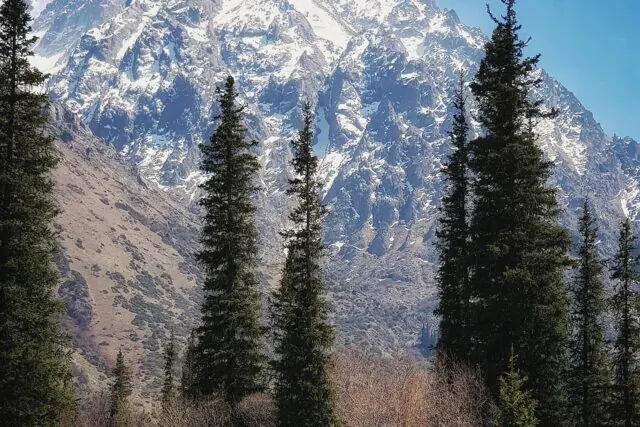
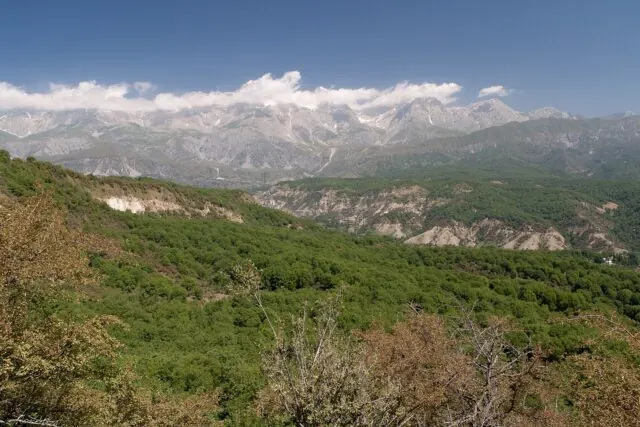
The appeal is contrast. Kyrgyzstan is thin on old architecture and heavy on landscape — alpine lakes, yurt camps, horse country, and a nomadic culture still visibly alive. Uzbekistan is the reverse: a settled, urban civilization of madrasas, bazaars and blue domes, with far less to offer anyone chasing mountains. Run together they answer each other. You spend the first half outdoors and physical, the second half slow and cultural, and neither half repeats the other. For a first trip to Central Asia, that rhythm beats doubling down on either country alone.
They also chain neatly on a map. Kyrgyzstan’s second city, Osh, sits in the same Fergana Valley as Uzbekistan’s eastern cities, so the overland link is short. Start in Bishkek in the north, work down through the lakes to Osh, cross west, and finish in Bukhara — a clean one-way line rather than a backtrack. Our Bishkek guide covers the northern start point in detail.
The route at a glance
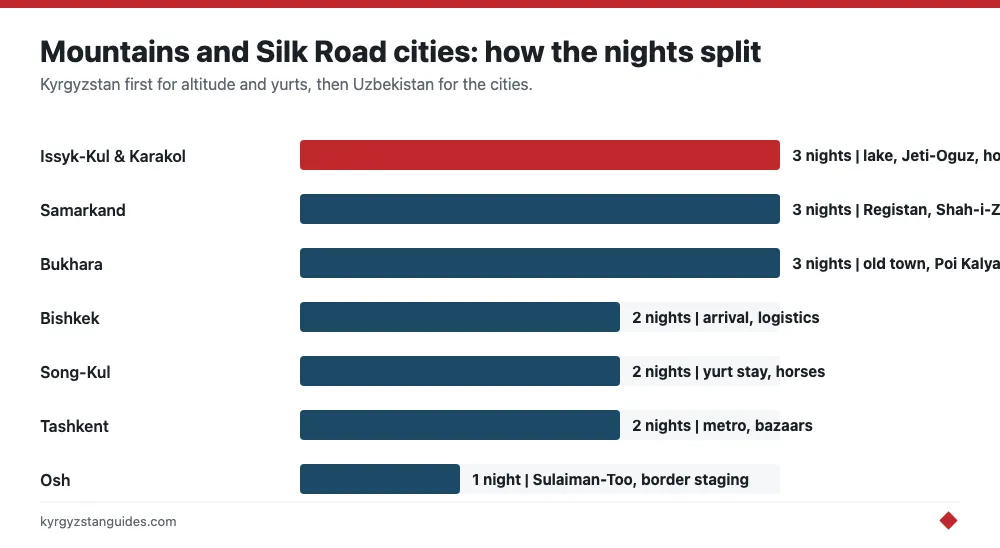
Here is the shape of a 19-day version. Compress the Kyrgyzstan lakes or drop Khiva to bring it under two weeks; add the Fergana Valley towns or Nurata to stretch it past three.
| Stage | Nights | Focus |
|---|---|---|
| Bishkek | 2 | Arrival, Ala-Too Square, Osh Bazaar, trip logistics |
| Issyk-Kul & Karakol | 3 | Lake, Jeti-Oguz, day hikes, hot springs |
| Song-Kul | 2 | Yurt stay, horse riding, high summer pasture |
| Osh | 1 | Sulaiman-Too, bazaar, border staging |
| Tashkent | 2 | Metro, bazaars, arrival into Uzbekistan |
| Samarkand | 3 | Registan, Shah-i-Zinda, Gur-e-Amir |
| Bukhara | 3 | Old town, Poi Kalyan, Lyabi-Hauz |
| Khiva (optional) | 2–3 | Walled Ichan-Kala, easy add-on by train/flight |
When to go, and which half when
This is the crux. Kyrgyzstan’s high country is a summer destination — the Song-Kul yurt camps and mountain roads are only reliably open from roughly mid-June to mid-September, and everything above 3,000 metres can hold snow outside that. Uzbekistan’s desert cities are the opposite: July and August routinely hit 40°C and sightseeing becomes a dawn-and-dusk affair.
The two windows overlap only at the edges of summer, and that overlap is where you want to be. Late May to mid-June and September are the sweet spots — the Kyrgyz passes are open (September is safer than late May for Song-Kul) and Uzbekistan is warm rather than punishing. If you can only travel in high summer, do it, but front-load the mountains and treat the Uzbek cities as early-morning outings with long shaded afternoons. Avoid the reverse mistake of saving the mountains for a September tail if you're starting in May, when Song-Kul may still be under snow.
Day-by-day framework
A workable spine you can shorten or pad:
Days 1–2 — Bishkek
Land, adjust, and sort the trip’s moving parts: a shared car or driver for the lakes, your Song-Kul yurt booking, and your Uzbekistan onward ticket. Bishkek is flat, cheap and light on must-see sights, so two nights is plenty.
Days 3–5 — Issyk-Kul and Karakol
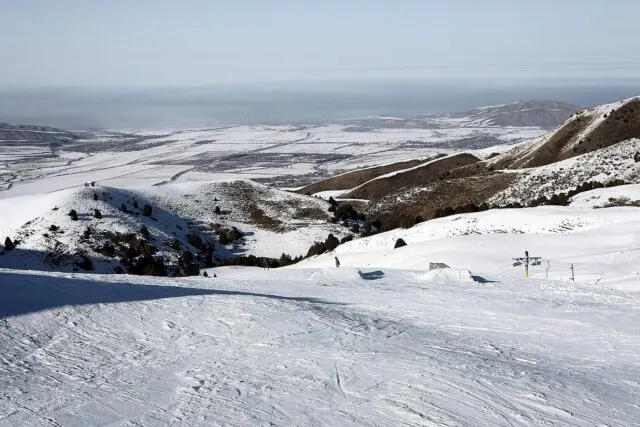
Head east along the world’s second-largest alpine lake to Karakol, the hub for the eastern gorges. Fit in Jeti-Oguz’s red rock formations and, if you have the legs, a taste of the Altyn-Arashan or Ala-Kul trails. Our Issyk-Kul guide lays out both shores.
Days 6–7 — Song-Kul
The trip’s high point, literally — a treeless alpine lake at about 3,000 metres ringed by summer yurt camps. Stay overnight, ride out to the herders, and expect cold nights even in July. The Song-Kul guide covers access routes and yurt logistics.
Day 8 — Transfer to Osh
The honest move is to return to Bishkek and fly to Osh (about an hour, roughly $40–60). The overland route via Kazarman and the Kaldama pass is spectacular but long, rough and weather-dependent — only for those with time and a sturdy vehicle.
Day 9 — Osh
Climb Sulaiman-Too, walk the sprawling bazaar, and stage for the border. Osh already feels half-Uzbek in food and faces, an easy bridge between the two halves. See the Osh guide for the city and the crossing point.
Days 10–12 — Tashkent
Cross the border, reach the capital, and use it as a decompression stop rather than a highlight. Tashkent is modern, green and spread out, with a Soviet-era metro worth riding for the stations themselves and the vast Chorsu Bazaar for a first taste of Uzbek trade. A night or two is enough before you catch the fast train south.
Days 13–15 — Samarkand
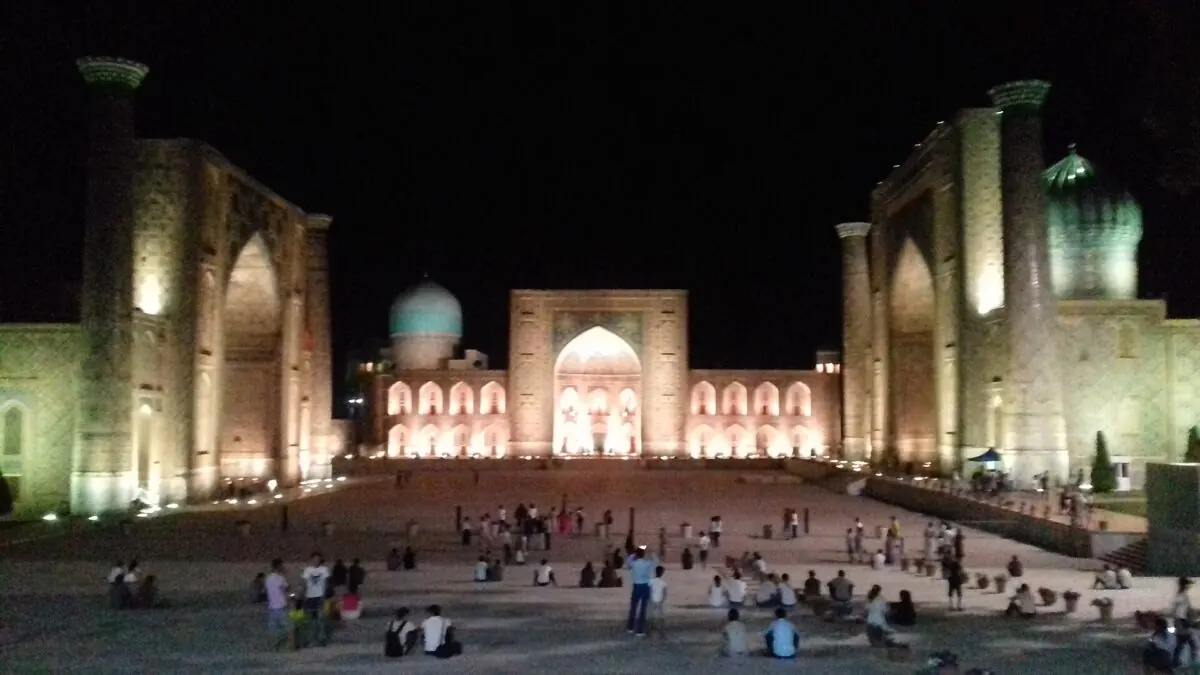
The monumental half of the trip. The Registan’s three madrasas are the postcard, but the tiled necropolis of Shah-i-Zinda and the Gur-e-Amir mausoleum reward slow mornings before the heat and the tour groups build. Three nights lets you see the set pieces twice — once at midday, once at golden hour, when the blue domes are at their best.
Days 16–18 — Bukhara
The trip’s quiet climax. Where Samarkand is monumental, Bukhara is intimate — a lived-in old town of madrasas, trading domes and the Poi Kalyan complex, small enough to walk end to end and old enough to feel unstaged. This is where the Silk Road half of the journey settles into something human-scaled after the grandeur upriver.
Days 19–21 — Khiva (optional)
If you have the days, the walled inner city of Ichan-Kala is a compact, almost museum-like finale, reachable by train or a short flight from Bukhara. It is the longest detour for the fewest connections to the rest, so treat it as a bonus rather than a fixture.
What changes when you cross
The border is not just a line on the map — the two halves feel different in ways worth bracing for. Language shifts: Russian carries you through Kyrgyzstan and still helps in Uzbekistan, but Uzbek is a Turkic language closer to Turkish than to Kyrgyz, and the script and signage change. Food changes register too — Kyrgyzstan’s meat-and-noodle mountain cooking gives way to Uzbekistan’s richer plov, samsa, and bread culture, with more vegetables and sweeter tea. And the pace of travel flips from improvised and weather-bound to scheduled and smooth. Expecting that gear-change makes the second half feel like a reward rather than a jolt.
Crossing from Kyrgyzstan into Uzbekistan
You have two realistic options, and they suit different travelers.
Overland via Osh–Dostuk. The Dostuk crossing sits a short taxi ride from central Osh and lets you out near Andijan in Uzbekistan’s Fergana Valley. From Andijan you take a domestic train or a shared car west to Tashkent, climbing over the Kamchik Pass through a long tunnel — a half-day of travel. This is the purist’s route and the one that makes the trip a true overland line. Check current status before you commit, as Fergana Valley borders have opened and closed over the years; our border crossings guide tracks the main posts.
Fly. Short regional flights connect Osh, and sometimes Bishkek, with Tashkent. Flying skips the Fergana Valley detour and the border queues entirely, at the cost of the overland romance and a bit more money. If your days are tight or the land border is unsettled, fly and don’t overthink it.
Getting around Uzbekistan
Uzbekistan is the easy half. The high-speed Afrosiyob trains link Tashkent, Samarkand and Bukhara on a comfortable, punctual schedule — Tashkent to Samarkand runs a little over two hours, Samarkand to Bukhara around an hour and a half. Book a few days ahead in peak season, as the fast trains sell out. Slower trains and shared cars fill the gaps, and city centers are walkable. After the logistics of Kyrgyz mountain transport, moving between the Uzbek cities feels almost effortless.
Visas for both countries
Rules differ by nationality, so check your own passport, but the broad picture for 2026 is straightforward and heavily online.
| Kyrgyzstan | Uzbekistan | |
|---|---|---|
| Many Western passports | Visa-free (30 days per 60) | Visa-free (commonly 30 days) |
| Indian passport | e-Visa online | e-Visa online |
| Where to apply | e-gov portal | state e-visa portal |
| Plan ahead | A few days processing | A few days processing |
Apply on the official portals only — Kyrgyzstan’s at evisa.e-gov.kg and Uzbekistan’s at e-visa.uz. Print your approvals; land borders sometimes want paper. Indian travelers should budget a few working days for each and carry both before reaching the Osh–Dostuk crossing, since you cannot fix an Uzbek visa at the border.
What it costs
Both countries are inexpensive by Western or even Indian standards, but the money moves differently. In Kyrgyzstan your budget goes on transport — shared cars, drivers to trailheads, the Osh flight — while beds and food stay cheap ($8–15 dorms, $25–40 guesthouses). In Uzbekistan transport is cheap and the spend shifts to nicer old-town guesthouses and train tickets. As a rough all-in figure, a mid-budget traveler can run this trip on something like $45–70 a day outside flights, more if you take private drivers in Kyrgyzstan. Indians flying via Almaty or Tashkent typically pay ₹25,000–45,000 return to reach the region.
How to cut it down
Short on days? The two cleanest trims: drop Khiva, which is the longest detour for the least connection to the rest, and compress Issyk-Kul to a single night on the way to Song-Kul. That alone brings a 19-day plan under two weeks without losing either country’s signature. What we wouldn't cut is Song-Kul or Bukhara — they're the emotional peaks of each half, and a version of this trip without them is just a city tour with a stopover. Build the route around those two and everything else is negotiable.
Frequently Asked Questions
Can you travel from Kyrgyzstan to Uzbekistan overland?
Yes. The main route crosses at Dostuk near Osh into Uzbekistan’s Fergana Valley, then continues by train or car over the Kamchik Pass to Tashkent. Confirm the border is open before you rely on it, as Fergana crossings have changed status over the years; flying Osh to Tashkent is the fallback.
How many days do you need for both countries?
Plan 16 to 21 days for a satisfying loop: about a week in Kyrgyzstan for Bishkek, Issyk-Kul and Song-Kul, then eight to ten days for Tashkent, Samarkand and Bukhara. Under two weeks is possible if you drop Khiva and trim the lakes.
What is the best time to visit both?
Late May to mid-June and September. Those windows keep Kyrgyzstan’s mountain roads and Song-Kul open while sparing you Uzbekistan’s 40°C desert summer. September is the safest single month, with reliable passes and comfortable city weather.
Do I need separate visas for Kyrgyzstan and Uzbekistan?
You handle each country separately. Many Western passports are visa-free for both. Indian and various other travelers apply for an online e-Visa to each on the official portals, so carry both approvals before crossing at Osh.
Should I start in Kyrgyzstan or Uzbekistan?
Either works, but starting in Kyrgyzstan and ending in Uzbekistan reads better: you go from physical mountain days to slow cultural ones, and you finish in Bukhara rather than backtracking. It also matches the natural north-to-south flow toward the Osh border.
If you are linking the two capitals directly rather than going through the Fergana Valley, the road route is covered in Bishkek to Tashkent overland, including which Kyrgyz–Uzbek checkpoints third-country nationals may legally use.