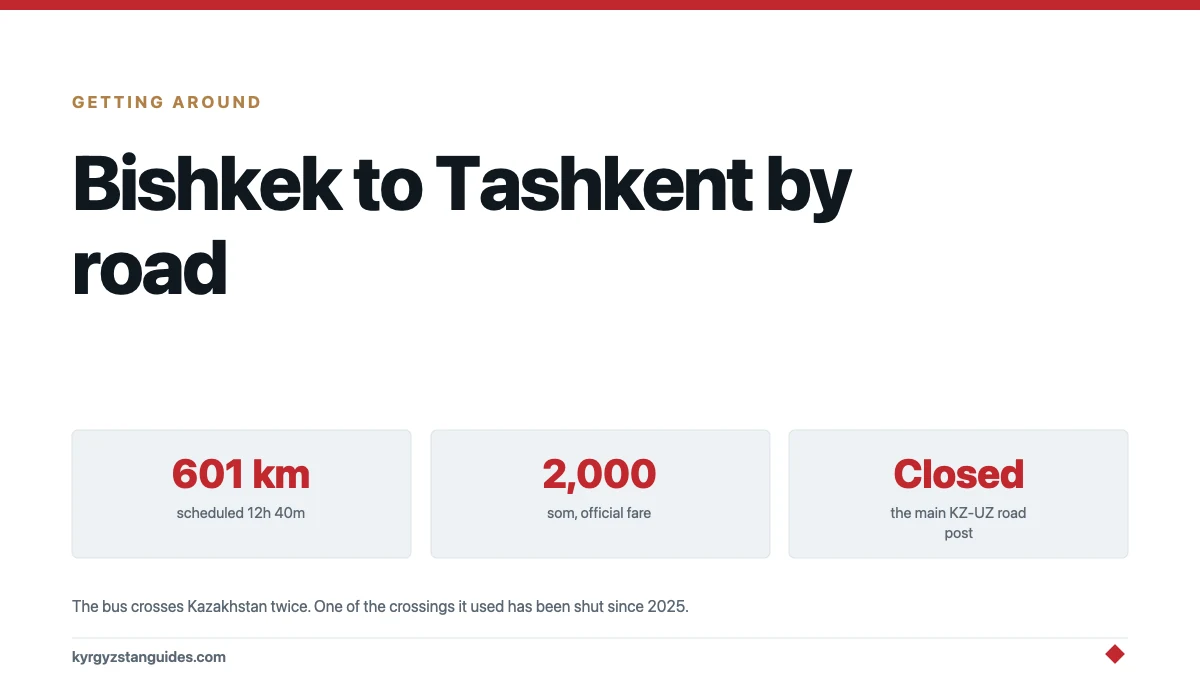
The direct Bishkek–Tashkent bus is 601 kilometres and scheduled at 12 hours 40 minutes. What that description hides is the geography: the road does not run through Kyrgyzstan to Uzbekistan. It goes north-west into Kazakhstan, along the Kazakh side of the Fergana rim, and back down into Uzbekistan. You cross an international border twice and you are in Kazakhstan for most of the journey.
That is why this route is more fragile than the distance suggests, and why the most important fact about it in 2026 concerns a Kazakh–Uzbek checkpoint rather than anything in Kyrgyzstan.
The crossing that has been closed since February 2025
Gishtkuprik on the Uzbek side, Zhibek Zholy on the Kazakh, known to everyone as Chernyayevka, is the main Tashkent–Shymkent road crossing. Around 30,000 people a day used it. It closed in February 2025 for simultaneous reconstruction on both sides and, as of 23 September 2026, no source confirms it has reopened.
The reopening date has been announced more than once and missed. Kazakhstan's State Revenue Committee told Kazinform in November 2025 that traffic would resume on 31 July 2026. Uzbek reporting in April 2026 gave September 2026, with capacity rising to 70,000 people and more than 2,000 cars a day. In July 2026 Kazakh officials were still inspecting an in-progress reconstruction.
During the closure, traffic has been redirected to Yallama. Kaplanbek is also closed, and Tazhen, Atameken and Kazygurt have been under reconstruction.
What this means for you: the bus still runs, but which posts it uses in 2026 is not something we could establish, and the crossing time on the Uzbek approach is not predictable. Build a buffer into anything you book in Tashkent.
The bus itself
The Kyrgyz Ministry of Transport's official timetable lists Bishkek–Tashkent as daily at 16:50 and 23:30, at 2,000 som, operated by OAO "TSA" and OOO "MGT". A second official ministry page gives the departures as 16:50 and 19:00, same fare. The two government pages disagree on the evening departure, and both carry old bylines.
From the Uzbek side, the Ministry of Transport lists Tashkent–Bishkek daily at 18:00 and 19:00 for 130,000 soum, but that page states its prices are as of 7 March 2020, so treat the fare as historical.
There is also a daily Bishkek–Jizzakh service at 15:50 for 2,200 som.
Treat 2,000 som as a floor rather than a current fare. Blog reports range from 2,200 to 2,700 som, which is what you would expect four years after an official page was last touched. Buy at the bus station and ask for the price on the day.
The route's timetable is agreed with Kazakhstan's Transport Committee under a Kyrgyz–Kazakh road transport agreement of 25 December 2003, re-agreed in Astana in February 2019. That is the mechanism that lets a Kyrgyz bus transit Kazakhstan on a fixed schedule at all.
Is there a train
Effectively no, and this catches people out because Uzbekistan has excellent trains internally.
The only Tashkent–Bishkek–Rybachye international passenger train documented on Uzbek Railways' own site is a seasonal tourism service routed through Kazakhstan, and that page is dated May 2019. Nothing suggests it runs now.
The 2026 Issyk-Kul train is domestic only: Bishkek-2 to Balykchy, 5 June to 13 September 2026, departing 08:06 and arriving 12:12, returning at 18:40. Tickets were 180 som cash or 150 by card in ordinary class, up to 7,200 som for a VIP compartment.
The China–Kyrgyzstan–Uzbekistan railway is about 17 per cent built and may finish ahead of schedule, but that is years away and it is a freight-first project.
The southern alternative, which is usually better
If your destination is the Fergana Valley or you are not in a hurry, the Osh route is more reliable than the Bishkek one.
From Osh, the Dostuk crossing sits next to the city. It was rebuilt from scratch and reopened in October 2022 with an electronic checkpoint pilot. Local minibuses on route 777 run from Osh bus station through Dostuk roughly every twenty minutes, at a reported 100 to 120 som, with simplified processing. From Andijan you continue by train or shared taxi to Tashkent.
We cover that route in detail in Kyrgyzstan to Uzbekistan overland and the wider itinerary in the Silk Road itinerary.
The catch is getting to Osh. The main Bishkek–Osh road is a long mountain drive, and the alternative North–South road via Balykchy and the Kok-Art tunnel is open only until November 2026, daylight hours 06:00 to 20:00, with an axle load limit of 11.5 tonnes and a tunnel toll between 100 and 5,000 som.
Which crossings you may legally use
This is the part travellers most often get wrong, and it is not a matter of custom. Kyrgyz–Uzbek checkpoints are legally either bilateral, meaning Kyrgyz and Uzbek citizens only, or multilateral, meaning third-country nationals may cross.
From 20 May to 1 October 2026 three Batken posts — Kadamjai, Chechme and Ak-Kyya — moved to 24-hour operation. The State Border Service stated explicitly that only Kyrgyz and Uzbek citizens may use them. If you are neither, a 24-hour headline about those posts is not about you.
Khanabad on the Uzbek side and Bek-Abad on the Kyrgyz, reopened in September 2023 after being shut since around 2010, is multilateral: open to third-country nationals, any vehicle registration, 24 hours, with capacity for 9,000 to 10,000 people and up to 300 vehicles a day. Mingtepa and Kara-Bagysh reopened the same day but are bilateral, pedestrian and daytime only.
As of June 2026 all Kyrgyz–Uzbek posts operate except Seydikum in Bazar-Korgon, which is still under negotiation. The two countries signed a final delimitation treaty on 30 July 2026 fixing 302.29 kilometres across 35 segments and agreeing to double the number of crossings from 15 to 30.
One clause in that treaty is worth reading carefully: a protocol exempts Kyrgyz and Uzbek citizens only from host-country registration for 15 days after crossing. It does not apply to you. See Kyrgyzstan border crossings for the full picture.
Uzbek entry and the registration rule
Uzbekistan's official MFA list gives 30 days visa-free for the UK, Ireland, EU states, Norway, Switzerland, Canada, Australia, New Zealand, Japan, South Korea, Israel, Singapore, Malaysia, Turkey, Brazil and the UAE, among others. The visa-free period runs from the moment you cross the border, and your passport must be valid six months.
For US citizens there is a live discrepancy. Presidential Decree UP-203 of 3 November 2025 grants US citizens 30-day visa-free entry from 1 January 2026 and repeals the earlier over-55 concession. The MFA's own visa page, as served in September 2026, still lists the USA only under the e-visa annex. The decree is the higher authority; the website has not caught up. If you are American, carry a printout and expect confusion rather than refusal.
E-visa fees where one is needed: single entry $20, double $35, multiple over 30 days $50, ordinary single-entry 30-day $60, transit 72-hour $40.
The registration rule is the one that actually bites. Britain's FCDO says register with OVIR within three days; hotels normally do it, and private stays go through the Emehmon system. Australia's advice is stricter in practice: registration for stays of three or more days, in each city. Exit checks compare your stamps against the 30-day allowance. Keep every slip.
Kyrgyzstan’s own rule, for comparison, is 30 calendar days within any 60-day period for citizens of 55 countries, under Cabinet Resolution No. 855 of 31 December 2025. Be careful here: the Kyrgyz foreign ministry’s own visa-regime page has not been updated and still publishes the old 60-day allowance. The allowance is also cumulative rather than per entry, so leaving and re-entering does not reset it. Our Kyrgyzstan visa guide has the detail.
FAQ
Is there a direct bus from Bishkek to Tashkent?
Yes, daily. The Kyrgyz Ministry of Transport's timetable gives departures at 16:50 and 23:30 for 2,000 som, though a second official page lists 16:50 and 19:00. Both pages are several years old, so check the current fare and time at the bus station rather than relying on a published figure.
How long does Bishkek to Tashkent take by road?
The scheduled running time is 12 hours 40 minutes over 601 kilometres. Real journeys vary widely because the route transits Kazakhstan and crosses two international borders, and the main Kazakh–Uzbek road crossing has been under reconstruction since 2025.
Is there a train from Bishkek to Tashkent?
Not a regular one. The only international service documented on Uzbek Railways' site is a seasonal tourism train routed through Kazakhstan, and that page dates from 2019. The Issyk-Kul train that runs each summer is domestic, between Bishkek and Balykchy only.
Which Kyrgyz–Uzbek border crossings can foreigners use?
Only the multilateral, or international, posts. Several checkpoints, including the three Batken posts that moved to 24-hour working in 2026, are bilateral and restricted to Kyrgyz and Uzbek citizens. Khanabad/Bek-Abad is explicitly multilateral, and Dostuk near Osh is the one most travellers use.
Do I need to register in Uzbekistan?
Yes. Registration is required within three days of arrival, normally handled by your hotel, or through the Emehmon system for private stays. Australian advice says register in each city for stays of three days or more. Keep the slips, because exit checks compare them against your entry stamp.
Is the Chernyayevka crossing between Kazakhstan and Uzbekistan open?
As of late September 2026 there is no confirmation that it has reopened. Gishtkuprik/Zhibek Zholy closed in February 2025 for reconstruction on both sides. Announced reopening dates of 31 July 2026 and September 2026 both passed without a confirming report.