Chuchuk is horse rib meat and fat, seasoned with salt, garlic, onion, black pepper and cumin, packed into cleaned intestine casing and simmered for about an hour to an hour and a half. Some versions are smoked instead, or as well. It arrives sliced cold on a plate, or hot on top of beshbarmak, and at a Kyrgyz wedding it is not optional.
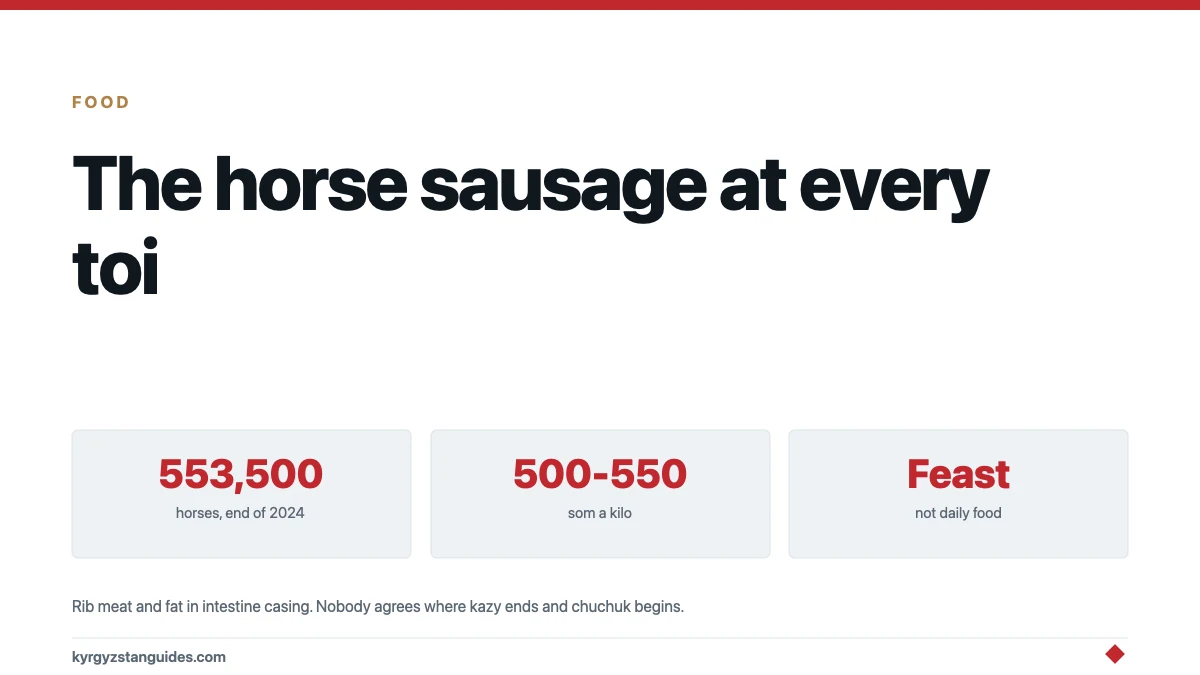
Horse meat is the thing most first-time visitors have a reaction to, and the reaction is usually based on a wrong assumption: that Kyrgyz people eat it constantly. They do not. The documented pattern is feast food — weddings, funerals, significant gatherings — rather than a daily staple.
So this is what chuchuk actually is, how it differs from the other horse-meat preparations whose names get used interchangeably, what it costs, and what to do when a plate of it arrives.
The naming problem, which nobody has solved
Five words circulate for horse-meat preparations: chuchuk, kazy, karta, zhal and zhaya. Sources genuinely disagree about where the boundaries fall, and I am not going to pretend otherwise.
| Term | What sources say |
|---|---|
| Chuchuk | Horse sausage from rib meat and fat in intestine casing, boiled and/or smoked |
| Kazy | Treated as a near-synonym of chuchuk by one Kyrgyz-authored source; distinguished by others as firmer and fattier, made strictly from rib meat with a full strip of fat, to stricter rules |
| Karta | In Kazakh sources, a sausage made from the large intestine itself, which serves as both casing and content |
| Zhal | Consistently described as smoked or salted fatty neck meat, not a sausage at all |
| Zhaya | Kazakh sources say salted and smoked meat from the hip or hind leg; a Kyrgyz-authored account calls it simply a smoked horse-meat delicacy without specifying the cut |
The Kyrgyz-authored source here, an essay by Daniiar Bakchiev, treats kazy and chuchuk as essentially the same thing. Travel-food writing draws a sharper line. Both are in circulation among people who eat this regularly.
What I could not find is a source that cleanly assigns any of these terms as exclusively Kyrgyz or exclusively Kazakh. The vocabulary is shared across the nomadic cultures with regional variation in exactly which cut each word covers. If a Kyrgyz host and a Kazakh guest disagree at the table about what kazy means, they are both right locally.
How many horses are we talking about
Kyrgyzstan had 553,500 horses at the end of 2024, up 10,900 head on the year, per National Statistical Committee data. Growth was concentrated in Chui and Jalal-Abad.
By region at the end of 2025, Naryn leads with 149,200 head, then Osh at 100,800, Jalal-Abad at 94,900 and Chui at 81,900. That Naryn tops the list will not surprise anyone who has been there — it is the highest, emptiest, most pastoral oblast in the country.
A caution on a number you may meet: a figure of "345.8 thousand horses" circulates from a 2026 regional breakdown. It is not a national total. Those four regions alone add to 426,800, so the smaller figure is a misreading of regional data rather than a real collapse in the herd.
What is genuinely missing is horse meat production by weight. The statistics committee publishes meat production in slaughter weight as a single aggregate — 252,900 tonnes in 2024 across beef, mutton, horse and poultry together — and does not break it out by animal in the tables I could reach.
What it costs
Horse meat sold for 500–550 som a kilogram at Bishkek's Osh, Alamedin and Orto-Sai bazaars as of 1 February 2025, against beef at 480–570 and mutton at 500–580.
Note what that says: horse is priced right alongside beef and mutton, not as a cheap meat or a luxury one. It is ordinary protein that happens to carry ceremonial weight.
I could not find a well-sourced, dated price for finished chuchuk sausage as opposed to raw horse meat. There are vendor posts quoting around 900 som a kilo for kazy-chuchuk, but a social-media listing with no date is not a market price and I am not going to present it as one. Expect finished sausage to cost meaningfully more than the raw meat, and ask at the counter.
When it is actually eaten
Bakchiev's essay puts horse meat consumption at "weddings, funerals, and other significant gatherings". That is the only direct, citable statement on frequency I found, and it matches what the price and the preparation effort imply. You do not spend an afternoon stuffing intestine casing for a Tuesday.
The dish it belongs to is beshbarmak, the national dish: boiled horse or mutton served over hand-cut noodles with onion, eaten communally. Slices of chuchuk or kazy are the traditional garnish on the platter. Our post on the toi economy explains how much a family will spend on one of these feasts, which is the context that makes a horse worth slaughtering.
One term I want to flag rather than repeat confidently: soguum, the winter slaughter. The general Central Asian practice is well established — animals are killed before winter so they do not have to be fed through it, and the meat is preserved. But I could not confirm the specific Kyrgyz term and its ethnographic description from a source I could open, so I am not going to build a paragraph on it. Similarly, I found nothing tying chuchuk specifically to Nooruz.
Is it safe, and is refusing rude
On safety, the reassuring structural point is that chuchuk is normally fully cooked by boiling, not raw-cured like European salami. That materially changes the risk profile compared with the charcuterie it superficially resembles.
Regulation is general rather than specific. Kyrgyzstan is in the Eurasian Economic Union, so meat falls under the union's general meat and meat products safety regulation, TR TS 034/2013. I found no Kyrgyz rule naming horse meat or cured sausage specifically. Normal caution around informally prepared meat applies, as it would anywhere.
On etiquette, I will be straight: I could not find a source addressing whether refusing horse meat is considered rude. It is the obvious question and it is not documented anywhere I could reach. What our post on hospitality rules does establish is that which piece of meat you are handed carries real meaning about your standing, so declining a portion that was deliberately selected for you is at minimum a more loaded act than declining a second helping of salad. A quiet, apologetic no, taken with obvious appreciation of everything else, is unlikely to cause offence with hosts used to foreign guests.
Also unverified, despite being repeated often: claims about horse fat having a lower melting point or milder taste than beef or mutton fat. I found no nutritional analysis behind those. What is uncontroversial is that chuchuk is fatty. That is the point of it.
What it tastes like, honestly
Rich, dense, and more like a firm cured sausage than a soft one, with a distinct sweetness that the cumin and garlic cut against. Served cold in thin slices it is a cold cut. Dropped into sorpo, the clear broth, it releases fat into the bowl and the broth becomes the better half of the dish.
If you are served it at a toi, you will get it on the beshbarmak platter alongside other cuts, and the whole thing is eaten with the hands — besh barmak means five fingers.
FAQ
What is chuchuk made of?
Horse rib meat and fat, seasoned with salt, garlic, onion, black pepper and cumin, stuffed into cleaned natural intestine casing and simmered at a low heat for roughly one to one and a half hours. Some versions are smoked instead of, or in addition to, boiling.
What is the difference between chuchuk and kazy?
Sources disagree. One Kyrgyz-authored account treats them as near-synonyms, both horse sausages made from ribs and fat. Other sources distinguish kazy as firmer, fattier and made strictly from rib meat with a full strip of fat, with chuchuk the leaner version. There is no settled answer, and usage varies regionally.
How much does horse meat cost in Kyrgyzstan?
Around 500–550 som per kilogram at Bishkek bazaars as of February 2025, which sits right alongside beef at 480–570 and mutton at 500–580. Finished chuchuk sausage costs more than raw meat, but I could not find a reliably dated price for it.
How many horses are there in Kyrgyzstan?
553,500 at the end of 2024, up 10,900 on the year. Naryn leads by region with 149,200 head, followed by Osh, Jalal-Abad and Chui. A figure of 345,800 sometimes circulates as a national total but it is a misreading of a regional breakdown.
Do Kyrgyz people eat horse meat every day?
No. The documented pattern is feast and ceremonial food — weddings, funerals and significant gatherings — rather than daily eating. Chuchuk and kazy appear as the garnish on the beshbarmak platter at those occasions.
Is chuchuk safe to eat?
It is normally fully cooked by boiling rather than raw-cured, which puts it in a different risk category from European-style cured sausage. Meat falls under the Eurasian Economic Union's general meat safety regulation; there is no Kyrgyz rule naming horse sausage specifically. Apply the same caution you would to any informally prepared meat.
Is it rude to refuse horse meat in Kyrgyzstan?
No source I could find addresses this directly, so I will not claim an answer. What is documented is that the specific cut you are handed is a statement about your standing as a guest, so refusing a portion chosen for you carries more weight than refusing a second helping. Declining politely and warmly, while eating everything else, is unlikely to offend hosts accustomed to foreign visitors.