Three strings, no frets, a body carved from a single piece of apricot wood. That is the entire hardware of the komuz, and out of it Kyrgyz musicians pull galloping horses, arguments, lullabies, and jokes. The komuz is Kyrgyzstan’s national instrument, a small long-necked lute you'll see on banknotes (it's on the one-som coin and woven into state iconography), in every folklore ensemble, and in the hands of schoolchildren at holiday concerts.
For a traveler, the komuz matters for two reasons. First, hearing it played well, live, is one of the most direct encounters with Kyrgyz culture you can have. No language required. Second, it's one of the best souvenirs in the country, if you know what separates a wall decoration from an instrument.
What it actually sounds like

Softer and rounder than you might expect. The komuz has no frets and traditionally uses gut or nylon strings (fishing line is a common modern substitute), so the sound is warm, buzzy, and intimate rather than bright like a banjo or mandolin. One string typically carries the melody while the others drone or answer it, and a skilled player makes the instrument sound like two or three people playing at once. Tunings change from piece to piece, which is part of the players’ craft.
Kyuu: melodies that tell stories
The core repertoire is the kyuu (küü). A short instrumental piece that narrates something specific: a race, a grieving mother, a historical episode, a camel searching for her calf. Traditionally the player introduces the story in a few words and then tells the rest with the strings alone. Legend credits the invention of the instrument to the hunter Kambar, and “Kambarkan” remains one of the foundational kyuu families every serious player learns. The great komuz composers of the 19th and 20th centuries — Toktogul Satylganov above all, whose name is on the national philharmonic in Bishkek — occupy roughly the cultural slot that composers like Chopin hold in Europe.
The tradition is oral. Kyuu pass from master to student by ear, and every komuzchu inherits pieces the way families inherit stories — with small personal changes accumulating over generations. State performance programmes, plus school ensembles in nearly every town, have kept the pipeline healthy; you'll meet twelve-year-olds who play circles around most adults, and that is entirely normal here.
The showmanship is part of the tradition
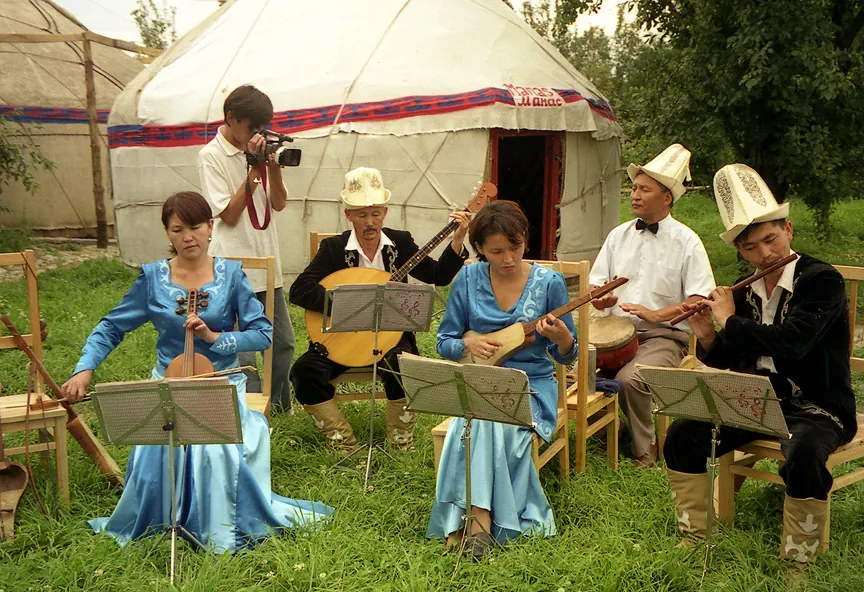
A proper komuz performance is also physical theater. Players flip the instrument behind the head mid-phrase, play it upside down, over the shoulder, one-handed, or with hands crossed — all without dropping the melody. This isn't a modern tourist gimmick; trick playing has long been part of how virtuosos demonstrated mastery, and audiences at village celebrations expected it. When an ensemble of teenagers in felt kalpaks starts spinning their instruments in perfect unison, cynicism isn't really an available response.
Where to hear it live
- Bishkek’s philharmonic and theaters: the Toktogul Satylganov Philharmonic stages folk orchestra concerts; check listings when you plan your Bishkek days.
- Dinner folklore shows, several traditional restaurants in Bishkek and Karakol run evening ethno-programs with komuz, throat-flavored vocals, and dance. Touristy, yes; also genuinely well played.
- Festivals and games. The World Nomad Games and summer ethno-festivals around Issyk-Kul are komuz-saturated, from stage concerts to musicians in yurt camps.
- Yurt camps: some camps at Song-Kul arrange short evening performances by local musicians. Ask when you book; small extra payments are normal and fair.
- National holidays — Nooruz (March 21) and Independence Day (August 31) fill city squares with free folk performances.
How a komuz is made
Traditional makers carve the pear-shaped body and neck from a single block of wood, apricot is the prestige choice for its density and warm tone, though juniper and walnut also appear. The block is seasoned for years before carving, hollowed from the back, and closed with a thin wooden soundboard; there is no round soundhole on the front the way a guitar has, which is part of why the voice is so contained and conversational. Three strings run over a small movable bridge to friction pegs, and the whole instrument typically measures around 85–90 cm and weighs almost nothing.
Workshop visits are possible: several Bishkek music shops double as ateliers, and folk-craft tours can add a maker’s studio where you watch a body being carved and hear the difference between a tourist piece and a seasoned-wood instrument in the space of two strummed chords.
Buying a komuz as a souvenir
Souvenir stalls sell miniature and decorative komuz for roughly 1,500–3,500 KGS (around $17–40), and they are fine as ornaments, just don't expect them to hold tune. A playable student instrument from a workshop or music shop in Bishkek typically starts around $60–100, with master-built instruments in fine apricot wood running several hundred dollars. Check that the neck is straight, the tuning pegs turn and hold, and the body has no cracks; ask the seller to tune and play it, which any legitimate shop will happily do.
Size is the good news: a komuz is light and slim, and most airlines will accept one as cabin baggage without drama, though a padded bag is worth the small extra cost. For where komuz shopping fits among felt, shyrdaks, and honey, see our full souvenirs guide.
Listen before you go
The komuz rewards a little homework. Search for “Kambarkan,” “Mash Botoy,” or simply “komuz kyuu” and spend twenty minutes listening before your trip; recordings by the ensemble Ordo Sakhna and by Ustatshakirt Plus players are a good modern entry point. It's a small investment, and it means that when the instrument finally comes off the wall in front of you — flipped behind someone’s head, mid-melody, in a yurt at dusk. You will know exactly how much skill you're watching.
The komuz is not on the UNESCO list, and the detail is worth getting right
You will read that the komuz is UNESCO-recognised heritage. It isn't. Kyrgyzstan has sixteen elements inscribed on the UNESCO intangible heritage lists and not one of them is instrument-specific. There is no komuz element, and none for the kyl-kyak or the temir-komuz either.
What is inscribed are the practices the komuz serves. "Art of Akyns, Kyrgyz epic tellers" went onto the Representative List in 2008, having been proclaimed in 2003, and UNESCO's own text for it says the shorter epics are "generally performed to the accompaniment of the komuz, the three-stringed Kyrgyz lute". "Aitysh/Aitys, art of improvisation", a joint Kazakh-Kyrgyz inscription from 2015, names "the Kazakh dombra or Kyrgyz komuz" as the accompanying instruments. The Kyrgyz epic trilogy of Manas, Semetey and Seytek, listed in 2013, is the outlier: Manas is narrated solo, without any instrument at all.
So the komuz is written into international heritage law as an accompanist rather than as a subject. That is a fair reflection of how it actually works here, and it is a more interesting fact than the one people get wrong.
Kyrgyzstan does honour it domestically. Komuz Day falls on 9 September, adopted in 2019, with concerts organised across every region by the culture ministry. If your trip crosses that date, change your plans to be somewhere with a square.
Two weeks of work, and nobody to hand it to
The making is slower than the "carved from one block of apricot wood" line suggests. Esenkul Bekturganov, a master in Kara-Oy village on Issyk-Kul, boils the blanks for several hours in a cauldron before drying them at length. One instrument takes him over two weeks. He has made more than a thousand in his career.
He has no younger successor in the village. That is the part to sit with while you are deciding whether to buy a factory souvenir or a real one.
The komuz also sits in a family that visitors rarely get named for them. Alongside it: the kyl kyyak, a two-string bowed instrument; the temir komuz, a metal jaw harp, and its wooden cousin the jygach komuz; and the choor, a flute. Ensembles like Ordo Sakhna add the chopo-choor, a clay ocarina, plus sybyzgy, kernei, surnai and dobulbas. A folk concert is not a komuz recital; it is this whole ecology.
The three names on every programme
Toktogul Satylganov (born 1864, though some sources say 1861; died 1933) is the one whose life explains the reverence. In 1898 he was sentenced to death over the Andijan rebellion, commuted to seven years of Siberian penal servitude. Today the national philharmonic in Bishkek, a city, a district and the country's largest hydroelectric station all carry his name, and the National Bank puts him on the 100 som banknote, describing him as "a virtuoso musician". You have been carrying his portrait around in your pocket.
Karamoldo Orozov (1883-1960), born Toktomambet in Korumdu village on Issyk-Kul, was the first musician ever given the title People's Artist of the Kyrgyz SSR, in 1935. The musicologist Alexander Zataevich transcribed 31 of his küü in 1928, which is a large part of why that repertoire survives at all, and the Kyrgyz Folk Instruments Orchestra was named after him in 1961.
Atai Ogonbaev (1904-1949) from Talas studied komuz and singing under Toktogul himself, founded the Ensemble of Komuzists of the Kyrgyz SSR in 1939, and went to Moscow in 1940 for composer-melodist training. "Kuydum chok" is his.
The institutions that carry this forward are younger than the country's independence in most cases. The Kyrgyz National Conservatory was created by presidential decree on 23 July 1993 and given national status in 1998, the first institution in the country to hold it; it is the republic's only professional music university and has produced around 3,000 graduates in thirty years. Kambarkan was founded in the late 1980s by Chalagyz Isabaev, under glasnost, explicitly to stop Kyrgyz folk music dying out. Ordo Sakhna, a folk-ethnographic theatre whose members are all conservatory graduates, dates only from 1999.
Much of what an akyn sings to komuz accompaniment comes from the body of small epics outside the Manas trilogy, which is the tradition the instrument is most closely bound to.
FAQ
Is the komuz UNESCO heritage?
No. Kyrgyzstan has sixteen UNESCO-inscribed elements and none is instrument-specific. The komuz appears inside other inscriptions: "Art of Akyns" (2008) and "Aitysh/Aitys" (2015) both name it as the accompanying instrument.
What is a komuz made of?
A single block of wood, apricot preferred, with three strings and no frets. A master in Kara-Oy boils the blanks for hours before drying them, and one instrument takes him over two weeks.
When is Komuz Day in Kyrgyzstan?
9 September. The observance was adopted in 2019 and the culture ministry organises concerts in every region. It is the single best day of the year to hear the instrument played publicly.
Who are the most famous komuz players?
Toktogul Satylganov (1864-1933), on the 100 som note and sentenced to death in 1898 before commutation to Siberian exile; Karamoldo Orozov (1883-1960), the first musician made People's Artist of the Kyrgyz SSR; and Atai Ogonbaev (1904-1949), who founded the Ensemble of Komuzists in 1939.
What other traditional instruments does Kyrgyzstan have?
The kyl kyyak, a two-string bowed instrument; the temir komuz, a metal jaw harp, and the wooden jygach komuz; the choor flute; and in larger ensembles the chopo-choor clay ocarina, sybyzgy, kernei, surnai and dobulbas.
Where can you hear live komuz music?
Folk ensembles such as Kambarkan and Ordo Sakhna perform for audiences including visitors, and school ensembles exist in nearly every town. Ask locally rather than assuming a published schedule.