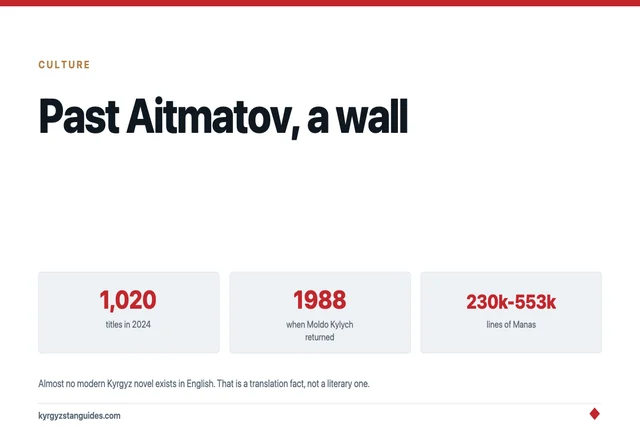
Everyone who reads anything about Kyrgyzstan learns about Manas: the world's longest epic, thirteen hours of continuous narration, tellers who take up the calling after a prophetic dream. What almost nobody learns is that Manas is one item in a much larger body of oral epic, and that the rest of it is performed in a completely different way.
They are called the small epics, which the scholars who use the term admit is a misnomer, since each is substantial. It simply means the Kyrgyz epic songs that are not part of the Manas, Semetey and Seytek trilogy.
How many, and why nobody will say exactly
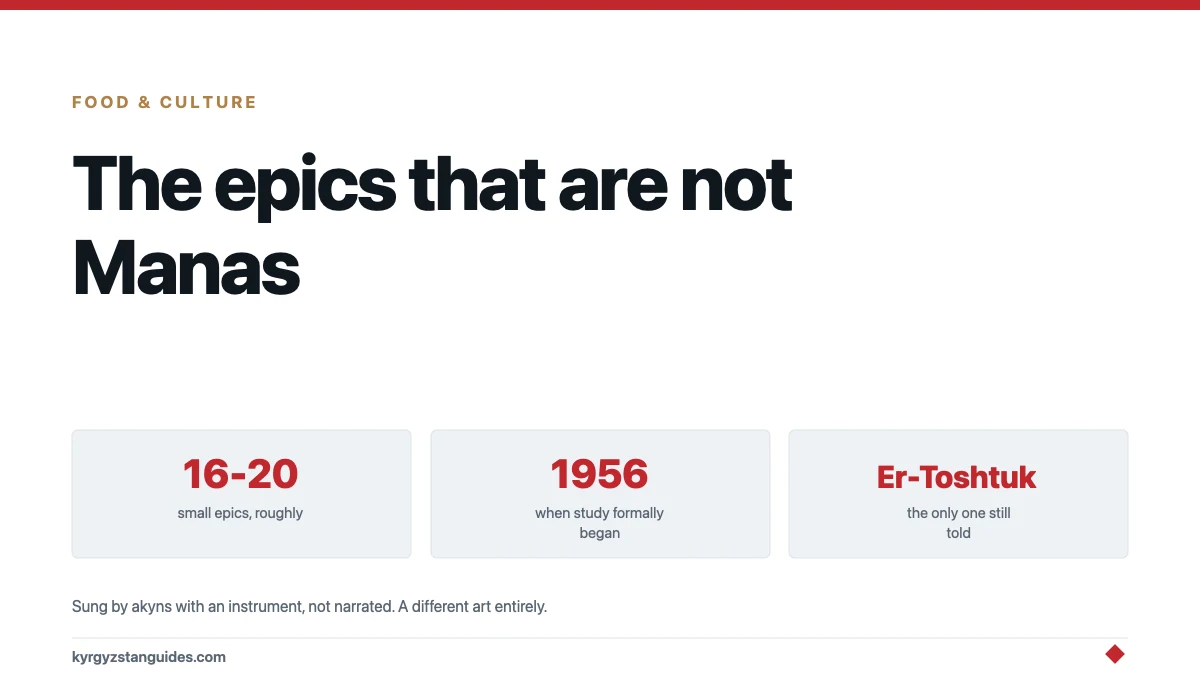
The Institute of History and Cultural Heritage at the National Academy of Sciences puts it plainly: the total number of small epics varies from 16 to 20, and it is difficult to be more precise because of how the genre is classified. Other summaries say about thirty, or over forty. The 16 to 20 figure is the one that comes from the Academy's own text rather than from a search result.
Kyrgyz folkloristics sorts them into four groups. Mythological: Kojojash, Er-Töshtük, Joodarbeshim. Heroic: Janyl-Myrza, Kurmanbek, Janysh-Baiysh, Al-Tabyldy, Seyitbek, Shyrdakbek. Social or everyday: Kedeykan, Mendirman. Lyrical-romantic: Oljobay and Kishimjan, Sarinji-Bököy.
Several of those names appear in the classification and nowhere else in the accessible literature. Joodarbeshim, Shyrdakbek, Mendirman, Al-Tabyldy, Al-Salton and Seyitbek are catalogued and grouped, but no plot summary for them turned up in anything I could read. They exist as titles in a list, which is itself a fair description of how much of this tradition now survives.
The performance difference that changes everything
Here is the detail that makes this worth knowing rather than just listing. Manas is narrated, solo, without an instrument. The small epics are not.
As the Academy source puts it: as a rule, small epics — except Er-Töshtük — are not performed by storytellers, but by singers, akyns, accompanied by a musical instrument. Er-Töshtük is the single exception still told by storytellers.
So if you go to a folk performance and hear an akyn with a komuz singing a long narrative, you are probably not hearing Manas. You are hearing something from this other tradition, and the accompaniment is the tell.
What the stories actually are
Kojojash is the one that stays with people. A hunter pursues Echki Sur, the grey goat, who is the protector-spirit of wild cloven-hoofed animals, and is destroyed for breaking a taboo. It survives in three recordings, taken from the narrators S. Konokbaev in 1923, A. Usenbaev in 1938 and T. Jeentaev in 1949, with the Usenbaev version regarded as the most complete.
Er-Töshtük sends its hero into the underworld to fight monsters and giants and free kidnapped people. Cognate versions exist in Kazakh, Bashkir, Tatar and Uzbek folklore, which points to an early Turkic origin, and in its final phase Töshtük was absorbed into the Manas cycle as a character. Sayakbay Karalaev's telling was published in Paris by Gallimard in 1965, in French, as the marvellous underground adventures of Er-Töshtük, giant of the steppes.
Kurmanbek, Al-Tabyldy, Al-Salton, Janyl Myrza and Seyitbek are all set in the Oirat and Jungar wars of the sixteenth to eighteenth centuries, with the enemy appearing collectively as the Kalmak. Janyl Myrza stands out as a warrior-maiden epic.
Kedeykan, whose name means khan of the poor, is class conflict in epic form: a poor youth raids a rich man's herds, wins a verbal duel against the khan's man, and takes the throne of Khan Azimkan on a wager. Sarinji-Bököy is fraternal: Bököy tries to take his brother's betrothed by force and is repaid. Janysh-Baiysh shares motifs with the Uzbek Alpamysh and the Altai Alyp Manash — capture during sleep, an invulnerable hero, a dungeon, a rescue by a horse. Baiysh cannot drown, burn or be shot, and the horse Janysh speaks.
Sayakbay Karalaev, and why one name keeps appearing
Almost every thread in this subject runs back through one man. Sayakbay Karalaev was the manaschy whose telling of the Manas trilogy became the standard reference version, and it was also his Er-Töshtük that Gallimard published in Paris in 1965. He was honoured as People’s Artist of the Kyrgyz Republic, and in December 2024 TURKSOY and the National Manas Academy marked his 130th birth anniversary, which places his birth in 1894.
That single career spans the transition this whole body of work went through: from a living oral tradition carried by individual memory, to something recorded, transcribed, edited and published by an academy. It is why the same handful of names attach to so many of the surviving texts.
UNESCO’s own description of the Manas tradition gives a sense of what is being preserved and what is not. Continuous narration of the trilogy may last up to thirteen hours. It is transmitted master to apprentice through non-formal education rather than schooling, and tellers accept the calling after a prophetic dream and perform in something close to a trance. None of that survives a printed edition.
What you can and cannot go and hear
If you want to encounter any of this on a trip, be realistic about the difference between the two traditions. Manas performance is supported, taught and sometimes staged for audiences; you can reasonably hope to hear a manaschy, and our epic-of-manas/">guide to the epic covers what that involves.
The small epics are a harder proposition. They belong to the akyn tradition with instrumental accompaniment, which means what you are most likely to encounter is a folk ensemble performance where an akyn sings a narrative passage — without it being announced as Kojojash or Janysh-Baiysh. Ask. The musicians will know exactly what they are performing even when the programme does not say.
One honest limit: I could find no published line counts or lengths for any individual small epic, and the figures that circulate for Manas itself trace to sources I will not use. If you want the texts, the Soviet-era academy editions are the real route, and they are in Kyrgyz and Russian.
Recorded, published, and possibly no longer sung
Formal study began at a specific moment: 1956, at the first extended meeting of the Academic Council of the Institute of Language and Literature at the Academy of Sciences of the Kyrgyz SSR, devoted to the people's small epics. Scholarly editions followed through the Soviet period — Subanbekov in 1963 and 1970, Zakirov on Er-Töshtük variants in 1960, Kydyrbaeva on Sarinji-Bököy in 1958 and Janyl Myrza in 1960, Kayypov on the poetics of Er-Töshtük in 1989.
Whether any of them are still performed today is something I will not assert either way. The Academy source describes the collapse of oral transmission through the twentieth century, says written recording became the only way to preserve them, and closes by calling publication of the small epics a primary task. That describes endangerment rather than a living repertoire, but it is not the same as saying nobody sings them, and I could not find a source that settles it.
One thing is settled: no small epic has its own UNESCO listing. The Manas trilogy was inscribed in 2013 and the art of the akyns in 2008, and that is the extent of it. Fifteen Kyrgyz elements are on the lists; none of the rest of this body of work is among them.
FAQ
What are the Kyrgyz small epics?
The body of Kyrgyz oral epic outside the Manas, Semetey and Seytek trilogy. The National Academy of Sciences puts the count at 16 to 20, though other summaries say thirty or more. The name is acknowledged as a misnomer, since each is substantial.
How are small epics performed?
By akyns — singers — accompanied by a musical instrument, unlike Manas, which is narrated solo without one. Er-Töshtük is the sole exception, still told by storytellers.
What is the Er-Töshtük epic about?
A hero who descends to the underworld to fight monsters and giants and free kidnapped people. Cognate versions exist in Kazakh, Bashkir, Tatar and Uzbek folklore. Sayakbay Karalaev's telling was published in French by Gallimard in Paris in 1965.
What is Kojojash?
A mythological epic in which a hunter pursues Echki Sur, the grey goat who protects wild cloven-hoofed animals, and is destroyed for breaking a taboo. Three recordings survive, from 1923, 1938 and 1949.
Are the small epics on the UNESCO list?
No. Only the Manas trilogy, inscribed in 2013, and the art of the akyns, inscribed in 2008, are listed. None of the small epics has its own inscription.
Are Kyrgyz small epics still performed?
Unclear, and worth being honest about. The Academy of Sciences describes twentieth-century collapse of oral transmission and treats written recording as the means of preservation, which implies endangerment. No source found settles present-day performance either way.