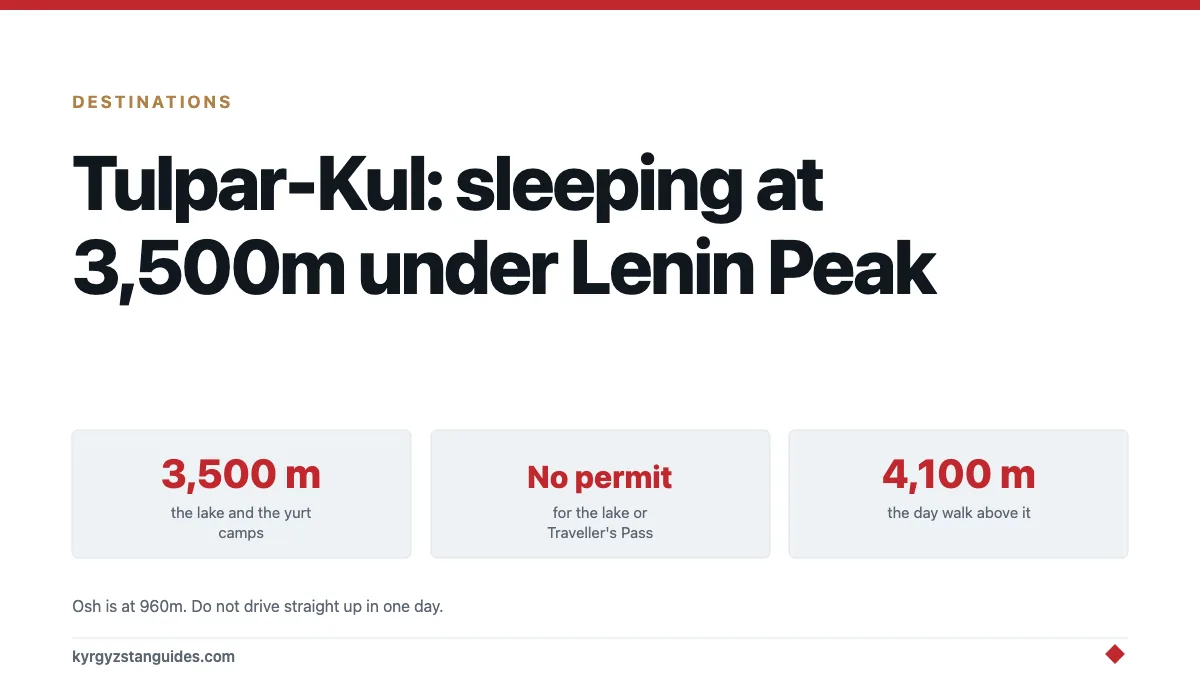
There is a lake in the Alay valley with half a dozen yurt camps along its southern shore, a seven-thousand-metre mountain filling the view, and no requirement to climb anything. Tulpar-Kul sits at 3,500 metres within walking distance of Lenin Peak base camp, and you can stay there without being a mountaineer, without a permit, and without technical skill.
That combination is rarer than it sounds. Most places in Kyrgyzstan that put you this close to serious mountains want either a permit, an expedition, or both.
Where it's and what's there
The Alay valley, in the far south, reached from Osh via Sary-Mogol. Our Osh to Sary-Mogol guide covers the route in.
The lake sits at 3,500 metres in open high country with the Trans-Alay range immediately south. Lenin Peak — 7,134 metres. Is the dominant thing in every direction you look, and the international base camp at Achyk-Tash is a walk away rather than a separate trip.
Accommodation is yurt camps along the southern shore, several of them, including a CBT camp and a number of family-run operations. They run through the summer season and close when the weather turns. Expect the standard arrangement: a bed in a shared yurt, dinner and breakfast, a stove, and a long drop somewhere behind. Our yurt stay guide covers what that's like generally.
The permit situation, which catches people
This is the detail worth getting right before you go.
No permit is needed to reach Tulpar-Kul itself, or to walk up to Traveller's Pass above it — Visit Alay, the local tourism body, states this plainly.
A border zone permit is required for Peak Lenin. The Alay valley runs close to the Tajik frontier and the base camp area falls inside the controlled zone.
So the practical position is that a visitor can stay at the lake and do the day walks without paperwork, but anyone going onto the mountain proper needs the permit: which the CBT office at Sary-Mogol arranges alongside homestays, guides and horses, usually with a day or two's notice. Our entry fees and permits guide explains the wider distinction between a fee and a permit, which is the thing most itineraries get wrong.
Rules in border zones change. Confirm locally rather than relying on any page, including this one.
What to do there without climbing
More than most people assume.
Traveller's Pass is the walk. It climbs to around 4,100 metres and puts you in front of the glaciers under Lenin Peak, roughly three hours up and two back down. No technical ground, no permit, and it is the single best half-day in the valley.
Walk around the lake, which is flat, slow and a good way to spend an afternoon adjusting to the altitude.
Go to base camp. Achyk-Tash is close enough to reach on foot, and an international base camp in season is a genuinely interesting place — tents, expedition teams, gear, and people at various stages of acclimatisation. You're a visitor rather than a participant, so be unobtrusive about it.
Sit and look at the mountain, which is what the camps are really for. Our Pik Lenin base camp guide covers the trekking side in more depth, and Heights of Alay the longer route through this country.
Altitude, seriously
3,500 metres is not a casual number, and the way people arrive here makes it worse.
Osh sits at about 960 metres. A vehicle gets you from there to Tulpar-Kul in a day. That is a gain of more than two and a half thousand metres in a few hours, which is well beyond what any acclimatisation guidance recommends.
The consequences are predictable: headaches, poor sleep, breathlessness on gentle slopes, and occasionally something worse. Our altitude sickness guide sets out the thresholds and the warning signs.
Practical version:
Spend a night at Sary-Tash or Sary-Mogol on the way up rather than driving straight through.
Give yourself an easy first day at the lake. Walk around it; don't go straight up Traveller's Pass.
Drink more water than feels necessary, skip alcohol the first night, and go down if symptoms get worse rather than waiting to see.
Nights are cold in any month. Our what to wear guide covers the packing, and it applies with force at this altitude.
What base camp in season is actually like
Worth setting expectations, because "Lenin Peak base camp" sounds more dramatic than the reality and is more interesting than the sound of it.
Achyk-Tash in July is a small temporary town. Dome tents in rows, mess tents, stacked gear, fuel drums, horses that brought loads up, and a population of climbers in the middle of a process, some acclimatising, some resting between rotations, some coming down having not summited.
Lenin Peak has a reputation as one of the more accessible seven-thousanders, and that reputation draws people with a wide range of experience. It also has a serious accident history, partly for exactly that reason. The mood in camp is not triumphal; it's people managing a long, cold, administrative slog with a genuine risk attached.
For a visitor walking up from the lake, it's a window into a world you are not part of. Watch, don't get in the way, don't photograph people without asking, and don't treat a base camp as a tourist attraction with a viewing platform.
When to go
July and August, essentially. The yurt camps operate through the short summer season, the passes into the valley are open, and the weather is as settled as it gets.
Late June and early September are possible and less crowded, with a higher chance of cold and cloud. Outside that window the camps are shut and the valley is a serious winter proposition.
Our passes guide tracks the timing.
Is it worth it if you're not climbing?
Yes, and this is the part that gets underplayed.
Kyrgyzstan's famous lakes, Song-Kul, Ala-Kul, are beautiful and busy. Tulpar-Kul is less visited, sits considerably higher, and has a seven-thousander in the frame rather than a ridge line. It's the only place in the country where a non-mountaineer can sleep under a peak of that scale with a stove and a cooked dinner.
The cost is the journey. This is the far south, a long way from the Issyk-Kul circuit, and it doesn't fit neatly into a ten-day northern itinerary. It fits into a trip that has decided to go south properly.
FAQ
Where is Tulpar-Kul lake?
In the Alay valley in southern Kyrgyzstan, at 3,500 metres, reached from Osh via Sary-Mogol. It sits within walking distance of the Lenin Peak base camp at Achyk-Tash.
Do I need a permit for Tulpar-Kul?
Not for the lake itself or for the walk to Traveller's Pass. A border zone permit is required for Peak Lenin, arranged through the CBT office in Sary-Mogol with a day or two's notice.
Can you stay at Tulpar-Kul?
Yes. Several yurt camps operate along the southern shore in summer, including a CBT camp and family-run operations, with a bed, dinner and breakfast in the standard arrangement.
How high is Traveller's Pass?
Around 4,100 metres. It's roughly three hours up and two down from the lake, with no technical ground, and it brings you in front of the glaciers below Lenin Peak.
Is altitude a problem at Tulpar-Kul?
It can be. You can drive from Osh at about 960m to 3,500m in a day, which is far faster than any acclimatisation guidance recommends. Break the journey at Sary-Tash or Sary-Mogol and take your first day at the lake easy.
When is Tulpar-Kul open?
July and August are the reliable months, with late June and early September possible but colder. The yurt camps close outside the short summer season and the valley becomes a winter proposition.