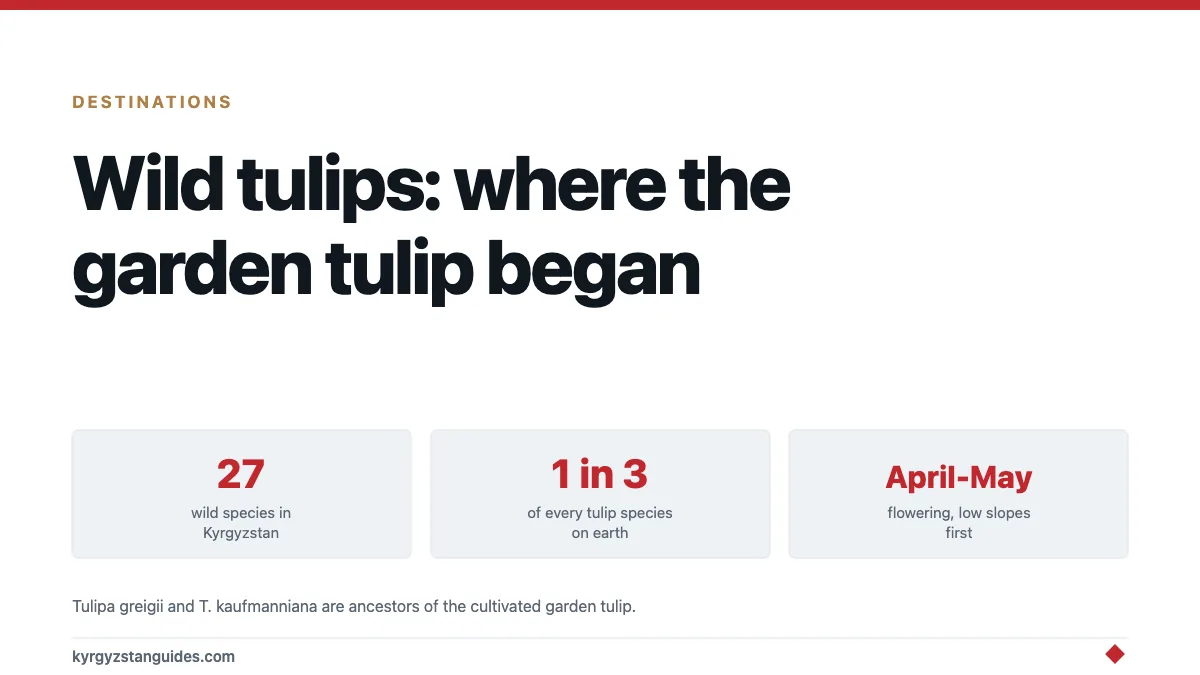
The tulips in a Dutch bulb catalogue trace back to mountainsides in Kyrgyzstan, and in April and May you can stand on the slope they came from. The country holds 27 wild tulip species, roughly a third of every species on earth, and two of them, Tulipa greigii and Tulipa kaufmanniana, are the wild ancestors behind a great many of the cultivated varieties sold in Europe every spring.
Which makes this one of the few things Kyrgyzstan is genuinely first in the world at, and almost nobody comes for it.
Why the tulip is a Central Asian plant
The association with Holland is a trade story, not a botanical one. Tulips reached Ottoman gardens, moved into European ones in the sixteenth century, and the Dutch built an industry on them. The plants themselves evolved on the dry, stony slopes of Central Asia, and researchers consider the region the most likely centre of origin for the genus.
Kyrgyzstan sits near the middle of that range. Tulipa greigii grows wild only in the northern and western Tien Shan, and matters enough to plant breeders that it has its own group in the horticultural classification. Tulipa kaufmanniana, the other heavyweight, grows wild nowhere but these mountains and their neighbours in Tajikistan and Kazakhstan.
A team from Cambridge University Botanic Garden went looking for them in 2018, partly because wild populations are under pressure from grazing and collection, and the expedition write-up is the clearest account in English of what these plants look like where they actually live. Short stems. Nothing like the tall, uniform thing in a florist's bucket.
Twenty-seven species is a lot for one country, and they're not evenly spread. Some are widespread across the Tien Shan; others sit in a single valley system and nowhere else on earth, which is what makes the grazing pressure a real conservation question rather than a rhetorical one. The Cambridge expedition was partly a seed-collecting trip for exactly that reason, and a write-up of the fieldwork describes hillsides where sheep had cropped the flowers before the botanists reached them.
There's a second reason plant people care. A wild population carries genetic variation that a century of commercial breeding has narrowed out of the cultivated stock — disease resistance, drought tolerance, traits nobody has needed yet. Lose the hillside and you lose the library.
When they flower
April and May, and the window moves with altitude the way everything here does.
Lower slopes in the south go first. Batken and the country around Osh start in April, and the Chuy valley near Bishkek follows. Higher ground runs later into May, and a cold spring pushes the whole thing back by a fortnight without warning anyone.
That variability is the practical problem with planning a trip around them. You can't book a tulip week eight months out and expect to land on it. What you can do is aim for late April, keep the itinerary loose, and treat the flowers as the reason you're in a particular valley rather than the fixed point the whole trip turns on.
Our guide to spring in Kyrgyzstan covers what else is open in those weeks, which matters because most of the high country still isn't.
Which species you're likely to meet
Names are worth knowing here, because the differences are visible once you've been told what to look at.
Tulipa greigii is the showy one — broad leaves, often mottled or striped with purple-brown, and a large flower in scarlet or orange. It's the parent of the Greigii garden group, and it's the species most people picture when they hear "wild tulip".
Tulipa kaufmanniana is smaller and earlier, cream to yellow with a pink or red flush on the outside of the petals, opening flat in sun like a waterlily. Which is where its garden name comes from. Kew's Plants of the World Online gives its native range as Central Asia alone — Kyrgyzstan, Kazakhstan, Uzbekistan and Tajikistan, and nowhere else on earth.
Tulipa ostrowskiana and Tulipa zenaidae turn up on the Bishkek-side slopes and in Ala-Archa, smaller again, easy to walk past.
Where to actually go
| Where | Species reported | Getting there |
|---|---|---|
| Ala-Archa National Park | Tulipa zenaidae, T. ostrowskiana | 40 min from Bishkek, ~500 KGS entry |
| Chuy valley — Kegeti, Shamshy gorges | Mixed | Day trip from Bishkek by car |
| Talas valley, northern slopes | T. greigii, T. ostrowskiana | 5–7 hrs from Bishkek |
| Arslanbob walnut forest | Under the walnut canopy | 3.5–4 hrs from Osh |
| Batken region, Kara-Bak | T. greigii, T. kaufmanniana | Remote; far southwest |
Ala-Archa is the easy answer if you're short on time. You're 40 minutes from the capital, the gate takes about 500 som for foreigners, and the lower meadows are walkable without committing to anything. The Ala-Archa guide has the access detail.
Arslanbob is the more interesting one, and the more photogenic. Tulips flowering under the world's largest natural walnut forest is a genuinely unusual combination, and it comes with the village, the waterfalls and a CBT homestay network already set up for visitors. See our Arslanbob guide for the practical side.
Batken has the concentration and almost nothing else. It's the far southwest, it takes real effort to reach, and it's the answer if the tulips are the entire point of the trip rather than a bonus.
Don't dig them up
Worth saying directly, because it comes up.
Wild tulip populations here are under pressure: overgrazing, land conversion, and collection of bulbs. Taking bulbs out of a wild population is damaging and, for getting them home, pointless: bulbs are plant material, and moving them across borders runs into phytosanitary rules that exist precisely to stop this.
If you want greigii in your garden, buy it from a nursery. The cultivated stock descends from these same plants and has for well over a century.
What this trip isn't
An honest word, since tour operators sell "tulip tours" and the photographs are extremely good.
You aren't going to see fields of tulips. The image in your head (dense blocks of colour to the horizon) is a Dutch commercial bulb field, not a Tien Shan hillside. What grows here's scattered: individual plants and loose groups on stony ground, often small, often among other spring flowers, sometimes taking a walk of an hour before you find a good stand.
For a botanist or a patient photographer, that's the appeal. If you were expecting Keukenhof at altitude, you'll be disappointed by lunchtime on day one.
Combining it with the rest of a trip
Late April is awkward in Kyrgyzstan and the tulips are one of the few good reasons to be here then. The high passes are shut, Song-Kul's yurt camps haven't opened, and Ala-Kul is under snow.
What is open: the Issyk-Kul shore, the lower Chuy valleys, Arslanbob and the south, Bishkek and Osh. So a tulip-season trip naturally becomes a low-altitude trip (the walnut forest, the lake, the towns, the gorges near the capital) which is a perfectly good two weeks and one almost nobody plans deliberately.
If you'd rather wait for the mountains, when the passes open sets out the timing valley by valley.
FAQ
When do wild tulips bloom in Kyrgyzstan?
April and May, starting lower and moving uphill. Batken, Osh and the Chuy valley go first in April; higher ground runs into May. A cold spring can delay the whole season by around two weeks, so keep the dates flexible.
Are tulips really from Kyrgyzstan?
The genus originated in Central Asia, and Kyrgyzstan holds 27 wild species. About a third of the world's total. Tulipa greigii and Tulipa kaufmanniana, both native to the Tien Shan, are ancestors of many cultivated garden tulips.
Where is the best place to see wild tulips in Kyrgyzstan?
Ala-Archa is the most accessible, 40 minutes from Bishkek. Arslanbob offers tulips under the walnut forest. Batken has the richest populations but takes real effort to reach.
Can I take tulip bulbs home from Kyrgyzstan?
No. Wild populations are already under pressure from grazing and collection, and bulbs are plant material subject to phytosanitary controls at borders. Buy cultivated stock from a nursery at home instead.
Do I need a guide to find wild tulips?
Not at Ala-Archa or the Chuy gorges, where you can walk the lower meadows yourself. For Batken or a species-specific search, a local botanical guide saves days. These are scattered plants on big slopes, not marked fields.
Is late April a good time to visit Kyrgyzstan generally?
For low-altitude travel, yes. The lake, the southern valleys and the cities are all open. For trekking, no. The high passes are still closed and the Song-Kul yurt camps haven't opened for the season.
Tulips are the famous ones, but they are a small part of it: see Kyrgyz wildflowers beyond the tulips for the foxtail lilies, the endemic irises and what the Red Book actually protects.