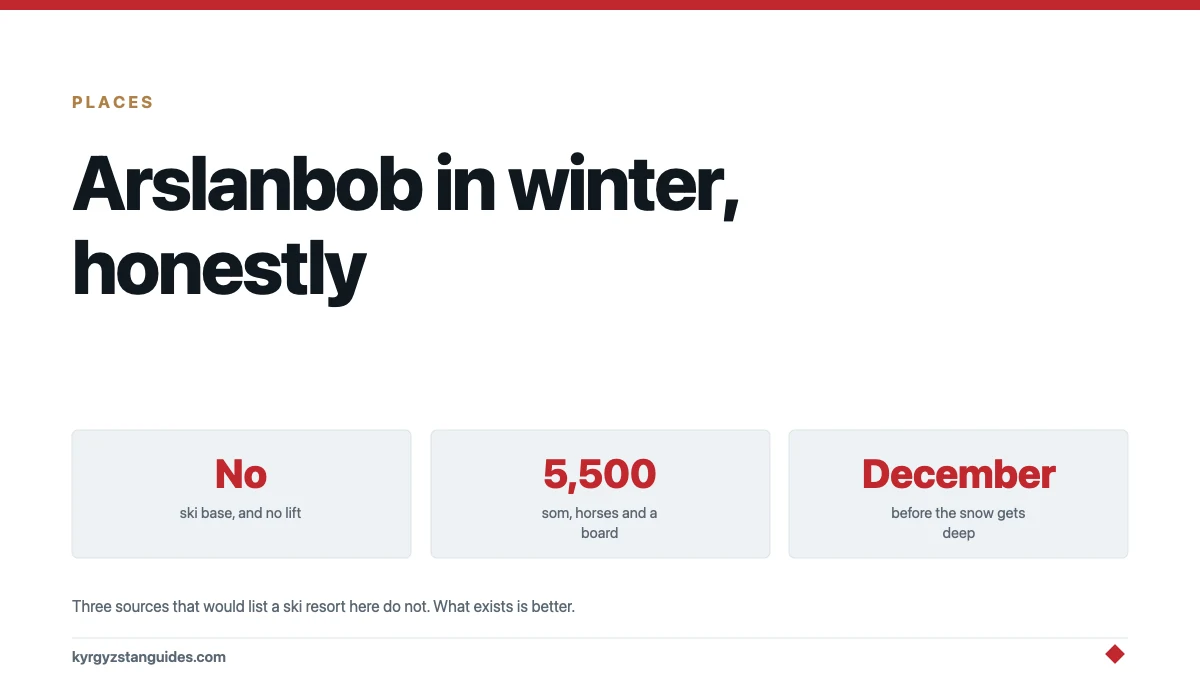
You will find "Arslanbob ski base" written in various places, with a 1,400-metre lift and prices per hour.
We could not confirm that any of it exists. Three separate sources that would list a ski resort here do not: the most detailed independent guide to the village covers it at length and states that all skiing there is backcountry skiing by default, with no lift prices because there are no lifts; the national tourism board's Arslanbob page makes no mention of any ski facility or winter sport at all; and a Kyrgyz survey of the country's ski bases — which covers Kashkulak, Karakol, Too-Ashuu, Orlovka, Chunkurchak, ZiL, Toguz-Bulak and others — does not include Arslanbob.
Whatever the village may have had in Soviet times, no operating lift-served ski base there is documented by anything we could open. We are stating that plainly rather than repeating figures we cannot trace.
What actually happens in winter
Something considerably more interesting than a chairlift.
The winter activity that exists is horse-assisted backcountry snowboarding and skiing, arranged through the local community tourism office. A first-hand December account describes it:
Horses carry you up to roughly 2,500 metres, onto wide, gently sloping agricultural land above the village. You ride down through fresh powder. No lifts, no piste, no queue.
Total 5,500 som for two people — 4,700 som for horses, guide and lunch, plus 800 som for snowboard rental. That is the only itemised winter price in som we could verify for Arslanbob, and the account is undated beyond "December", so treat it as historical rather than current.
The horses are tame enough for complete beginners. The slope is gentle and the runs are short. The framing in the account is that it feels more authentic and interesting than a resort, not that it is better skiing — which is the honest way to put it.
The constraint nobody mentions
Here is the operational detail that decides your trip.
That December visit happened in December specifically because the snow level was still manageable for the horses, and the visitors were explicitly unsure whether January to March would work.
Think about what that means. The access method has a snow ceiling. Too much snow and the horses cannot get up. So the practical window is early winter, not midwinter — the opposite of how a ski destination normally works.
Independent guidance gives December and January as the best months for skiing here, with February possible.
The village out of season
Arslanbob is a mountain village at 1,600 metres in Jalal-Abad oblast, predominantly Uzbek-speaking, which makes it feel like the Ferghana valley rather than the Kyrgyz mountains. It has an 80-metre waterfall and a second smaller one.
Its whole economy and tourist season is the walnut forest. The harvest runs late September to early October, when nearly the entire village decamps to camp under the trees for close to a month, and the community office runs a walnut harvest festival on the first weekend of October. The forest draws around 10,000 people seasonally at harvest, including Uzbeks from the Ferghana valley.
Peak tourist months are June, July and August, plus the harvest.
Which leaves winter as the quietest the village gets: snow-covered, mountain roads harder and often needing 4WD up from Bazar-Korgon, and the multi-day treks to the Holy Lakes and the high passes shut. Community homestays stay open year-round.
That is the genuine draw. An Uzbek mountain village with no other tourists in it. See our Arslanbob guide for the rest of the year and the walnut harvest for the autumn.
Why we are being this careful
A note on method, because refusing to print a price list is unusual for a travel article.
The "Arslanbob ski base" figures circulate widely: a lift length, a base altitude, weekday and weekend hourly rates, rental costs. They look authoritative because they are specific. We could not trace a single one of them to a page that would open.
Specific numbers with no reachable source are the most dangerous kind of travel information, because they survive copying better than vague ones do. A reader who turns up at Arslanbob in February with 2,500 som expecting an hour on a lift has been failed by whoever wrote that down first and by everyone who repeated it.
So: if an operating ski base exists at Arslanbob, we would like to know and will say so. On the evidence available, it does not, and the three sources most likely to list it do not.
What to do instead if you want lifts
If lift-served skiing is what you actually want in Kyrgyzstan, the country has it — just not here.
Karakol is the best of it: chairlifts, groomed runs, rental, a ski school and a town at the bottom. It is at the opposite end of the country from Arslanbob, on the eastern shore of Issyk-Kul.
Several smaller bases operate near Bishkek. For ski touring rather than lifts, Jyrgalan in winter is the specialist answer, with snowmobile access and no patrol.
Arslanbob is worth a winter visit for the village, the emptiness and the horses. It is not worth a winter visit for the skiing, and anyone travelling the length of the country expecting a resort will be disappointed on arrival.
Getting there
Osh to Arslanbob is 200 som, plus about 20 som for the local hop up to the turbaza within the village. From Jalal-Abad it is roughly an hour and a half by shared taxi; from Bazar-Korgon about thirty minutes.
In winter, expect the final climb to need four-wheel drive.
One figure to be careful with
The national tourism board states the walnut forest covers 600,000 hectares and calls it the largest natural walnut forest on Earth.
The most detailed independent source says flatly that the size of the forest is under debate, gives no hectare figure, notes the stands are a thousand years old at most two thousand, that the forest is shrinking from grazing, haymaking and climate change, and that it remains the world's largest source of walnuts.
The 600,000-hectare figure almost certainly describes the whole walnut-fruit forest belt of southern Kyrgyzstan, not the Arslanbob stand. Do not repeat it as the size of this forest. Our guide to the walnut-fruit forests covers the belt as a whole.
What we could not establish
Whether the community office still runs the winter horse-and-snowboard product at all, and what it costs in 2026. Whether any ski base or lift ever existed here. Snow depth, reliability and typical road closures from January to March. The real hectarage of the Arslanbob stand. And whether the harvest festival ran in 2025 or is scheduled for 2026.
If winter is your plan, write to the community office before booking flights.
FAQ
Is there a ski resort at Arslanbob?
No lift-served ski base is documented by any source we could open. The most detailed independent guide states that all skiing at Arslanbob is backcountry by default, the national tourism board's page mentions no winter sport, and a Kyrgyz survey of the country's ski bases omits Arslanbob entirely.
Can you ski at Arslanbob?
Yes, but by horse. The winter activity that exists is horse-assisted backcountry snowboarding and skiing arranged through the community tourism office — horses carry you to around 2,500 metres and you ride down through powder. A December account gives 5,500 som for two people including horses, guide, lunch and board rental.
When is the best time to ski at Arslanbob?
December and January, with February possible. The unusual constraint is that the horse access has a snow ceiling — too much snow and the horses cannot get up — so early winter works better than midwinter, which is the opposite of a normal ski destination.
What is Arslanbob like in winter?
Quiet, snow-covered and almost empty of tourists. The multi-day treks to the Holy Lakes and the high passes are shut and the road up from Bazar-Korgon often needs four-wheel drive, but the community homestays stay open year-round.
How do I get to Arslanbob?
Osh to Arslanbob is 200 som, plus about 20 som for the local hop up to the turbaza. From Jalal-Abad it is about an hour and a half by shared taxi, and from Bazar-Korgon about thirty minutes.
How big is the Arslanbob walnut forest?
Disputed. The national tourism board says 600,000 hectares, but that figure almost certainly covers the whole southern Kyrgyz walnut-fruit forest belt rather than the Arslanbob stand, and the most detailed independent source declines to give a number at all, saying the size is under debate and the forest is shrinking.