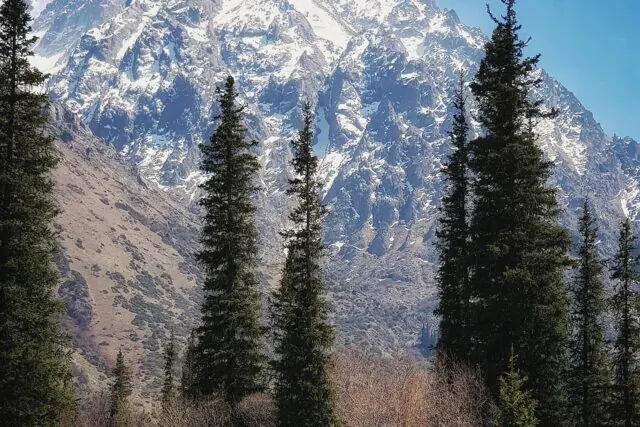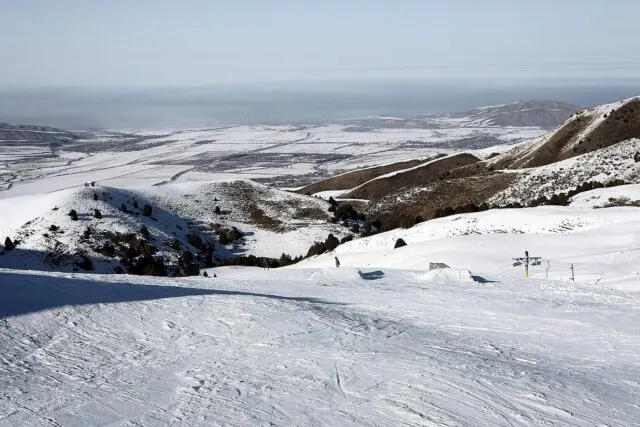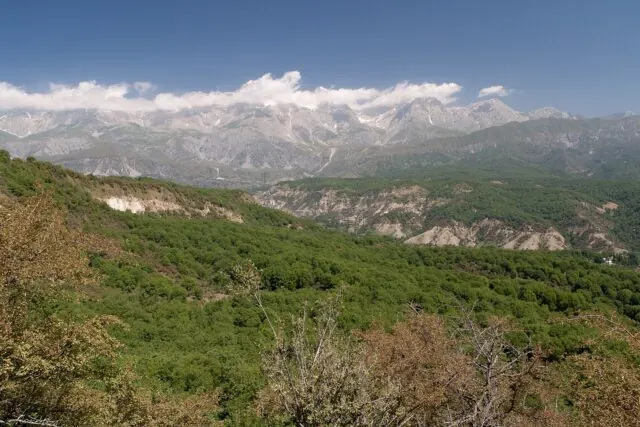
There are no lifts at Jyrgalan. No piste, no patrol, no ticket office. Everything is ski touring, splitboarding and snowshoeing, with snowmobile assist, starting directly from the guesthouse doors.
That is the pitch, and it is a good one. But the more interesting thing about this village is what is underneath it: a coal mine that opened in 1959, flooded in 2012, and that people with presidential attention and Russian development money have been trying to restart ever since — in the same valley the tourist board markets as a ski destination.
The basics
Jyrgalan sits at roughly 2,250 metres, about 60 kilometres from Karakol, at the head of a dead-end valley in the Terskey Ala-Too. Nobody passes through by accident.
Season: December through April. January to March are the powder months.
Marshrutka 380 from Karakol takes about an hour for 100 som. See our Jyrgalan guide for the village year-round.
What it costs
These are the destination organisation's own posted rates, checked in September 2026:
| Item | Price |
|---|---|
| Snowmobile tour | From 5,000 som per person |
| Snowmobile towing for freeride access | $120 per person |
| Finnish sauna at a village guesthouse | 3,000 som per hour, minimum two hours |
| Gear rental | Full ski, snowboard and snowshoe kit — price not published |
Snowmobile bookings need a minimum of two machines and advance notice; towing needs several days.
For a guided multi-day package, a specialist operator was quoting €3,600 for one person down to €1,350 each at six for eight days of ski touring in the 2025/26 season, with a six-day option at $1,100 for one down to $650 each at four or more.
Guesthouses are widely reported at $15 to $28 a night with meal plans at $8 to $15 a day. Those are third-party figures rather than published tariffs.
What is conspicuously not published anywhere: guide day rates, rental prices in som, avalanche-kit hire, or any snow-depth figure.
The thing that is not published, and matters
There is no avalanche bulletin for this area that we could find. No forecast provision, no published guide certification standard, no patrol.
That is the honest counterpart to "no lift queues". The terrain is described by the destination organisation itself as ranging from beginner to extreme, and the extreme end is uncontrolled backcountry in a country with no national mountain rescue service, where helicopter evacuation is a private arrangement taking days if it happens at all. Our guide to Kyrgyzstan's hardest treks sets out that context.
Take the avalanche gear, take a guide, and do not assume that a marked trekking network in summer implies any equivalent in winter.
The mine
This is the part nobody writes about, and it is documented in detail by Kyrgyz reporting.
1949: the mine is founded after a Soviet decree ordering two Kyrgyz sites prepared for pits of 200,000 to 300,000 tonnes a year.
1959: it enters operation, producing high-quality grade D coal — described as equal to the Kazakh coal Kyrgyzstan now imports to fire the Bishkek power plant.
Reserves are assessed at 18 million tonnes. Design capacity was 100,000 tonnes a year; actual output in recent decades never exceeded 50,000. Lifetime production: over four million tonnes.
1996: converted to a joint-stock company, 71 per cent state-held.
2002–2005: the state put 22.4 million som of budget money in. An audit then judged the mine inefficient, and it was sold at auction with all its property for 12 million som.
The buyer was Sabyr Japarov, brother of Sadyr Japarov, now the country's president. Chinese investors were brought in. Residents later complained that Chinese workers arrived with the new equipment while locals were left out. Sabyr Japarov's account is that the mine recovered and paid its taxes and wages on time, then was buried under inspections connected to his brother's political activity, after which the investor walked away and the operation collapsed.
September 2012: a fire. Work stopped permanently and the mine flooded.
A case was opened against a former State Property Fund head, and the anti-corruption service found privatisation violations causing roughly 22.4 million som of damage to the state. Russian companies were approached in 2010 and an investment tender floated in 2014; both failed. In February 2017 the licence was annulled.
And then it did not end. In 2023 the Cabinet claimed the deposit had been restarted after twelve years idle and would supply Karakol with coal. A former Issyk-Kul governor, a journalist and the son of a former pit owner all countered that what existed was a mini-mine. The president has said a businessman took a $1.7 million loan from the Russian-Kyrgyz Development Fund and bought a new conveyor system.
Why that matters to a skier
Because the tourism is a consequence of the closure, not a coincidence.
With the mine shut and people leaving, the village turned to ecotourism. By 2021 it offered eight homestays, two yurt camps and one guesthouse, and the destination organisation now publishes a full catalogue of treks and winter activities.
The tension is real and worth stating: the coal is not definitively dead. There is presidential attention, development-bank money and an active argument about whether the restart is real. A ski-touring village and a working coal mine in the same dead-end valley are not obviously compatible, and which way that goes is not settled.
How it compares with Karakol
Worth setting out, because most people will be choosing between the two and they are not the same product.
Karakol has the country's best lift-served ski area: chairlifts, groomed runs, rental shops, ski school, patrol, and a town with restaurants at the bottom. If you want to ski laps without carrying anything uphill, that is where you go.
Jyrgalan has none of that and offers the opposite: you earn every metre or you pay for a snowmobile to tow you, the terrain is uncontrolled, and there is essentially nobody else on it.
The practical split is skill and intent. A confident piste skier who has never toured will have a better week at Karakol. A ski tourer or splitboarder with avalanche training and a partner will find Jyrgalan the reason to come to Kyrgyzstan at all.
You can also do both. They are an hour apart on the same road, and a week that starts on lifts and finishes on skins is a sensible shape for a first trip.
Practical notes
Book ahead, and further ahead than you think. The village has a handful of guesthouses, snowmobile capacity is limited to whatever machines are running, and towing needs several days' notice. This is not a place with spare inventory in February.
Bring your own avalanche kit if you have one. Rental gear is available but the destination organisation does not publish what it has or what it costs, and turning up expecting a transceiver, shovel and probe to be waiting is a poor plan.
Cash. Assume no card payment and no ATM in the village. Draw som in Karakol.
Altitude is modest but the cold is not. At 2,250 metres in a dead-end valley in January, the nights are severe. The guesthouses are heated; the terrain is not.
What else there is in winter
Half-day and full-day snowshoeing and snowmobiling tours, and the sauna. That is the published list.
The summer trekking network — the Keskenkija Loop, Boz-Uchuk lakes, the Ailampa glacier loop — is not a winter product. Those are June to September routes.
FAQ
Is there a ski lift at Jyrgalan?
No. There are no lifts, no pistes and no patrol. Everything is ski touring, splitboarding or snowshoeing with snowmobile assistance, starting from the guesthouses. That is the attraction and also the risk.
When is the ski season at Jyrgalan?
December through April, according to the local destination organisation, with January to March generally the best powder months.
How much does skiing at Jyrgalan cost?
Snowmobile tours start at 5,000 som per person and snowmobile towing for freeride access is quoted at $120 per person. A sauna is 3,000 som an hour with a two-hour minimum. Guided multi-day packages from specialist operators ran from about €1,350 to €3,600 per person for eight days in the 2025/26 season depending on group size.
Is there avalanche forecasting at Jyrgalan?
None that we could find. There is no published bulletin, no patrol and no national mountain rescue service in Kyrgyzstan. Helicopter evacuation is a private arrangement that can take days. Bring avalanche equipment and hire a guide.
How do I get to Jyrgalan in winter?
Marshrutka 380 from Karakol, about an hour, 100 som. Jyrgalan is 60 kilometres east of Karakol at the head of a dead-end valley, so there is no through traffic.
What happened to the Jyrgalan coal mine?
It opened in 1959, was privatised in the 2000s to the current president's brother, caught fire in September 2012 and flooded, and had its licence annulled in February 2017. Efforts to restart it continued into 2023 with a $1.7 million development-bank loan, and whether the restart is real is disputed locally.