On the second afternoon of the Keskenkija loop, you crest a pass a little above 3,400 m and the whole eastern Terskey opens out in front of you — ridge behind ridge, a green valley dropping away, and not another trekker in sight. That moment is the reason this trek exists on people’s lists.
The Keskenkija loop is Jyrgalan’s flagship route: a three-day, two-night circuit of roughly 40–45 km that strings together a waterfall, two high passes, and open summer pastures, starting and finishing in Jyrgalan village. It's moderately hard: you cross ground above 3,000 m and gain real altitude each day. But it's well marked, well supported, and easy to arrange, which sets it apart from the country’s rougher DIY treks.
Why Jyrgalan, and why this loop
Jyrgalan is a former coal-mining village that reinvented itself as a community-tourism base, and the payoff for trekkers is a network of marked, maintained trails with yurt camps stationed along them. The Keskenkija loop is the one everyone starts with because it packs the region’s best scenery into a manageable three days without needing a support crew or serious navigation skills. If you are weighing it against the busier east, our Jyrgalan travel guide covers the village itself, and the wider Kyrgyzstan trekking guide sets it against Ala-Kul and Song-Kul.
Day by day
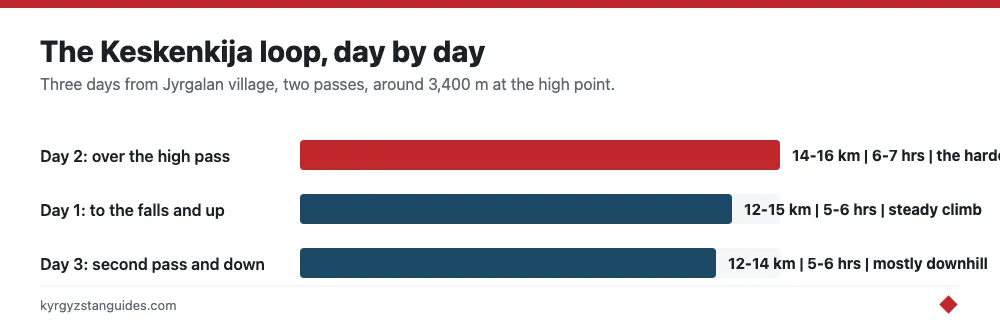
Distances and times vary with the exact route your guide picks and the weather, but the shape holds. Here is the standard three-day version:
| Day | Route | Rough stats | Sleep |
|---|---|---|---|
| 1 | Jyrgalan to Keskenkija falls and up the valley to the first camp | ~12–15 km, 5–6 hrs, steady climb | Yurt camp / tent |
| 2 | Over the high pass (~3,400 m) into the next valley | ~14–16 km, 6–7 hrs, the hardest day | Yurt camp / tent |
| 3 | Second pass and long descent back to Jyrgalan | ~12–14 km, 5–6 hrs, mostly downhill | Guesthouse in village |
Day one eases you in. You leave the village on a clear track, reach the Keskenkija waterfall within a couple of hours, then keep climbing through spruce and out onto open pasture to the first night’s camp. It is a warm-up day with a scenic payoff and no pass to worry about.
Day two is the crux. The trail grinds up to the main pass above 3,400 m: the highest point of the loop and where altitude will slow you if you haven't acclimatized. From there it drops into a fresh valley of jailoo and grazing herds. It's the longest day and the one most exposed to weather, so an early start matters.
Day three crosses a second, gentler pass and then descends steadily back toward Jyrgalan, delivering you to a hot shower and a guesthouse bed by mid-afternoon. Tired legs, but the hard climbing is behind you.
Where you sleep
The two nights on the trail are the loop’s real luxury. Jyrgalan’s tourism association runs seasonal yurt camps along the route, so instead of carrying a tent you can book a bed under felt with dinner and breakfast included — a hot meal and a warm quilt at 3,000 m after a day on the pass. Camps operate from roughly mid-June to mid-September; outside that window, or if they are full, you camp. If a night in a yurt is new to you, our yurt stay guide explains the etiquette. Book the camps in advance through the village. Turning up and hoping isn't a plan.
How hard is it, really
Call it moderate-to-hard. The trail itself is non-technical (no scrambling, no glacier) but you spend real time above 3,000 m and gain 800–1,000 m on the big days, so cardiovascular fitness and a day or two of acclimatization matter more than mountaineering skill. Because the yurt camps handle food and shelter, your pack stays light, which takes a lot of the sting out of the passes. The honest limiter is altitude and weather, not difficulty of ground.
Arranging it
This is one of the simplest multi-day treks in the country to set up. Jyrgalan’s destination-management organization can package the whole thing, guide, yurt-camp beds, meals, and a horse if you want one, as a fixed itinerary, and you can arrange it a day or two ahead in the village or by email before you arrive. A guide runs roughly 3,000–5,000 KGS ($34–57) a day, a yurt night with full board 2,000–3,000 KGS, and a pack or riding horse 1,500–2,500 KGS. There is no permit or park fee. Figures are 2026 rates at around 88 KGS to the dollar, and the total sits well within a mid-range Kyrgyzstan travel budget.
Getting to Jyrgalan is a marshrutka or shared taxi from Karakol (roughly 150–250 KGS, about 1.5 hours), so most people stage out of Karakol the night before.
Before you commit, check off this list
- You have a spare day or two around it to acclimatize: do not fly in and hit a 3,400 m pass cold.
- You have booked the yurt camps ahead, not assumed they will have space.
- You're carrying a warm sleeping layer and a -5°C bag if camping; nights freeze even in July.
- You have offline maps loaded and a windproof shell for the passes.
- You have told your guesthouse your route and return date before walking out of signal.
The mine did not close when the Soviet Union did
Jyrgalan is usually introduced as a coal village abandoned when the USSR fell. That is not what the record says, and the real sequence is better.
The mine was founded by a Soviet Council of Ministers order in 1949 and commissioned in 1959. Over its life it produced more than four million tonnes, against a design output of 100,000 tonnes a year and actual output under 50,000 in later decades. It was corporatised in 1996 with the state holding 71 per cent, and eventually sold at auction for 12 million som — the buyer being Sabyr Japarov, brother of the president.
The end came in September 2012, when a fire stopped production and the workings flooded. The licence was finally cancelled in February 2017. So the village lost its employer two decades after independence, not at independence, and the tourism project began almost immediately afterwards rather than after a long decline.
The 2022 census counted 998 residents. Jyrgalan is classed as a village now, having previously been a town-type settlement — the administrative demotion that follows this kind of closure.
Tourism here is barely older than the mine's licence cancellation. Six families formed a destination management organisation in late 2016, in a place where, by its own account, tourism “did not even exist in 2015”. USAID's Business Growth Initiative supported the first eighteen months, ending in June 2018, with training in guesthouse management, first aid and trekking guiding. The organisation funds itself by taking 20 per cent of equipment rental and 10 per cent of guesthouse bookings. Roughly 500 tourists came in the winter of 2017–18.
Two honest gaps: I could not find a documented jobs-created figure, or any visitor total for the village beyond that single winter estimate, and published sources disagree about when the mine first opened, with 1932 appearing in tourism material against 1949 in the news record. There is also still coal here — a small mine was reported operating and paying tax in 2023, so the reinvented valley sits beside a working one.
Frequently Asked Questions
Do I need a guide for the Keskenkija loop?
Not strictly. The trail is marked — but we recommend one. A guide handles the yurt-camp logistics, reads the weather on the passes, and knows the exact line where the path fades across pasture. On a trek this affordable, it's cheap insurance for a first-timer.
How fit do I need to be?
Reasonably fit and comfortable walking 5–7 hours a day with altitude gain. There is no technical climbing, but the two passes above 3,000 m will test anyone who hasn't acclimatized. A couple of easier days beforehand makes a big difference.
When is the loop open?
Roughly mid-June to mid-September, when the passes are clear of snow and the yurt camps are staffed. Early June can still hold snow up high, and by late September nights freeze hard and the camps close for the season.
Can I do it on horseback?
Yes. Jyrgalan is set up for horse treks, and you can ride most of the loop with a guide leading. It is a good option if you would rather not carry a pack or grind up the passes on foot, though the steepest descents are usually done leading the horse.
Is it busy?
Far quieter than Ala-Kul. Jyrgalan sees a fraction of the traffic of the Karakol trailheads, so even in peak August you'll share the passes with only a handful of people, if any.
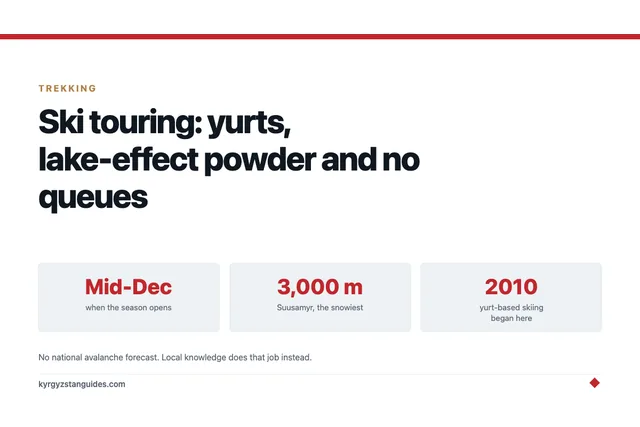
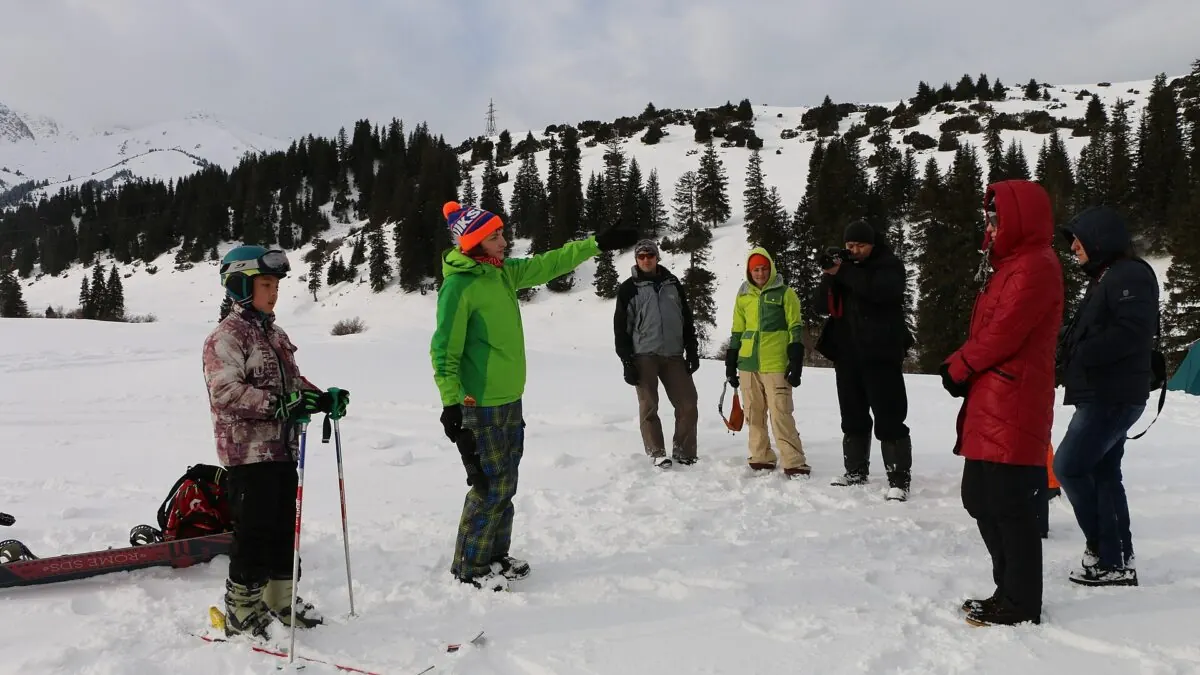
Trekking is only half of Jyrgalan’s year: in the snow months the village turns into a ski-touring base — no lifts, no patrol. Jyrgalan in winter covers that side, posted prices and the coal mine under the village included.
What happened to the Jyrgalan coal mine?
It was founded by Soviet order in 1949, commissioned in 1959, and produced over four million tonnes. A fire stopped production in September 2012 and the workings flooded; the licence was cancelled in February 2017. The village therefore lost its employer two decades after independence, not at independence as is usually said.
How many people live in Jyrgalan?
998 at the 2022 census. The settlement is now classed as a village, having previously been a town-type settlement, which is the administrative demotion that normally follows a mine closure.
How did Jyrgalan become a trekking destination?
Six families formed a destination management organisation in late 2016, in a village where tourism did not exist in 2015. USAID's Business Growth Initiative supported the first eighteen months to June 2018 with training in guesthouse management, first aid and guiding. The organisation funds itself from 20 per cent of equipment rental and 10 per cent of guesthouse bookings.