There is a boulder in Issyk-Ata gorge with a Buddha carved into it, cut at a date nobody has settled, when this valley sat on a branch of the Silk Road and Buddhism still had a foothold in the Tien Shan. A few hundred meters away, workers in a concrete Soviet sanatorium have been prescribing the same thermal water for joint complaints since 1931. Few places compress this much Central Asian history into one small mountain valley. And almost no foreign travelers come.
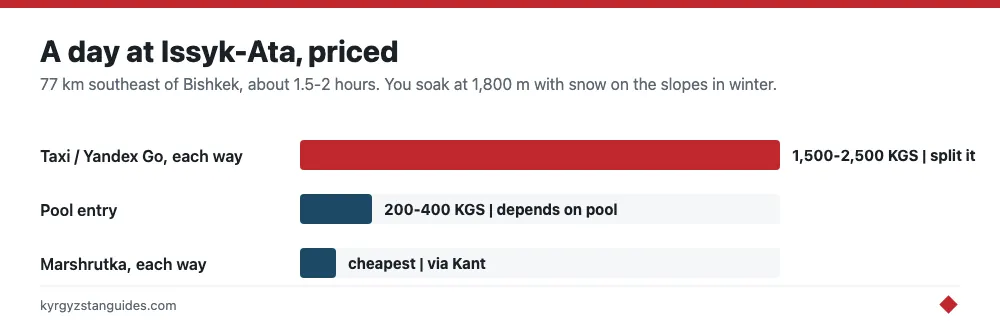
The essentials: Issyk-Ata is a hot-spring resort 77 km southeast of Bishkek, reachable by marshrutka or taxi in about 1.5-2 hours. Entry to the territory and pools is cheap, figure around 200-400 KGS depending on which pool and what day, and the valley behind the sanatorium offers easy, beautiful walking. It works as a day trip with no planning beyond an early start.
The thermal pools
The springs emerge at around 50-55°C and feed several pools on the sanatorium grounds. The main outdoor swimming pool is kept at a comfortable warm-bath temperature and is the one most day visitors use; smaller and hotter soaking pools and indoor bath cabins exist for those on treatment programs. The water is mildly mineralized, silky rather than sulfurous, without the rotten-egg smell that puts people off some hot springs.
The setting is the real selling point. You're soaking at about 1,800 m with steep green slopes rising on both sides, and in the colder months, snow down to the pool fence. Like Altyn-Arashan near Karakol, this is a place where the temperature contrast is the show — Issyk-Ata just happens to require a marshrutka instead of a day’s hike. Weekends draw Bishkek families in numbers; go midweek if you want space to float.
Bring a swimsuit, towel, flip-flops, and a swim cap if you plan to use the main pool — staff sometimes enforce the old Soviet cap rule, and buying one on site is a lottery. Lockers exist but are basic; leave valuables in Bishkek.
The Buddha stone and short walks
The carved boulder sits near the sanatorium grounds and takes ten minutes to find, ask anyone for “Budda” and they'll point. The relief is worn and easiest to read in angled morning or evening light, but it's genuine, roughly 1,200 years old, and standing in front of it while sanatorium loudspeakers crackle somewhere behind you is a very Kyrgyzstan collision of eras.
Beyond the buildings, a dirt track continues up the gorge along the Issyk-Ata river. This is easy, gently rising walking, no scrambling, no navigation, through meadows that fill with wildflowers in June. Walk an hour and turn around, or push roughly 8-10 km up-valley toward a waterfall if you want a full hiking day: a route that also features in Trekking Union of Kyrgyzstan group outings. Herders graze horses through here all summer, and the further you go, the more the valley feels like proper backcountry rather than resort fringe.
Getting there by marshrutka
Marshrutkas toward Issyk-Ata leave from Bishkek’s eastern bus station area, typically via the town of Kant; service runs a few times daily and costs around 100-150 KGS, taking up to two hours with stops. Departure times drift with the seasons, so confirm the schedule the day before, your guesthouse can call. The lazier and still-cheap option is a taxi or Yandex Go at roughly 1,500-2,500 KGS each way; split among three or four people it beats the marshrutka on every metric except price purity. General ground-transport tactics are in our getting around guide.
Aim to arrive by late morning. That leaves time for a valley walk before a long afternoon soak, with the last marshrutka or your arranged car back before dark. Note that return marshrutkas thin out by late afternoon: this is the one logistical trap of the trip, so lock in your ride home first, not last.
Staying overnight, honestly described
You can sleep at the sanatorium, and rooms with meals and treatment access are startlingly cheap. Often the price of a hostel bed in Western Europe for full board. But be clear about what you're buying: this is a functioning post-Soviet health resort, not a spa hotel. Expect thin towels, institutional food on a schedule, hot water that keeps its own hours, and corridors that haven't been touched since the Brezhnev era. Some travelers find that genuinely wonderful — a living museum you can sleep in, populated by pensioners on prescribed soaking regimens. Others last one night and flee to Bishkek.
We would recommend the overnight only to travelers who already know they enjoy faded-Soviet atmosphere for its own sake. Everyone else gets 90 percent of the experience from a day trip. In winter the calculus improves, steaming outdoor water, snowbound valley, almost no other guests. And it makes a fine easy outing in a season with limited options, as covered in our winter guide.
Is it worth your day?
Yes, with one caveat: manage expectations on polish. Issyk-Ata is cheap, historic, scenic, and utterly unpackaged for foreign tourism. That is the appeal and the warning in one sentence. Pair it with a couple of city days from our Bishkek guide and you have a varied capital-region itinerary without a single long drive.
Two things here that sound documented and are not
Issyk-Ata attracts confident numbers. Two of the most repeated do not survive checking, and it is better to know that than to quote them.
The water temperature and mineral composition. You will see "+54 °C year-round", precise ranges of 48.5 to 54.4 °C, a chemistry of nitrogen-siliceous chloride-sulphate hydrocarbonate-sodium water, a radon figure, six boreholes at 26.6 litres a second, and 130 springs. Every one of those traces back to the same encyclopedic source and its copies. The sanatorium's own operator page states no temperature and no composition at all. The springs are genuinely hot and genuinely mineral. Beyond that, treat any specific figure as unverified.
The Buddha carving's date. There is a relief of a Buddha with Tibetan inscriptions on a boulder in the gorge, partly gilded by modern devotees. Its existence is not in doubt. Proposed datings run from the 8th to 10th centuries, to simply "10th century", and — by analogy with the Tamga Tash inscriptions on Issyk-Kul, which UNESCO's own dossier assigns to Jungar times, the 15th to 18th centuries — potentially far later. A 2025 peer-reviewed paper on Tibetan inscriptions in Kyrgyzstan exists but I could not obtain it. Nobody should be giving you a century for this carving, including me.
What the sanatorium actually is
The parts that are documented are worth having. The Ysyk-Ata sanatorium sits on the right bank of the river about 78 km from Bishkek at 1,775 m, and has been operating since 1891. It holds 274 guests, is run by the Federation of Trade Unions of Kyrgyzstan, and consists of five sleeping blocks, a polyclinic, a water-and-mud treatment centre and the open-air mineral pool most day visitors use.
It is classified as a balneo-mud facility and treats musculoskeletal, nervous-system, gynaecological and digestive conditions. That framing matters for what you should expect: this is a medical institution that admits day bathers, not a spa that happens to have doctors.
It reopened on 17 December 2024 after reconstruction, with the president attending. The main buildings date from the Soviet build-out of the 1930s to 1960s, after which the place deteriorated through underinvestment and, as the state news agency put it, illegal land privatisation.
One correction on status: Issyk-Ata gorge is not inside a protected area. Chuy oblast's nature parks are Ala-Archa, established 1976, and Chon-Kemin, established 1997 in Kemin district. Neither covers this valley.
FAQ
How much does Issyk-Ata hot springs cost?
Budget around 200-400 KGS for pool access, with small extra charges possible for lockers or hotter soaking pools. Even with a taxi from Bishkek split between passengers, the whole day trip rarely exceeds $15-20 per person.
Can I visit Issyk-Ata as a day trip without a tour?
Easily. Take a morning marshrutka (around 100-150 KGS, up to 2 hours) or a taxi (1,500-2,500 KGS each way), soak and walk, and return by late afternoon. Just confirm your return transport early — marshrutkas back to Bishkek thin out after mid-afternoon.
Is the Issyk-Ata sanatorium worth staying in overnight?
Only if faded Soviet resorts appeal to you as an experience. Rooms and full board are very cheap, but conditions are institutional — set meal times, dated rooms, unreliable hot water. Most travelers are happier with the day trip.
How hot are the Issyk-Ata hot springs?
Nobody publishes a verified figure. The commonly quoted 54 °C and the detailed mineral composition all trace to one encyclopedic source and its copies; the sanatorium's own operator page states neither. The water is hot and mineral — treat specific numbers as unverified.
How old is the Issyk-Ata Buddha carving?
Unsettled. Proposed dates range from the 8th to 10th centuries to considerably later — comparable Tibetan inscriptions elsewhere in Kyrgyzstan are dated by UNESCO to the 15th to 18th centuries. No reliable source gives a century for this one.
What is the Issyk-Ata sanatorium?
A balneo-mud medical facility at 1,775 m, about 78 km from Bishkek, operating since 1891 and run by the Federation of Trade Unions of Kyrgyzstan. It holds 274 guests and reopened on 17 December 2024 after reconstruction.
Can day visitors use the Issyk-Ata pools?
Yes. The open-air mineral pool is the one most day visitors use, with smaller hotter soaking pools and indoor bath cabins for those on treatment programmes. Remember it is a medical institution admitting bathers, not a resort spa.
Is Issyk-Ata gorge a protected area?
No. Chuy oblast's nature parks are Ala-Archa, from 1976, and Chon-Kemin, from 1997 in Kemin district. Neither covers Issyk-Ata.