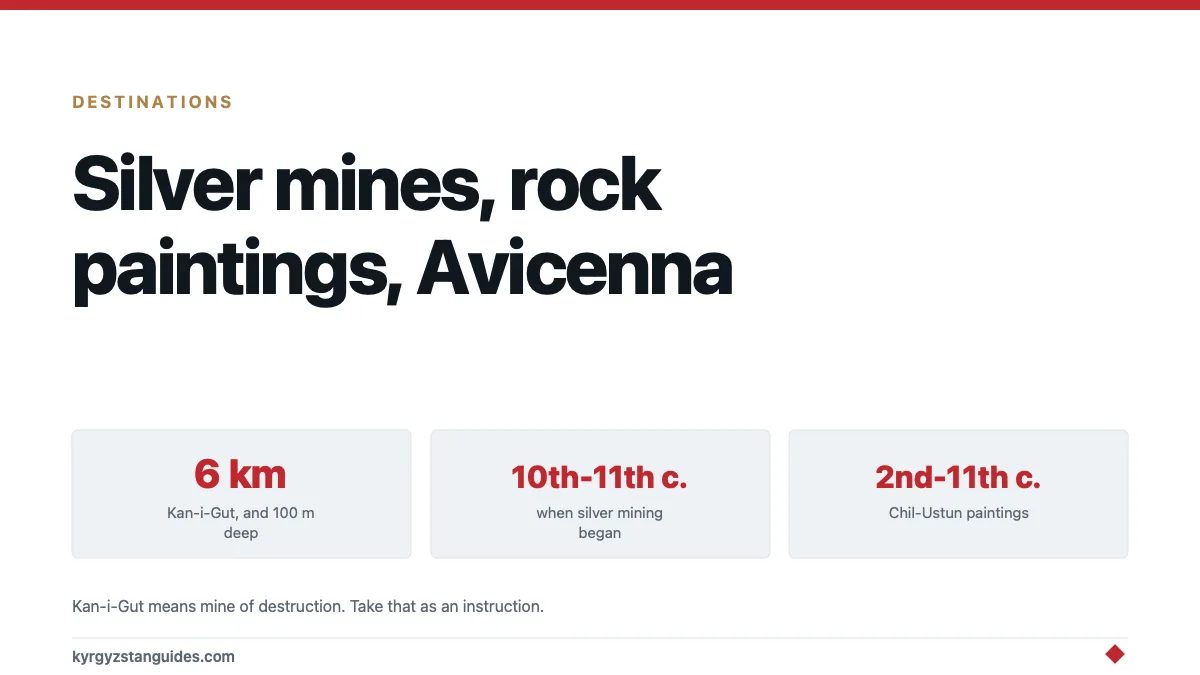
In Batken region there is a cave called Kan-i-Gut — "mine of destruction" — that runs over six kilometres and 100 metres deep, through 18 large caverns linked by narrow passages and tunnels.
It was being mined for silver in the tenth and eleventh centuries. It appears in the writing of Ibn Sina — Avicenna. The physician and philosopher whose name is now, by a strange loop, attached to Lenin Peak.
And nearly half of its mapped length was only discovered in 2017. That is recent work by cavers, not a historical record.
Kyrgyzstan's caves are almost entirely absent from travel writing, and two of them are genuinely significant.
Kan-i-Gut
The name is usually given as "mine of destruction" or "mine of perdition", and the reputation is old. Local legend holds that people went in and didn't come out.
The reality is more interesting than the legend. It is an ancient silver mine (worked from the tenth or eleventh century, possibly earlier) cut into a natural karst system, so what you have is a cave that people spent centuries extending.
That makes it an archaeological site as much as a geological one: tool marks, working galleries, and the remains of a medieval extractive industry inside a limestone massif.
It sits in Batken region, the country's most overlooked province and the one better known outside for border complications and the world's last mercury mine.
Descriptions of the cave consistently note the combination that makes it unusual: a natural karst system extended by centuries of human mining.
It isn't a show cave. There is no lighting, no walkway, no ticket office. Entry requires a guide who knows the system, proper equipment, and a genuine understanding that an unmapped medieval mine is a serious environment.
Chil-Ustun
Smaller, far more accessible, and the one with the art.
Documentation of Kyrgyz caves lists the main systems and where they are.
Chil-Ustun, also called Aravan cave, sits in Paleozoic limestone about 3.5 km from Aravan in Osh region. The cave is around 380 metres long, and the entrance is an arc roughly 15 metres high and 25 metres wide, impressive before you go anywhere near the dark.
Inside are galleries of ancient rock paintings, dated from around the second to the eleventh centuries.
The name means "forty columns", for the formations.
This sits in the same archaeological landscape as Sulaiman-Too in Osh — a pre-Islamic sacred geography of caves, rocks and springs that Islam absorbed rather than replaced, and which is still visited.
Aravan itself is known for a separate rock-art site depicting horses, which is the other reason to go.
Why there are caves here at all
Karst. Specifically, limestone.
The Fergana range and the ridges around Osh and Batken include substantial Paleozoic limestone, and limestone dissolves in slightly acidic groundwater over geological time. That produces the cavities, passages and formations that make a cave.
The northern Tien Shan around Bishkek and Issyk-Kul is largely granite, gneiss and sedimentary rock without the same karst development, which is why the caves are overwhelmingly in the south. The International Union of Speleology maintains the wider context for how these systems are surveyed and recorded.
Going caving
Realistic expectations, because this is not a developed activity.
There is no show-cave infrastructure. No lit walkways, no guided tours on a schedule, no safety railings.
You need a local caving contact. Kyrgyz speleological groups exist and are the route in. Turning up at an entrance is not the plan. Ask through an operator in Osh or Batken rather than searching for a contact from abroad.
Equipment matters. Helmet, three light sources, appropriate clothing, and someone who knows the system.
Tell someone. The same principle as everything else in this country — see our mountain rescue guide. There is no cave rescue service.
Do not go into Kan-i-Gut casually. A six-kilometre unmapped medieval mine with a name meaning "destruction" isn't a place to wander into with a phone torch.
Chil-Ustun is the realistic visit for an ordinary traveller — large entrance, short system, near a road, reachable from Osh.
The legend, and what's under it
Kan-i-Gut's reputation is worth taking seriously as evidence rather than dismissing as folklore.
The stories are consistent: people entered and did not return, and the cave was said to swallow those who went in for the silver. A name meaning destruction isn't chosen casually.
There is a plain reading. An unlit, unmapped, multi-level mine with eighteen caverns and narrow connecting passages is an environment in which a person without a light and a plan dies. Medieval miners worked it by lamp, and lamps go out.
There is a second reading that's also plausible: bad air. Mine workings accumulate carbon dioxide and can be depleted of oxygen in low-lying chambers, with no warning and no smell. A person walking into a pocket of it collapses within a minute or two, and anyone going to help collapses as well. That pattern (several people lost together) is what generates legends of caves that swallow people.
Either way the legend is a safety instruction rendered in narrative, which is what a great many legends are. Treat it as one.
The other underground place
Worth mentioning because it is the one visitors are most likely to actually enter.
Chon-Tuz, near Kochkor, is a 500-metre horizontal gallery cut into a salt mountain and operating as a speleotherapy sanatorium — beds underground, for asthma patients, since 1980. It's a mine rather than a cave and it's a genuinely strange place.
If you want to be underground in Kyrgyzstan and you're not a caver, that is the answer.
Why it matters
Because caves preserve things that surfaces do not.
Rock paintings from the second to the eleventh centuries survive at Chil-Ustun because they're out of the weather. Tool marks from an eleventh-century silver operation survive at Kan-i-Gut for the same reason. The Saimaluu-Tash petroglyphs at 3,000 m are under snow most of the year, which does the same job.
In a country where the record is thin — where the Saka kurgans are found by road crews and the medieval towns are under a lake. The places that happen to be sheltered carry more than their share of the evidence.
FAQ
What is Kan-i-Gut?
An ancient silver mine in a karst cave system in Batken region, over six kilometres long and 100 metres deep, with 18 large caverns. It was worked from the tenth or eleventh century and is mentioned by Ibn Sina.
Are there rock paintings in Kyrgyz caves?
Yes. Chil-Ustun cave near Aravan in Osh region contains galleries of paintings dated from roughly the second to the eleventh centuries.
Can tourists visit Kyrgyz caves?
There is no show-cave infrastructure. No lighting, walkways or scheduled tours. Chil-Ustun is the most accessible; Kan-i-Gut requires a knowledgeable guide and proper equipment.
Where are Kyrgyzstan's caves?
Overwhelmingly in the south, in the Paleozoic limestone of the Fergana range and the ridges around Osh and Batken, where karst has developed.
How long is Chil-Ustun cave?
About 380 metres, with an entrance arch roughly 15 metres high and 25 metres wide, some 3.5 km from Aravan.
Is there a cave rescue service in Kyrgyzstan?
No. Caving here requires local contacts, proper equipment and telling someone your plan, as with any remote activity in the country.