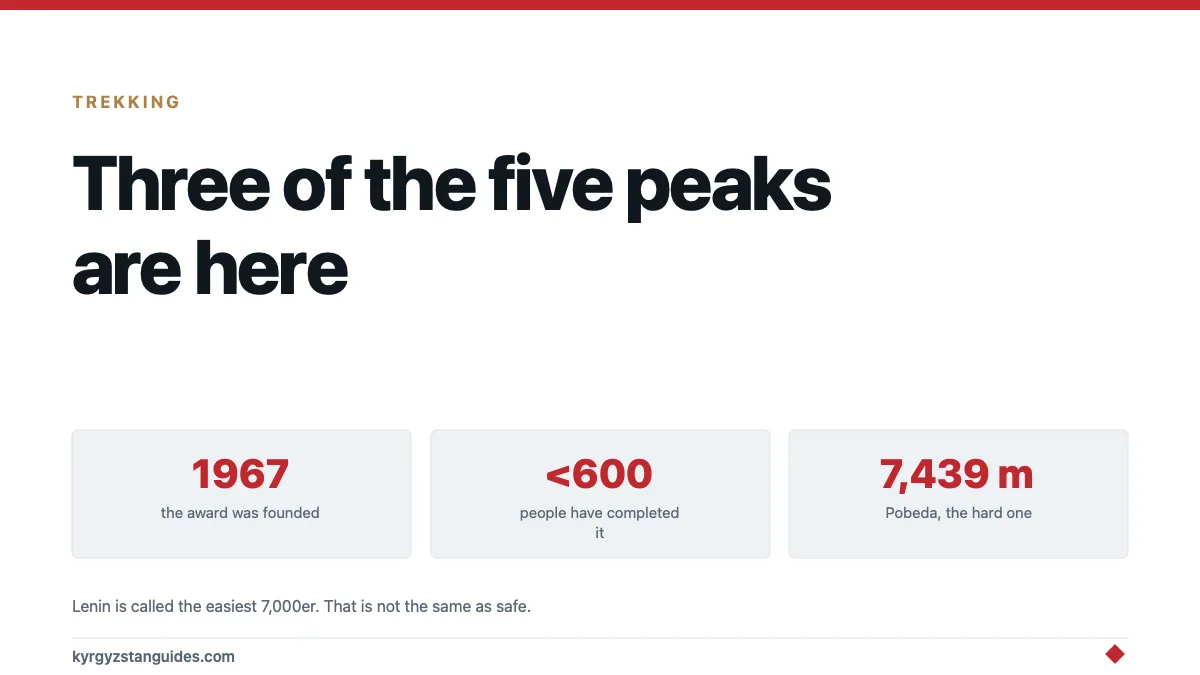
There is a Soviet mountaineering title called Snow Leopard, founded on 12 October 1967, awarded for climbing all five peaks in the former USSR above 7,000 metres.
Fewer than six hundred people have ever completed it.
And three of those five mountains are in or on the borders of Kyrgyzstan — a country most visitors arrive in thinking of as a trekking destination rather than a serious mountaineering one.
The five peaks
| Peak | Height | Range | Where |
|---|---|---|---|
| Ismoil Somoni (ex-Communism) | 7,495 m | Pamir | Tajikistan |
| Jengish Chokusu (ex-Pobeda) | 7,439 m | Tien Shan | Kyrgyzstan / China |
| Ibn Sina (ex-Lenin) | 7,134 m | Pamir | Kyrgyzstan / Tajikistan |
| Ozodi (ex-Korzhenevskaya) | 7,105 m | Pamir | Tajikistan |
| Khan Tengri | 7,010 m | Tien Shan | Kyrgyzstan / Kazakhstan |
The renaming is its own piece of history. Communism Peak became Ismoil Somoni after the Samanid ruler; Lenin Peak became Ibn Sina after the philosopher-physician; Pobeda ("Victory") became Jengish Chokusu, which means the same thing in Kyrgyz.
Almost nobody uses the new names. Climbers say Lenin, Pobeda and Communism, and so will everybody you meet.
Which is the hard one
Not the highest.
Ibn Sina / Lenin Peak, 7,134 m is widely called the easiest 7,000er in the world, which is why it's the one most people attempt and why the 1990 disaster that killed 43 climbers happened there. Technically straightforward, objectively dangerous, and reachable from Sary-Mogol by road to a base camp at 3,600 m, as our base camp trek guide covers.
Jengish Chokusu / Pobeda, 7,439 m is the serious one. It is frequently described as the hardest of the five and among the most dangerous 7,000-metre peaks anywhere: an enormous, exposed summit ridge, appalling weather, extreme cold for its latitude, and a long way from any help. Its death rate is the reason it has the reputation. Summaries of the five peaks consistently place it as the crux of the set.
Expedition operators running the challenge treat it as a multi-year commitment for exactly this reason.
Khan Tengri, 7,010 m is the beautiful one — a marble pyramid that turns red at sunset, which is where its Kyrgyz name Kan-Too, blood mountain, comes from. Technically harder than Lenin, and the aesthetic objective of the group.
Two of the three Kyrgyz peaks are reached from the Inylchek glacier, which is also where the lake that empties itself every August sits.
What it takes
This is not a trek with a certificate at the end.
Five separate expeditions, usually across several years, each requiring altitude acclimatisation, permits and a weather window.
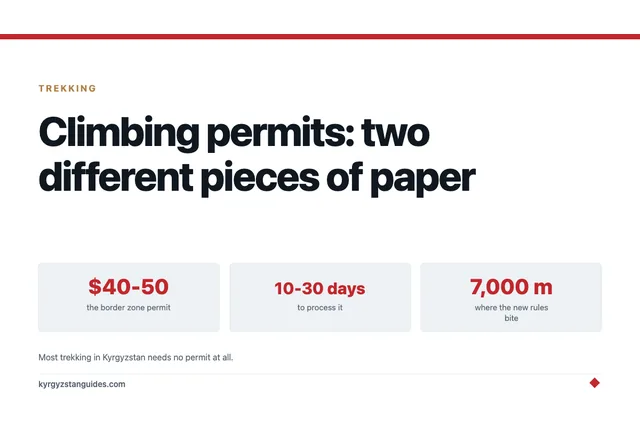
Two countries minimum, with the Pamir peaks in Tajikistan and the Tien Shan ones in Kyrgyzstan, and border-zone permits on both sides. Our mountaineering permits guide covers the Kyrgyz side.
Real money. Helicopter access to the Inylchek, expedition logistics, and the time to wait out weather.
Genuine risk. These are not guided-summit mountains in the Himalayan commercial sense. Mountain rescue here is limited, evacuation is expensive and slow, and Pobeda in particular kills experienced people.
Fewer than six hundred completions in nearly sixty years is the honest measure of how hard it is. ExplorersWeb's introduction to the challenge sets out what each peak demands.
The Soviet system that produced it
Worth understanding, because the award is a cultural artefact as much as a mountaineering one.
Soviet alpinism was organised, state-funded and hierarchical. Climbers progressed through formal grades, trained at institutional camps, and were awarded titles (Master of Sport, Honoured Master of Sport) on a points system. The Snow Leopard sat inside that structure as a specific, checkable achievement.
It also had a nationalist frame. The five peaks were the highest in the Soviet Union, and climbing all of them was implicitly a statement about the territory. Three of the five carried the names Communism, Lenin and Victory.
Two consequences followed from the system.
It produced extremely tough climbers with very high altitude experience and limited access to Western equipment, which is why Soviet and post-Soviet alpinists have a particular reputation.
It produced mass expeditions. Large teams, camps, and a lot of people on a mountain at once: which is the background to both the 1974 loss of an eight-woman team on Lenin Peak and the 43 deaths in 1990.
When the USSR dissolved, the peaks ended up in three countries and the award ended up administered by nobody in particular. It is still recognised across the CIS, and it is still the thing that brings serious alpinists to Kyrgyzstan.
Why this matters to a non-climber
Because it changes what you are looking at.
Kyrgyzstan is marketed as yurts, horses and alpine meadows, and those are real. It is also a country containing two of the five highest mountains of the entire Soviet Union, a glacier system among the largest outside the poles, and terrain that a serious alpinist regards as a career objective.
Standing at Pik Lenin base camp, or looking east from Karakol toward the Inylchek, you are at the edge of that. You cannot see Khan Tengri from a road, and the fact that it is several days' walk from the nearest one is the point.
Our piece on the explorers covers the earlier phase of the same story — Merzbacher going in specifically to find out where Khan Tengri actually was, and producing the first accurate map of it in 1905.
Can you get close?
Yes, at three levels.
Trekking. Pik Lenin base camp at Achik-Tash, around 3,600 m, reached by vehicle, with day walks up toward Camp 1. This is genuinely accessible and one of the best short trips in the country.
Expedition-supported. South Inylchek base camp below Khan Tengri and Pobeda, by helicopter from Karkara or by a multi-day glacier trek. Border-zone permits required, and it's expedition logistics rather than tourism.
Not at all, for Pobeda. There is no casual way to look at Jengish Chokusu. It's a long way in, and that's part of why it retains the reputation it has.
For most visitors the answer is Achik-Tash, and it is a good answer. Our hardest treks guide covers what sits between trekking and mountaineering here.
FAQ
What is the Snow Leopard award?
A Soviet mountaineering title founded on 12 October 1967, awarded for summiting all five peaks in the former USSR above 7,000 metres. Fewer than 600 people have completed it.
Which peaks make up the Snow Leopard?
Ismoil Somoni (7,495 m), Jengish Chokusu or Pobeda (7,439 m), Ibn Sina or Lenin Peak (7,134 m), Ozodi or Korzhenevskaya (7,105 m) and Khan Tengri (7,010 m).
How many Snow Leopard peaks are in Kyrgyzstan?
Three touch Kyrgyzstan: Jengish Chokusu on the Chinese border, Lenin Peak on the Tajik border, and Khan Tengri on the Kazakh border.
Which Snow Leopard peak is hardest?
Jengish Chokusu, also known as Pobeda, is generally considered the most difficult and among the most dangerous 7,000-metre peaks in the world, despite not being the highest of the five.
Why is Khan Tengri called the blood mountain?
Its Kyrgyz name Kan-Too refers to the red colour the marble summit takes at sunset.
Can trekkers get close to these peaks?
Pik Lenin base camp at around 3,600 m is reachable by vehicle and is a straightforward trekking destination. Khan Tengri requires helicopter access or a multi-day glacier approach with permits.