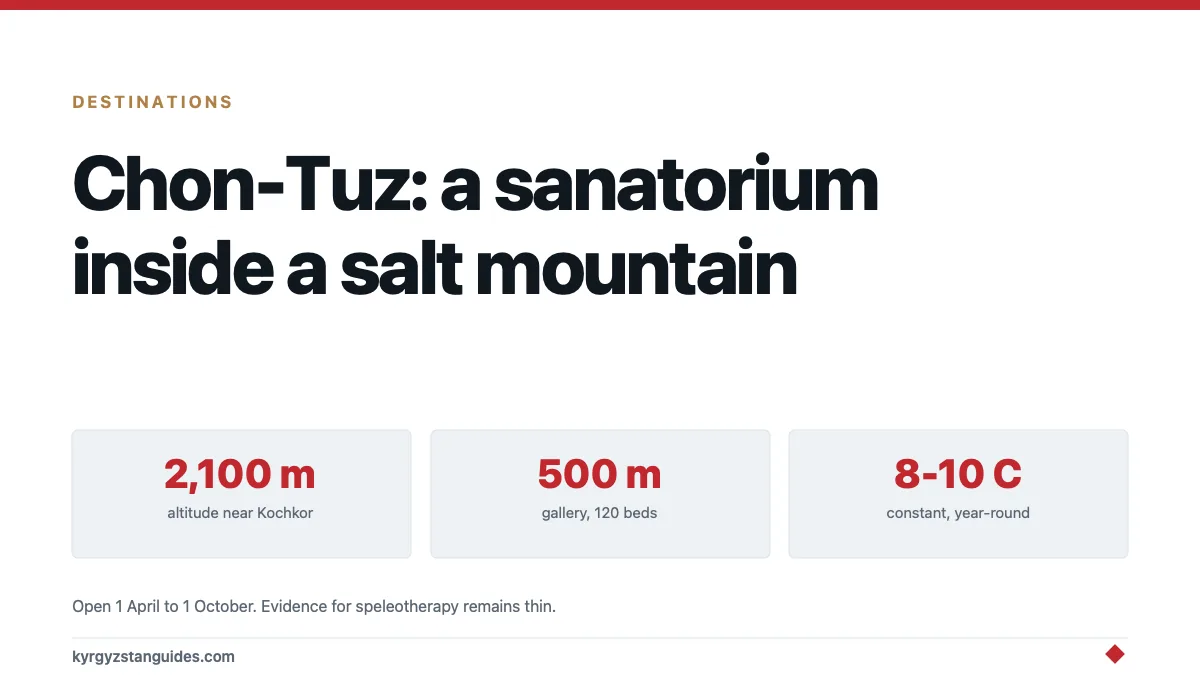
Half an hour from Kochkor, at 2,100 metres, there is a 500-metre tunnel driven horizontally into the Kek-Too mountain. Inside it are beds. People with asthma check in for three weeks and sleep underground in salt air, and have been doing so since 1980.
Chon-Tuz isn't on anybody's Kyrgyzstan itinerary. It appears in Russian-language sanatorium directories, on a handful of local operator listings, and almost nowhere in English travel writing. It is one of the more genuinely unusual places in the country, and this guide covers both what it is and the awkward question of whether it works.
What it actually is
"Chon-Tuz" means big salt. It's the name of the village, the deposit, and the facility.
The gallery is cut horizontally into the mountainside rather than sunk as a shaft — you walk in. The dimensions are unglamorous and specific:
| Feature | Measurement |
|---|---|
| Altitude | 2,100 m |
| Gallery length | 500 m |
| Width | 5 m |
| Height | 3 m |
| Capacity | 120 beds |
| Operating since | 1980 |
| Season | 1 April – 1 October |
Three metres of headroom over five metres of width, for half a kilometre, with wards partitioned along it. It's a working mine repurposed as a hospital, and it doesn't pretend otherwise.
The season is the giveaway that this is a Soviet-designed facility in a mountain region: it closes for winter, when the road over from Kochkor becomes an unreliable proposition.
The conditions inside
Speleotherapy facilities publish their microclimate the way a spa publishes its treatment list, because the microclimate is the treatment. Chon-Tuz's figures:
- Salt aerosol: 5–10 mg per cubic metre of air - Particle size: up to 75% of those crystals under 5 micrometres - Air ionisation: 4,000–11,000 ions per cubic metre - Bacterial load: 3–5 microbes per cubic metre - Temperature: a constant +8 to +10°C - Humidity: 45–65% - Pressure: around 600 mmHg
The particle size is the number that matters and the one worth explaining. Below roughly 5 micrometres, an aerosol particle is small enough to get past the upper airway and reach the bronchi. Larger particles deposit in the nose and throat and never arrive. So a facility claiming 75% of its salt aerosol under that threshold is claiming its air delivers salt where the disease is, which is the entire premise of the treatment.
The bacterial figure is also striking. Three to five microbes per cubic metre is extraordinarily low — ordinary indoor air runs orders of magnitude higher. Salt is hostile to bacteria, and a sealed salt gallery ends up close to sterile by accident.
Note the 600 mmHg. That's the altitude, not the mine: sea level is 760. You are being treated for a respiratory condition in air that is meaningfully thinner than what you breathe at home, which is its own consideration and is covered in our altitude guide.
Does it work?
Here is where this guide has to be honest, because the sanatorium's own literature won't be.
The Cochrane Collaboration reviewed speleotherapy for chronic asthma and found three trials, 124 asthmatic children, and only one of reasonable methodological quality. Two trials suggested short-term benefit to lung function. The conclusion was that the available evidence does not permit a reliable verdict on whether speleotherapy is effective, and that randomised trials with long-term follow-up are needed.
That is not a debunking. It's something more uncomfortable: after decades of practice across the former Soviet bloc and Central Europe, nobody has done the trials that would settle it.
So the accurate statement is that Chon-Tuz offers a treatment with a plausible mechanism, generations of reported patient benefit, and no robust evidence base. Whether that is worth three weeks of your life is a judgement, and it should be made alongside a doctor rather than a brochure.
What we will say without hedging: don't substitute this for asthma medication. If you have a controller inhaler, you take it underground with you.
Can a traveller go?
Realistically, this isn't a drop-in attraction.
The facility is a medical one with a course-based admission: patients come for a stay measured in weeks, not an afternoon. Some local operators in the Kochkor area do arrange visits, and Kochkor is already a stop for people heading to Song-Kul or running shyrdak workshops, so the detour is small if you're in the neighbourhood.
If you want to try:
Arrange it from Kochkor, in advance. Community-based tourism offices there can call ahead. Turning up at the gate of a working sanatorium and asking to look around is not a plan.
Go between April and October. Outside that, it's shut.
Bring a layer. It's 8–10°C inside, permanently, in a country where the summer valley temperature outside might be 30°C. People consistently underdress for this.
Do not expect a tourist experience. There is no gift shop, no lighting design, no interpretive panels. It's a tunnel with hospital beds in it.
Getting to Kochkor first
Chon-Tuz is only reachable via Kochkor, so that's the real logistical question.
Kochkor sits on the Bishkek–Naryn road about 270 km from the capital. Shared taxis and minibuses run from Bishkek’s main bus station on Alma-Atinskaya 1/1 through the day, and the trip takes roughly four to five hours depending on the Dolon pass and how long the driver waits to fill the vehicle. Our Bishkek to Naryn guide covers that road in detail — Kochkor is the turn-off point rather than a separate journey.
From Kochkor the salt mine is a short drive, but not a walkable one, and there is no scheduled transport to it. You are arranging a car.
This is also why Chon-Tuz makes sense as a half-day add-on rather than a destination: you are almost certainly passing through Kochkor anyway on the way to Song-Kul, and the detour costs you an afternoon rather than a day.
Why it's worth knowing about anyway
Even if you never go in, Chon-Tuz tells you something about how healthcare worked here.
The Soviet system built sanatoria at scale and sent people to them on prescription. Mineral water at one place, mountain air at another, salt galleries at a third. It treated geography as a pharmacy. A great many of those facilities across Central Asia and the Caucasus are now ruins; Tskaltubo in Georgia is the famous example, abandoned and photographed to death.
Chon-Tuz is not a ruin. It is still open, still admitting patients, still running the same protocol. In a region littered with the shells of this idea, a functioning example is the rarer thing.
FAQ
Where is the Chon-Tuz salt mine?
In Naryn region, roughly half an hour from Kochkor town, at 2,100 metres. The gallery runs into the Kek-Too mountain.
What is Chon-Tuz used to treat?
Bronchial asthma, chronic bronchitis and some allergic respiratory conditions, through speleotherapy. Extended stays in salt-saturated underground air.
Is speleotherapy scientifically proven?
No. The Cochrane review found only three trials covering 124 children and concluded the evidence does not permit a reliable judgement either way. It's neither proven nor disproven.
When is the Chon-Tuz sanatorium open?
From 1 April to 1 October each year. It closes for the winter.
How cold is it inside the salt mine?
A constant +8 to +10°C year-round, with humidity between 45% and 65%. Bring a warm layer regardless of the outside temperature.
Can tourists visit Chon-Tuz?
It is a medical facility rather than an attraction, but visits can sometimes be arranged through operators in Kochkor. Ask in advance rather than arriving unannounced.