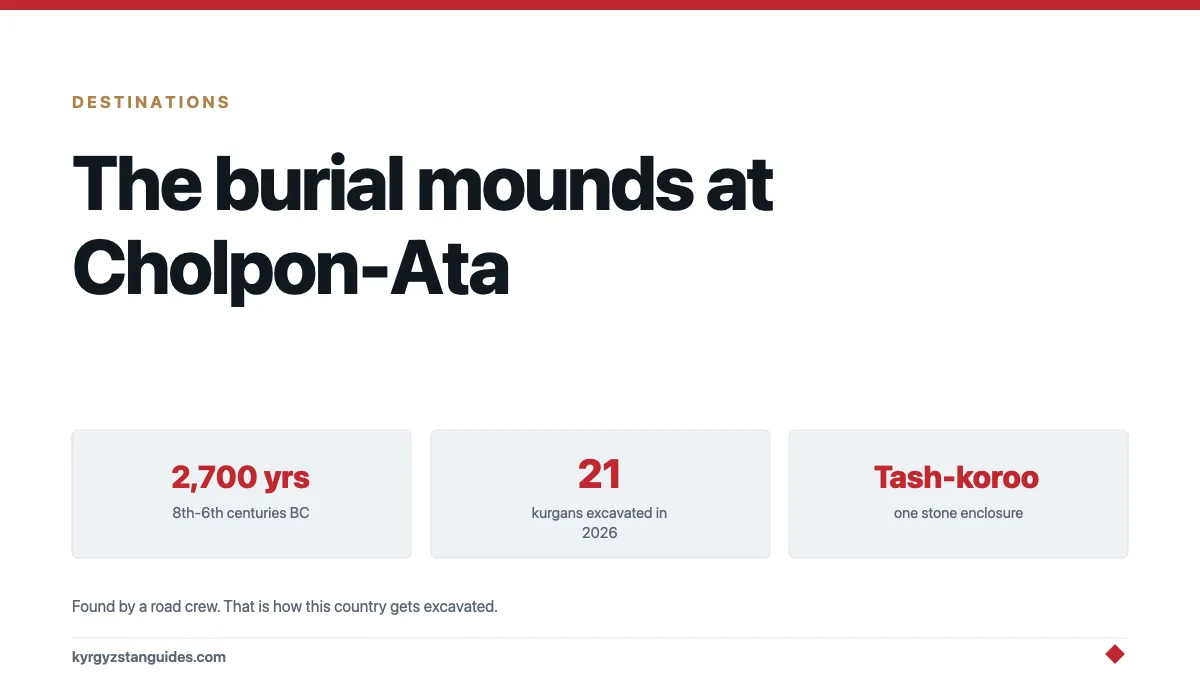
In spring 2026, a bypass road was being built on the northern edge of Cholpon-Ata. The construction ran into a cemetery that had been in the ground for roughly 2,700 years.
Kyrgyz archaeologists examined 22 of 30 heritage objects on the site: 21 kurgan burials and one large stone enclosure, locally called a tash-koroo. The dating put them in the 8th to 6th centuries BC, and the people in them were early Saka: the eastern branch of the Scythian world.
They are still out there. Once you know what a kurgan looks like, the northern shore of Issyk-Kul becomes a different landscape.
Who the Saka were
Mobile pastoralists across the Eurasian steppe from roughly the 9th century BC, known to the Greeks as Scythians and to the Persians as Saka.
The cultural markers are consistent from Ukraine to Mongolia:
Horses at the centre of everything: transport, warfare, wealth and burial.
Kurgan burial, a grave under a raised earth or stone mound, with grave goods and often with horses.
Animal-style art — deer, big cats, raptors and griffins rendered in a distinctive coiled, tense style, usually in gold or bronze.
Elite graves with gold. The most famous being the Golden Man from the Issyk kurgan in south-eastern Kazakhstan, excavated in 1969, buried in a costume covered with thousands of gold plates.
That kurgan is Kazakh, near Almaty, not Kyrgyz. The confusion is easy to make because it shares a name with Issyk-Kul and is a few hours away, but the cultural world is the same one and it reached across the mountains into what is now Kyrgyzstan.
What the 2026 dig found
Not gold. Which is itself worth saying.
The recovered finds included ceramic vessels, a bronze pin and a stone whetstone. The ceramics were most likely burial offerings; the pin was probably part of clothing or personal adornment.
These are ordinary graves of ordinary people, and that's the more informative kind of site. Elite burials tell you what a society aspired to. Twenty-one modest kurgans in a row tell you who was actually living beside this lake in 700 BC, and that there were enough of them, settled enough, to maintain a cemetery.
The excavation was led by the Kyrgyz archaeologist A. Abdykanova and began on 5 April 2026. Fuller coverage of the site describes the enclosure as the most puzzling element of it. Heritage Daily reported the discovery, as did Arkeonews.
The tash-koroo
The single large stone enclosure is the intriguing object.
Tash-koroo translates roughly as stone pen or stone enclosure. Circular or sub-circular stone structures turn up across the steppe in Saka-period contexts and their function isn't settled: ritual enclosure, funerary precinct, the remains of a structure associated with the cemetery, or something else.
That uncertainty is normal in this period. The Saka left no writing. Everything known about them comes from graves, from the objects in them, and from what literate neighbours — Greeks, Persians, Chinese — wrote about them from outside, usually with an agenda.
Rescue archaeology is how this country gets excavated
Worth noticing, because the pattern repeats.
The Cholpon-Ata kurgans weren't found by a research programme. They were found because a road was being built, and they were dug because the law requires heritage assessment before construction proceeds. Thirty objects identified, twenty-two examined, on a schedule set by the roadworks.
That is rescue archaeology, and in Kyrgyzstan it is the main mechanism by which anything gets excavated at all. There isn't the funding for large speculative digs. What there is, increasingly, is construction (roads, bypasses, the railway being cut through the south) and each project turns up whatever happens to be under it.
It has an obvious drawback. What gets investigated is determined by where the diggers are working rather than by what is archaeologically important, and the time available is whatever the contractor can spare.
It also means the record is being written now, in fragments, by small teams working fast. The submerged town in the lake and these kurgans surfaced within a year of each other, both incidentally.
How to see kurgans here
They aren't fenced attractions. They are lumps in fields, and the skill is learning to recognise them.
What to look for. A low, roughly circular mound, a few metres to tens of metres across, often flattened by centuries of ploughing, sometimes with a visible stone kerb. Frequently in lines or clusters, because cemeteries.
Where. The northern shore of Issyk-Kul, the Chuy valley, the Talas valley and the Ketmen-Töbö basin. Once you start seeing them from a car window you will not stop.
Around Cholpon-Ata specifically, alongside the open-air petroglyph field: a very large stone gallery on the edge of town, which is a different and much more visitable site.
In museums. The regional museum at Cholpon-Ata and the State Historical Museum in Bishkek hold material from these excavations.
What not to do. Do not dig, do not take anything, and do not drive onto a mound. Kurgan looting is a genuine problem across Central Asia and casual tourist interference is part of it.
Where this sits in the sequence
Kyrgyzstan's archaeological record around this lake is unusually layered, and the pieces connect.
Bronze Age. The Saimaluu-Tash petroglyphs at over 3,000 m, and the Cholpon-Ata stone field.
Iron Age, 8th–6th c. BC. These Saka kurgans.
Medieval. The Silk Road towns, including the one under the lake, and the Christian cemeteries of the Chuy valley that turned out to hold the origin of the Black Death.
That is roughly three thousand years of continuous occupation around one body of water, most of it undisturbed, much of it unexcavated, and a good deal of it currently being found by road crews.
Our history overview is the short version of how it fits together.
FAQ
What is a kurgan?
A burial mound. A grave covered by a raised heap of earth or stone, used across the Eurasian steppe. Kyrgyzstan has large numbers of them, particularly around Issyk-Kul and in the Chuy and Talas valleys.
Who were the Saka?
Mobile pastoral peoples of the eastern Scythian world, present in Central Asia from around the 9th century BC, known for horse-centred life, kurgan burials, animal-style art and elite gold grave goods.
What was found at Cholpon-Ata in 2026?
Excavation ahead of a bypass road uncovered 21 kurgan burials and a large stone enclosure dated to the 8th–6th centuries BC, with ceramics, a bronze pin and a whetstone recovered.
Is the Golden Man from Kyrgyzstan?
No. The Golden Man was found in the Issyk kurgan in south-eastern Kazakhstan in 1969. The name is similar to Issyk-Kul, but it is a different site in a different country.
Can I visit the Saka kurgans?
They are unmarked mounds in open country rather than a managed site. You can see them from roads around Issyk-Kul and in the Chuy valley, and finds are displayed in museums at Cholpon-Ata and Bishkek.
How old are the Issyk-Kul kurgans?
The Cholpon-Ata group dates to roughly the 8th to 6th centuries BC, making them around 2,700 years old.