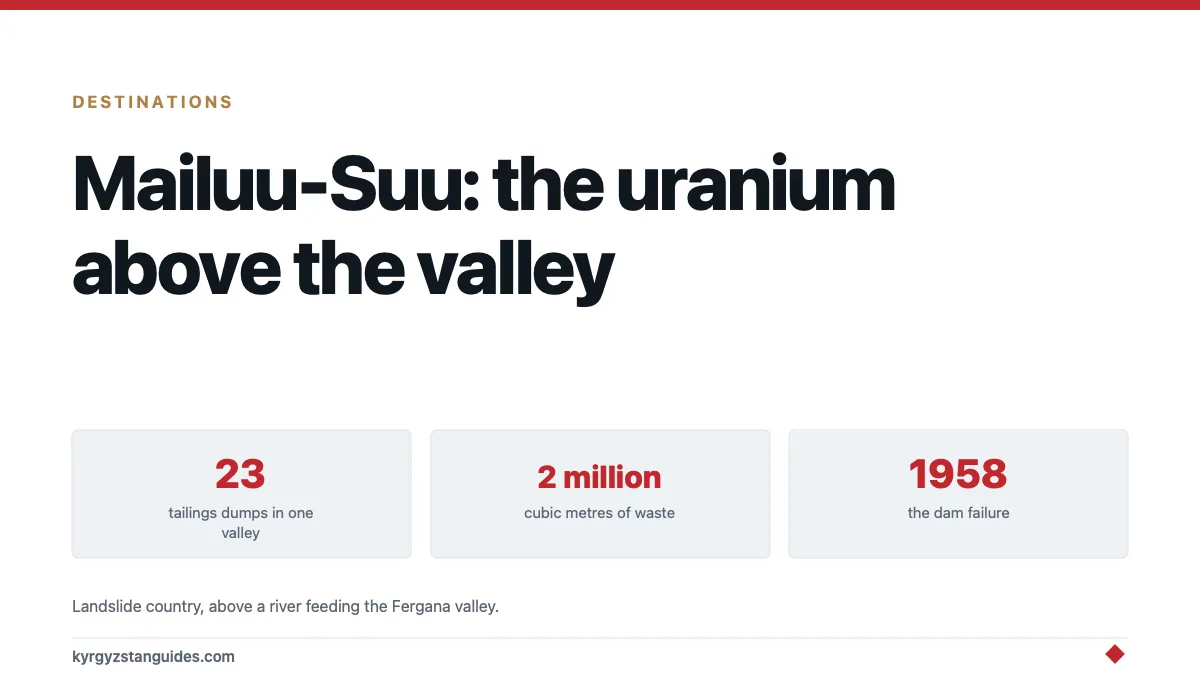
In a narrow valley in Jalal-Abad region there is a town sitting underneath 23 uranium tailings dumps holding around two million cubic metres of radioactive waste, plus 13 mine spoil heaps of roughly another 0.9 million.
They are stacked along the sides of a river valley in one of the most landslide-prone parts of Central Asia. The river below them, the Mailuu-Suu, is a tributary of the Syr Darya and flows into the Fergana valley. The most densely populated agricultural region in Central Asia, with somewhere around fourteen million people in it.
This is not a travel destination and this guide isn't suggesting you go. It is the single most important environmental fact about southern Kyrgyzstan, and almost nothing written for visitors mentions it exists.
Why a uranium town is there
Mailuu-Suu was a closed Soviet city. Between roughly 1946 and 1968 it processed uranium ore (some mined locally, some brought in from elsewhere) and it supplied material to the early Soviet nuclear programme.
Closed cities weren't on maps and were not discussed. They had better supplies, better housing and better schools than surrounding areas, and in exchange their inhabitants lived where they were told, worked on what they were told, and didn't talk about it.
When processing ended, the waste stayed. Tailings — the crushed rock left after the uranium has been extracted — retain most of the original radioactivity, and there's a great deal more tailings than there ever was uranium. They were placed where it was convenient: in the valley, beside the river, below the slopes.
Why the location is the problem
Not the radioactivity in isolation. The geology.
Mailuu-Suu sits in a seismically active, heavily faulted, landslide-prone valley. Slopes here fail regularly. Some of the tailings dumps have already been damaged by landslides, mudslides and floods, and several sit in areas where further major landslides are expected.
The failure mode people worry about is specific and it has already happened once. In 1958 a tailings dam at Mailuu-Suu failed and released waste into the river.
Run that forward with modern population figures. A landslide pushes a tailings dump into the Mailuu-Suu river; the river carries the material down into the Syr Darya system and into the irrigation network of the Fergana valley, where it's used on food crops across three countries. That is the scenario, and it is why this small Kyrgyz town appears in international environmental funding documents out of all proportion to its size.
The same seismic energy that built the mountains is what makes this dangerous. Geology doesn't distinguish between scenery and hazard.
What is being done
Slowly, and with international money, because Kyrgyzstan cannot fund this alone.
A World Bank pilot project over 2010–12 recovered one particularly precarious tailings dam and reburied it, at a cost of $8.4 million. For one dump. That produced an estimate of roughly $50 million to deal with ten other high-risk sites in the area.
More recently, remediation at Mailuu-Suu (the largest uranium legacy site in the country) has been funded through a grant of about €23 million from the Environmental Remediation Account for Central Asia, managed by the EBRD. World Nuclear News reported the start of those works.
The World Nuclear Association's country profile sets out the inventory in detail, and Dialogue Earth has reported from the town itself on what living above it's actually like.
Note the arithmetic. One dump cost $8.4 million. There are 23, plus 13 spoil heaps, plus comparable legacy sites elsewhere in the country. This is a problem measured in decades.
Why this is so hard to fix
A reasonable question: it is a finite pile of rock in a known location, so why is it still there after thirty years?
The volume is the problem, not the danger per tonne. Tailings are low-activity and enormous. Two million cubic metres has to be physically moved, and moving it safely means excavating material that is currently stable, transporting it through a populated valley, and reburying it somewhere that won't fail. Every stage creates exposure that doesn't exist while it sits still.
There is nowhere obviously better. A relocation site needs stable geology, no groundwater connection and no settlement. In a valley system this steep, those sites are scarce and not necessarily close.
Doing nothing is also a decision that costs. Slopes keep moving whether or not anyone acts, so the risk is not static while the funding is arranged.
It's nobody's jurisdiction in the way that matters. The waste is Kyrgyz territory. The population at risk is mostly Uzbek and Tajik. The state that created it dissolved in 1991. That mismatch is precisely why the money has come through multilateral remediation accounts rather than from any single government.
The people who live there
Around twenty thousand, give or take.
They didn't choose this. Most are descendants of people who were posted to a closed city for work, in a system that no longer exists, and there is no obvious elsewhere for them to go. The town has the standard post-Soviet single-industry profile: the industry is gone, the infrastructure it justified is decaying, and the population is older and poorer than the national average.
Health data is contested and incomplete, which is a pattern by now familiar from Khaidarkan and Kumtor. Studies exist, they disagree, and systematic long-term surveillance isn't something this town has had.
What can be said plainly is that people are living among the tailings, and their children play in a valley where the soil in places is not ordinary soil.
Why a traveller should know
You will not visit. You may well drive past the valley on the way between Jalal-Abad and the Uzbek border, and you will have no idea.
Three reasons to carry the knowledge anyway.
It's the cost side of the scenery. Kyrgyzstan is marketed as pristine. The same Soviet system that built the sanatoria, the roads and the electricity grid also left uranium tailings above a river feeding fourteen million people. Both things are true and they are the same history.
It explains the region's water anxiety. When downstream states in the Fergana valley are cautious about what comes out of Kyrgyzstan, this is part of what they mean, alongside the reservoir arguments.
It's a pattern, not an anomaly. Mercury at Khaidarkan, gold and glaciers at Kumtor, uranium at Mailuu-Suu. Extraction here has consistently been organised far away, for benefit realised far away, with the residue left in a valley.
Nobody is asking you to feel bad about a holiday. Just don't repeat the word "untouched".
FAQ
What is Mailuu-Suu?
A town in Jalal-Abad region, southern Kyrgyzstan, that processed uranium ore from roughly 1946 to 1968 as a closed Soviet city, and which is now surrounded by radioactive tailings.
How much uranium waste is at Mailuu-Suu?
Around 23 tailings dumps holding roughly two million cubic metres of material, plus about 13 mine spoil heaps containing a further 0.9 million cubic metres.
Why is Mailuu-Suu dangerous?
The tailings sit in a landslide-prone, seismically active valley above a river that flows into the Syr Darya and the densely populated Fergana valley. A landslide failure could carry radioactive material into an irrigation system serving millions.
Has there been an accident there?
Yes. A tailings dam failed in 1958, releasing waste into the river. Several dumps have since been damaged by landslides, mudslides and floods.
Is anything being done about it?
Yes. A World Bank pilot project reburied one dump at a cost of $8.4 million in 2010–12, and more recent remediation has been funded through roughly €23 million from an EBRD-managed remediation account for Central Asia.
Can you visit Mailuu-Suu?
It is an ordinary working town rather than a closed zone, but there's no reason for a traveller to go and no visitor provision of any kind.
The last real town before this climb is Kara-Balta, built on a uranium combine and an oil refinery that have both stopped: see the Kara-Balta guide.