For most of the last sixty years, if you switched on a cheap light bulb somewhere in Soviet Central Asia, there was a fair chance it had been made in a mountain town in southern Kyrgyzstan that most maps did not show. Mailuu-Suu is better known today for the uranium waste in its hills. But the thing that kept the town alive after the uranium stopped was glass, tungsten wire and hundreds of millions of bulbs a year.
In September 2026 the factory stopped making incandescent bulbs altogether. This is the story of how a plant built to turn out 302 million lamps a year ended up there, told through the plant’s own records and Kyrgyz reporting, with the gaps marked where the sources run out.
Why a lamp factory in a uranium town
Mailuu-Suu was a closed Soviet city. From roughly 1946 to 1968 it processed uranium ore for the early Soviet nuclear programme, and our guide to Mailuu-Suu’s uranium legacy covers what that left behind. As the uranium work wound down, the town needed something else to do.
The answer came from Moscow. According to the plant’s own published history, construction began in December 1964 after a Soviet government decree on building an electric lamp factory in Maili-Sai, as the town was then called. The plant’s history says the decree was signed by Anastas Mikoyan, who was the Soviet head of state at the time. The main building was handed over in 1966, and the first products followed around 1967.
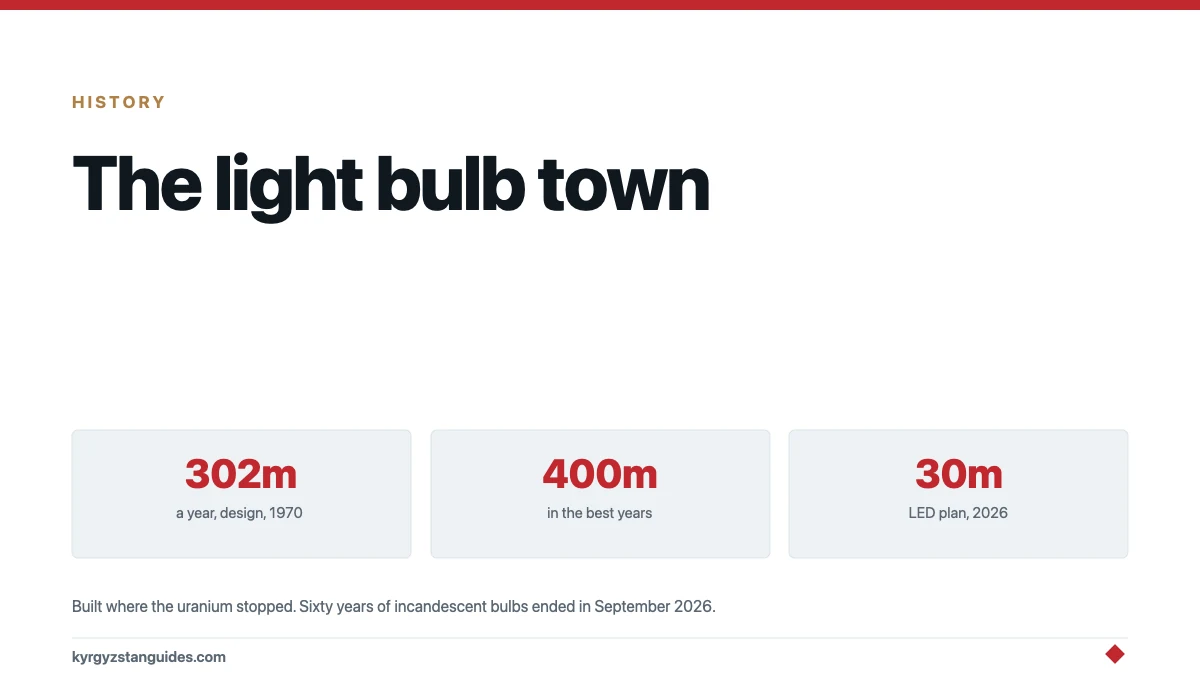
The factory later carried the name of the Komsomol’s fiftieth anniversary, a typical Soviet honorific. It reached its design capacity of 302 million lamps a year in 1970.
It is worth pausing on that number. Three hundred million bulbs a year is close to a million a day, from one plant in a small town in the hills above the Fergana Valley. Kyrgyz homes could never have absorbed that many on their own. The plant was sized for the Soviet market, not the republic it stood in.
How big it really got
The plant’s history gives the design figure. For the peak, the best source is Azattyk, the Kyrgyz service of Radio Free Europe, which reported in 2020 that in its best years the factory produced up to 400 million units.
Employment figures are less certain. The same Azattyk report says the plant once gave work to around 7,000 to 8,000 people. One long-serving worker interviewed for the piece put the number at up to 10,000 across three shifts. We cannot settle which is right; the 7,000 to 8,000 range is the reporter’s figure, and the 10,000 is a worker’s memory. Either way, in a town of this size the factory was not one employer among many. It was the town.
The long fall
The collapse came in stages, and each one has a date.
1995 to 2003: changing hands. The plant’s history lists the paperwork of the post-Soviet years. In July 1995 it became a state joint-stock company under a restructuring programme the history calls PESAC. In 1998 it became an open joint-stock company, and in September 2003 it was registered again. Azattyk reported that in 2003 the plant was sold to Russian businessmen for $3.6 million.
2009: bankruptcy. Debts to the state kept growing, and in 2009 the plant was declared bankrupt, according to Azattyk. The State Property Fund appointed a special administrator, who was still running it more than a decade later. In December 2010 a new limited company was formed on the plant’s assets.
2010: the border. In September 2010 the economy ministry warned, after a minister toured the south, that the closed Uzbek border would soon force the line to halt; AKIpress carried the report. For a plant that depended on trade across that border, a shut crossing meant a stopped line.
2019 to 2020: shrinking. By 2019 output had fallen to 100 million bulbs. From January 2020 the plant worked four days a week, and wages fell by about a fifth. An assembly worker, Meliskan Toktogulova, told Azattyk her pay had dropped from 14,000 som a month to 12,000. The head of the assembly shop, Tashbolot Bolotov, explained the sales problem: Uzbekistan and Russia were no longer buying lamps above 100 watts.
That detail explains the whole decline better than any statistic. The factory was built to make one product, and its two biggest markets had stopped wanting that product.
The rescue attempts
In September 2020 Azattyk reported that the government had approved handing the plant to the state oil company Kyrgyzneftegaz. By then it employed a little under 1,500 people and made about 90 million bulbs a year. The technical director, Murza Toktobaev, said the managers had tried to raise $4.5 million for a plastic-window workshop but had been turned down by the Russian-Kyrgyz Development Fund because of the way the plant was run.
In December 2022 the state put real money in. According to 24.kg, the plant received a budget loan of 1 billion som, with a first tranche of 400 million. The plan was to make LED lamps and glass containers, rebuild the glass furnace, and sell to state bodies and state-owned companies. The head of the Cabinet said the plant “should work day and night, in several shifts, if necessary.”
It did not work out that smoothly. In January 2026 the deputy head of the Cabinet, Bakyt Torobaev, told Trend that wages were three months in arrears and promised they would be paid by the end of that month. Workers were put on unpaid leave until full production restarted, and the government confirmed that incandescent bulbs would be phased out.
September 2026: the last incandescent
By June 2026 AKIpress was reporting plans for 10 kinds of glass container and 14 kinds of modern bulb. On 10 September 2026 it reported that the plant had stopped making incandescent bulbs and was being turned into an industrial park.
Akchabar filled in the details on 28 September. Asem Zhusupov, deputy director of the new industrial park, said LED output would reach up to 30 million units a year when running two shifts, at a production cost of 45 to 50 som per lamp. The new LED and glass lines were expected to create more than 450 jobs, with salaries of 35,000 to 40,000 som. Staff training was due to start at the end of October, with the first new products in October and November. The same report put the cost of the changeover plainly: over half of the plant’s old workforce was already out of work.
In early October 2026 AKIpress reported a Chinese investor’s proposal, raised in parliament by Deputy Chairman Daniyar Amangeldiev, to make glass wool from the factory’s waste. AKIpress headlines also put total spending on the revival at over 2.2 billion som and on a new glass production facility at 1.5 billion som. We could only see those headlines, not the full reports behind them, so treat the figures as reported rather than checked.
Compare the numbers and the scale of the change is plain. The Soviet plant was designed for 302 million lamps a year and peaked at around 400 million. The new LED line, at full two-shift operation, is planned for 30 million.
Can you visit?
Not the factory itself, as far as we can establish. We found no public tour, and an industrial site in the middle of a restructuring is not somewhere to turn up unannounced.
The town is a different matter. Mailuu-Suu sits in Jalal-Abad region, and the uranium tailings, the river and the factory buildings are all part of the same small landscape. Our Jalal-Abad guide covers the regional base, and the uranium page explains where the tailings sit and why they matter. If you go, the factory is the large complex the town is built around; you will not miss it.
How it fits the wider pattern
Mailuu-Suu is one version of a story that runs through Kyrgyzstan’s former industrial towns. A single Soviet plant built for a union-wide market loses that market after 1991. It then lives on for decades on smaller orders, changes of owner and state rescues. The same arc shows up in the country’s sugar beet industry and in the collapse of Soviet collective farms. What makes Mailuu-Suu unusual is that the product itself became obsolete while the factory was still trying to sell it.
What we could not establish
- Whether it was the largest lamp plant in the Soviet Union. Some English-language reports say so, but we could not find a primary figure that compares it with other Soviet lamp plants.
- The exact peak workforce. The figures are 7,000 to 8,000 according to the reporter and up to 10,000 according to one worker.
- The detail behind the 2.2 billion and 1.5 billion som figures. These are from AKIpress headlines whose full text sits behind a paywall.
- Whether the October 2026 production start happened on schedule.
FAQ
What did the Mailuu-Suu factory make?
Incandescent light bulbs, for almost sixty years. The plant reached a design capacity of 302 million lamps a year in 1970 and produced up to 400 million in its best years, according to Azattyk. It stopped making incandescent bulbs in September 2026 and is switching to LED lamps and glass containers.
When was the Mailuu-Suu lamp factory built?
Construction began in December 1964 under a Soviet government decree, according to the plant’s own history. The main building was handed over in 1966, the first products followed around 1967, and the plant reached its design capacity in 1970.
Why did the Mailuu-Suu light bulb factory decline?
It lost its markets. After 1991 the plant changed owners several times, was sold to Russian businessmen in 2003, and was declared bankrupt in 2009. Border closures with Uzbekistan halted production in 2010, and by 2020 Uzbekistan and Russia were no longer buying lamps above 100 watts.
Is the Mailuu-Suu factory still working?
Partly. In September 2026 it stopped making incandescent bulbs and is being turned into an industrial park. Plans announced that month call for up to 30 million LED lamps a year on two shifts, plus glass containers, with more than 450 jobs.
How many people worked at the Mailuu-Suu lamp factory?
Around 7,000 to 8,000 at its height, according to Azattyk, though one worker remembered up to 10,000 across three shifts. By 2020 it employed a little under 1,500, and the 2026 changeover left over half of the old workforce without a job.
Can tourists visit the Mailuu-Suu lamp factory?
We found no public tour, and the site is in the middle of a restructuring, so do not plan a trip around getting inside. The town itself can be visited, and the factory complex is impossible to miss. Read up on the uranium tailings before you go.
Sources: Mailuu-Suu Lamp Plant: plant history (Russian), Azattyk: residents worry about the lamp plant’s future, March 2020 (Russian), 24.kg: Mailuu-Suu plant to produce glass containers, December 2022, Akchabar: what will the Mailuu-Suu factory do next, September 2026