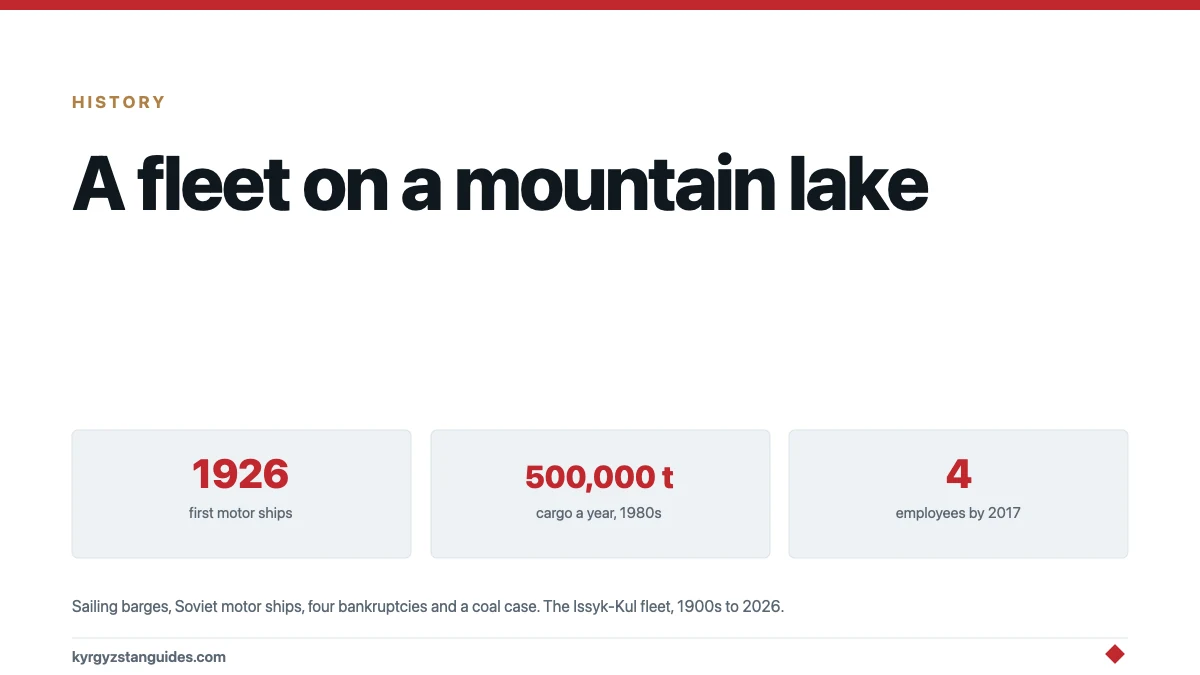
Issyk-Kul sits at 1,600 metres, 180 kilometres long, with no outlet to any sea. For a century it has had its own fleet. Sailing barges hauled timber across it before the Soviet Union existed. Two motor ships built on its southern shore were launched in June 1926. By the 1980s a state shipping company was moving more than half a million tonnes of cargo a year between about thirty lake ports, with eight lighthouses to guide the way. Then the Soviet Union ended, the ships were sold for debts or cut up for scrap, and by 2017 the company had four employees and one working crane.
None of this story exists in English. What follows comes from the Issyk-Kul regional archive as reported by Kyrgyz media, from the memoirs of the first captain, from a long Kloop report filed at the Balykchy port in 2017, and from court and tax records that surfaced in 2023 and 2024. The numbers do not always agree, and we say so where they clash.
Before the engines: sails on Issyk-Kul
The first commercial boats on the lake belonged to merchants. According to regional archive material summarised by Turmush, a trader named Suleymanov owned two vessels in the early 1900s, a single-masted boat carrying 300 tonnes and a three-masted one, and ran a timber works at Jargylchak on the southern shore. The wood went by water to Rybachye, now Balykchy, and on by cart to Pishpek, now Bishkek.
The first captain’s memoirs, written by Dmitry Kolesnikov and held by the Balykchy local history museum, describe those early craft less kindly. The wooden barges of Suleymanov and the Reshetnikov family had crude square sails and could only run before the wind, so a trip from Lipenka or Jargylchak to Rybachye could take six to eight weeks. That changed when two shipwrights from the Sea of Azov, Alexander Shchetina and Semyon Korostelev, arrived and built proper sailing vessels: the Kommunar, Yuny Kommunar, Krasny Vostok, Azov and Issyk-Kul. These were galiot-type boats that could sail across or into the wind, and with a following wind they could outrun the first motor ships.
In 1924 an agricultural commune in the Tyup bay built two motor launches, the Kommunar and the Krasny Vostok, each carrying six to eight tonnes of building materials and farm produce. They were the first engines on the lake.
1925–1927: a shipyard at Jargylchak
The Soviet government ordered the Central Asian state shipping administration, based in Tashkent, to build two motor ships for Issyk-Kul. The regional archive dates the founding of the Issyk-Kul state shipping company at Rybachye to 1925; Kloop, citing the company itself, gives 1926. Both are defensible, since the enterprise was set up in one year and its ships launched the next.
Construction chief Nikolai Fedotyev arrived in 1925. A shipyard went up at Jargylchak with a slipway, and within two weeks the builders had added a bakery, a bathhouse and barracks. The timber was Tien Shan spruce, dragged in by oxen, with planks sawn by hand. Less than a year later the Progress Kirgizstana and the Pioner were ready. They were launched in June 1926, each able to carry 200 tonnes, and entered regular service in 1927. Kolesnikov took command of the Progress Kirgizstana and Timofey Chernogor of the Pioner.
How fast were they? Here the sources split. Kolesnikov wrote that in good weather his ship covered Rybachye to Przhevalsk, today’s Karakol, in 12 to 13 hours, and a 2020 Rossiyskaya Gazeta feature says the crossing took about a day. The Turmush summary of the archive says the route took five days. We trust the captain, and suspect the five-day figure describes a full round trip with loading at both ends, which was done entirely by hand.
The effect on the region was immediate. In 1926, Kolesnikov wrote, the whole district had one motor car, so all passenger traffic moved onto the water. His chief accountant’s report for 1927 recorded 72,000 tonnes of cargo, including towed timber rafts, and 9,860 passengers. Grain, hides, apples and timber went west to Rybachye; kerosene and building materials came back east. Driving livestock from one shore to the other had taken two weeks; by ship it took under 18 hours. Each vessel made about ten voyages a month.
Rybachye grew with the fleet. In 1925 it was about a hundred mud-brick houses. Within a few years it had several piers, a grain elevator, a sawmill and a branch of the state bank.
The Soviet fleet, ship by ship
The archive material lists the fleet as it grew:
| Year | Vessel | Note |
|---|---|---|
| 1926 | Progress Kirgizstana, Pioner | 200 tonnes each, built at Jargylchak |
| 1931 | Sovetskaya Kirgizia | 420 tonnes, built at Karakol with specialists from Gorky |
| 1931 | Pyatiletka | 200 tonnes |
| 1935 | Kirov | entered service 1 September |
| 1936 | Ysyk-Kol | 75 tonnes, at the Tamchy state farm |
| 1938 | Komsomol, Ob | brought to the lake in 1937 |
| 1966 | Nord, Zyuyd, 40 Let Kirgizstanu, General Panfilov | two tugs, a motor ship and a tanker |
A line of annual figures from the archive runs 29.6 in 1931, 36.5 in 1932, 41.6 in 1934, 50.6 in 1935 and 56.5 in 1936. The published summary calls these “tonnes”, which cannot be right for a fleet that moved 72,000 tonnes in 1927; they are almost certainly thousands of tonnes. Grain alone reached 18,000 tonnes in 1939 and 30,800 tonnes in 1941.
The war changed the cargo. Ships carried supplies for the front and, from 1941, people: 3,500 passengers that year and 45,300 in 1943, soldiers and evacuees among them. After the war the Bystrovka–Rybachye railway reached the lake and road transport took the passengers, so the fleet went back to freight: coal from the Jyrgalan mine, cement from Kurmenty, and the output of new meat and dairy plants around the shore.
In 1956 the company became a self-financing enterprise. The 1966 additions, including a tanker named for General Panfilov, reflect a deliberate Soviet policy that Rossiyskaya Gazeta describes: move freight by water to protect the lake’s environment and spare the shore road.
The peak
Boris Chumakov joined the company and stayed fifty years, rising to deputy director. When Kloop met him in 2017 he was 82 and still came to the port most days. His account of the 1980s, supported by the company’s own figures, is the high-water mark. More than 500,000 tonnes of cargo a year. Around thirty ports on the shore and eight lighthouses. Over 500 employees working in shifts, with crews competing over who could move the most freight. The company built housing and kindergartens for its staff and ran a holiday home at Bosteri.
Chumakov named many of the ships himself. Almost all of them are gone.
1991 to 2017: four bankruptcies
Kloop’s 2017 report lays out the sequence.
- 1998–1999. The enterprise became a joint-stock company in 1998 and was declared bankrupt a year later over debts to the Social Fund. There were no orders to pay them with. The company was liquidated and stood idle for six years.
- 2004–2009. Reopened in 2004, it worked tolerably until a second bankruptcy in 2009.
- 2003–2010. Under court order it sold four large vessels, the Issyk-Kul, General Panfilov, Albatros and BIS, plus five barges and other equipment. The total raised was five million som, enough to clear the debts of the day.
- April 2010. In the unrest after the April revolution, coal belonging to a private firm, Brok Komur Service, was sitting in the company’s warehouses awaiting shipment to Karakol. Armed men took it. The firm then sued the shipping company for 4.5 million som. District and regional courts ruled against the company; the Supreme Court sent the case back for review. By 2017 the litigation had run six years.
- 2011. Taalaybek Mukashev became director and spent most of his tenure in court.
- 2014. The state’s one direct intervention: a five million som loan for repairs.
- 2017. A fourth bankruptcy petition. Four employees remained: the director, a crane operator and two guards. Two ports, at Balykchy and Karakol, and a pier at Kurmenty. Two motor ships, one small vessel, four barges and two cranes, one barge half sunk with rust. No cargo had moved by water for two years; coal tenders for Karakol were going to trucking firms. The company lived on unloading coal from trains onto lorries, at about 60 som a tonne.
The ship repair base had been privatised. So had the lake station buildings. Passenger boats tied up at the cargo port were being hired for weddings.
A proposal to hand the company to the national railway, Kyrgyz Temir Jolu, was discussed but not taken up. Rossiyskaya Gazeta reported in 2020 that the large ships had been cut up and sent to China as scrap, and that what remained were a few small vessels converted into pleasure craft.
2021 to 2026: a coal company’s branch, and a coal case
The next record of the company is not a shipping story. By 2023 the “Issyk-Kul Steamship Company” existed as a branch of the state coal enterprise Kyrgyzkomur, running the transhipment point at Balykchy where coal from Kara-Keche arrives by truck and leaves by rail for the Bishkek power plant.
On 18 June 2023 the State Committee for National Security announced arrests in what it called a “coal mafia” case: a deputy energy minister and Kyrgyzkomur’s commercial director were detained over the theft of at least 15,960.81 tonnes of coal, worth more than 40 million som, between 2021 and 2023 on the Kara-Keche to Balykchy to Bishkek route. The company’s branch was named in the case. In 2024 the tax service listed the branch among debtors owing more than ten million som, at 11.2 million. In March 2026 Turmush reported that the former deputy minister had paid seven million som in the case.
So the enterprise founded to carry grain and apples across a mountain lake in 1926 ended up, a century later, as a coal yard with a court file.
December 2024: new hulls on the lake
The lake itself has not given up on boats. On 3 December 2024, Kaktus.media and Sputnik reported that a private company, Sky Ships, had brought two new passenger vessels to Issyk-Kul from China, one for 84 passengers and one for 54, with Mercury marine engines. It was the first new vessel launched on the lake since the 1980s. Co-founder Emilbek Razhapov, who grew up on the shore, said the boats were test examples, that the company planned regular routes between the north and south shores including Cholpon-Ata to Ton, and that it hoped to build large vessels in Kyrgyzstan.
We could not find a report confirming that scheduled crossings had started by October 2026. If you see a timetable posted at Cholpon-Ata, it is newer than our sources.
What a traveller can see
Balykchy’s cargo port is on the lake at the end of Ozernaya Street. It is a working coal yard, not a sight, and there is no reason to go inside. From the shore road you can see the cranes and whatever hulls are tied up. Our Balykchy guide explains the town’s other role as the railhead and road junction.
The Balykchy local history museum holds Kolesnikov’s manuscript, which is where the early fleet’s story comes from. Karakol’s pier and the old pier at Kurmenty, near Tyup, are the other surviving pieces. The Soviet navy’s separate presence on the lake, the torpedo range at Koy-Sary, is covered in our piece on torpedo testing on Issyk-Kul; it was never part of the shipping company.
Pleasure boats run from Cholpon-Ata in summer. Several of them are former working vessels, which is as close as most visitors will come to the fleet that once fed the whole shore.
What we could not establish
- Whether the Sky Ships route is running. The December 2024 reports describe test operation and plans.
- The units in the 1931–36 series. The archive summary says tonnes; the context says thousands of tonnes.
- The real speed of the first ships. Twelve hours by the captain’s memoir, five days by the archive summary.
- The exact fate of each large vessel. Kloop names four sold between 2003 and 2010; Rossiyskaya Gazeta says the big ships went for scrap to China.
- Who runs the Balykchy branch today, after the 2023 arrests.
FAQ
Are there ships on Lake Issyk-Kul?
Yes, but mostly small pleasure boats now. A state shipping company ran cargo and passenger vessels on the lake from 1926, peaking at more than 500,000 tonnes of cargo a year in the 1980s. Its large ships were sold or scrapped after the Soviet collapse. In December 2024 a private firm brought two new passenger boats, for 84 and 54 people, the first new vessels since the 1980s.
When did the Issyk-Kul Steamship Company start?
The enterprise was set up at Rybachye, now Balykchy, in 1925 according to the regional archive, or 1926 according to the company. Its first two motor ships, the Progress Kirgizstana and the Pioner, were built at Jargylchak on the southern shore and launched in June 1926.
What happened to the Issyk-Kul fleet?
It was bankrupted four times after 1991. Four large vessels and five barges were sold under court order between 2003 and 2010 for a total of five million som, and other ships were cut up for scrap. By 2017 the company had two motor ships, one small vessel, four barges, two cranes and four employees.
Can you take a boat trip on Issyk-Kul?
Yes. Pleasure boats run from Cholpon-Ata in summer, and a private company has been testing two new passenger vessels since December 2024 with plans for routes between the north and south shores. The old state cargo port at Balykchy is not a tourist site.
Why does Issyk-Kul have a port?
Because for most of the twentieth century water was the cheapest way to move grain, timber, coal and livestock around a lake 180 km long with poor roads. In 1926 the whole district had one motor car. The port at Balykchy still handles coal, now arriving by truck and leaving by rail.
What was the coal case at Balykchy?
In June 2023 Kyrgyzstan’s security service arrested a deputy energy minister and a Kyrgyzkomur director over the theft of nearly 16,000 tonnes of coal, worth over 40 million som, between 2021 and 2023 on the route through the Balykchy transhipment point run by the shipping company’s successor branch.
Sources: Kloop: “When the ships stand still” (2017, Russian), Rossiyskaya Gazeta: 95 years of the high-altitude fleet (2020, Russian), Ministry of Transport: Issyk-Kul Steamship Company (Russian), 24.kg: arrests in the coal case (June 2023, Russian), Kaktus.media: new passenger vessels delivered (December 2024, Russian)