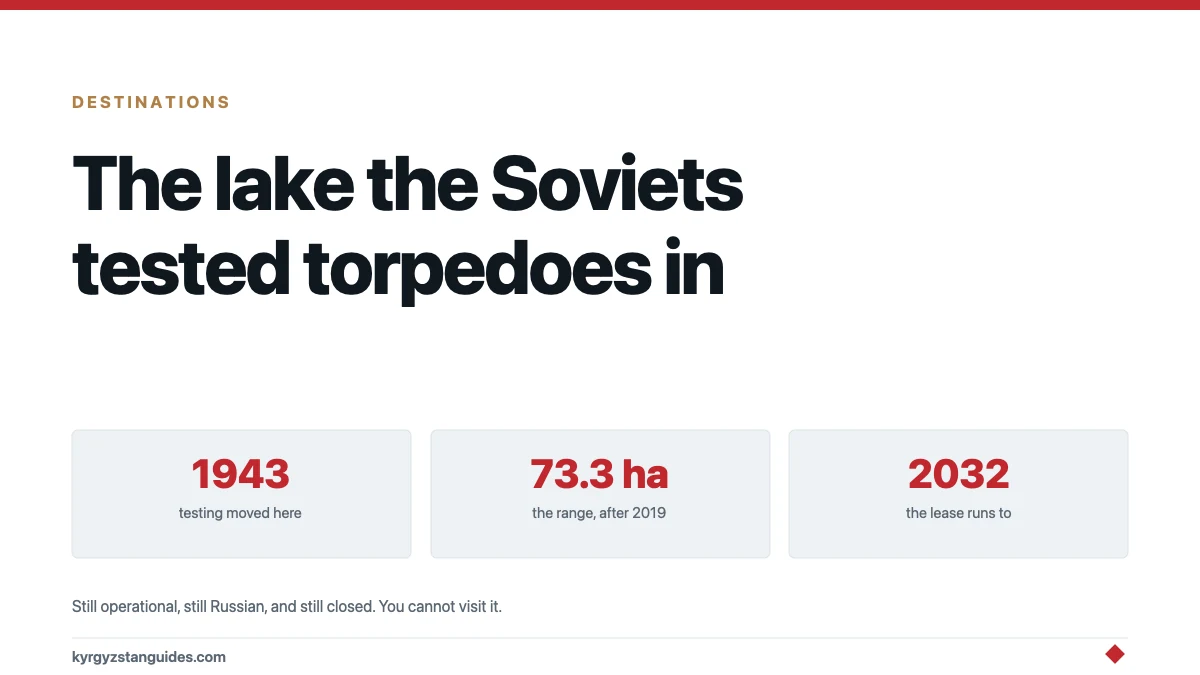
Issyk-Kul is sold as a beach. It is also, and has been continuously since 1943, a naval weapons testing range, and the facility at Cape Koy-Sary twelve kilometres from Karakol is Russian, operational, and leased until at least 2032.
Nobody puts this on a lake itinerary, which is odd, because it explains a lot about the eastern shore.
Why a landlocked country tests torpedoes
The lake's physical properties are the reason, and they are the same ones the tourist brochures use. Issyk-Kul is endorheic — no outflow — roughly 180 by 60 kilometres, up to 700 metres deep, slightly saline, and it does not freeze. Deep, calm, year-round, closed, and entirely inside one country's territory. For a weapons programme that needs to fire something underwater and then go and find it again, that is close to ideal.
The Soviet Union arrived at that conclusion under pressure. Part of evacuated plant No. 182 was moved to the lake in 1942, and torpedo production and testing were relocated here in 1943, when the front reached the Caucasus. The settlement of Pristan-Przhevalsk, twelve kilometres north-west of Karakol, received urban status in 1944 on the back of it. Today it is semi-ruined buildings and an abandoned port.
What is there now, and whose it is
The active facility is the Russian Navy's 954th Anti-Submarine Weapons Test Base. What it tests is narrower than the legend suggests: elements of torpedo armament without live warheads, and diving apparatus.
Its legal basis is an agreement signed in Bishkek on 20 September 2012 and ratified by Kyrgyzstan through Law No. 200 of 17 December 2012. That agreement consolidated four Russian facilities into one united base, which entered into force on 29 January 2017 for fifteen years, running to 2032 and auto-renewing in five-year periods unless someone gives written notice.
The four components are worth knowing because they are scattered across the country: the Kant airbase near Bishkek, the 954th test base at Koy-Sary, a naval communications node at Chaldovar with a 312-metre antenna mast, and a seismic station at Mailuu-Suu monitoring for nuclear tests.
The money: Kant is rent-free. The naval facilities cost over $4.5 million a year. A protocol of 28 March 2019 enlarged the base by 58.3 hectares — the test range itself grew from 55 to 73.3 hectares — and lifted the rent to $4.79 million, at fifty US cents per square metre.
There is also a Russian-Kyrgyz joint venture at the site called Ozero, meaning Lake, in which Russia holds 95%. Under an earlier 1993 arrangement Russia owed around $3 million a year for the facility and in practice settled much of it by training Kyrgyz officers free of charge.
Dastan, and the debt that was never paid in shares
The manufacturing side is in Bishkek. Dastan began in 1956 as the Physical Instruments factory, was renamed in 1975 for the fiftieth anniversary of the Kirghiz SSR, and became the joint-stock transnational corporation Dastan in 1993.
In February 2009 the two presidents agreed that Kyrgyzstan would transfer 48% of Dastan to Russia against $180 million of debt. It never happened. Shares were bought up by structures connected to Maxim Bakiyev, and Russia subsequently demanded up to 75%, arguing the assets had depreciated since the original deal. No source I could find confirms that Russia ever acquired any equity.
What Dastan currently produces is not something I can tell you reliably. Its own product pages return errors, and no recent reporting gives output, employment or the present state shareholding. The company site's security certificate has expired, which is its own kind of answer.
Four sites, one lease, and why it is contested
Consolidating four separate facilities into a single leased base was not a tidying exercise. It gave Russia one agreement covering an airbase, a weapons range, a communications node and a nuclear-monitoring station, on a single renewal clock, in a country that borders China.
The renewal mechanism is the part worth noticing. The lease does not simply expire in 2032; it rolls over automatically in five-year blocks unless one side gives written notice. Doing nothing extends it. That places the burden of action on whichever government would want it to end, which is a meaningful piece of drafting.
It also puts a price on the arrangement that is low by any measure. Fifty US cents a square metre, and under five million dollars a year for the naval sites, in a country where the Kumtor mine alone has generated hundreds of millions in a year. Whether that represents good value is a live domestic argument rather than a settled question.
What you can and cannot see
Koy-Sary is a closed military site and off limits. Karakol itself is entirely open and is the base for the whole eastern shore. The practical upshot for a visitor is simply to know where not to point a camera, and that the military-looking installations along that stretch are exactly what they look like.
Two claims to treat carefully. Reports that Russia tested the deep-water Futlyar torpedo here in 2016 exist alongside a Russian General Staff denial; that is a claim and a denial, not an established fact. And the figure of a thousand torpedoes tested a year in the Soviet period circulates widely with no source behind it.
On contamination, I want to be precise because it would be easy to imply something. The only peer-reviewed sediment survey of the lake, published in 2025, sampled Balykchy, Chok-Tal, Cholpon-Ata, Bosteri, Tyup and Ottuk, and found most sites moderately contaminated with significant contamination only at Tyup. It does not sample Koy-Sary at all. So there is no study of the test range, and no evidence of torpedo-related contamination either way. Absence of a study is not absence of a problem, and it is not evidence of one.
For the lake as a visitor experiences it, our Issyk-Kul guide covers the shores, and Karakol is where you would base yourself.
FAQ
Does Russia still test torpedoes on Issyk-Kul?
Yes. The 954th Anti-Submarine Weapons Test Base at Cape Koy-Sary is operational under an agreement in force since 29 January 2017, running fifteen years to 2032 and auto-renewing. It tests torpedo armament elements without live warheads, and diving apparatus.
Why was Issyk-Kul chosen for torpedo testing?
It is a closed lake with no outflow, roughly 180 by 60 km, up to 700 m deep, slightly saline and it does not freeze. Deep, calm, year-round and entirely within one country — ideal for firing something underwater and recovering it.
Can you visit the Issyk-Kul torpedo testing site?
No. Koy-Sary is a closed military site and off limits to visitors. Karakol, twelve kilometres away, is completely open and is the normal base for the eastern shore.
How much does Russia pay for its bases in Kyrgyzstan?
The Kant airbase is rent-free. The naval facilities cost over $4.5 million a year, raised to $4.79 million by a protocol of 28 March 2019 at fifty US cents per square metre, when the test range grew from 55 to 73.3 hectares.
Is Lake Issyk-Kul contaminated by torpedo testing?
No study exists either way. The one peer-reviewed sediment survey, published in 2025, sampled six other locations and found most moderately contaminated with significant contamination only at Tyup. It does not sample Koy-Sary.
What is Dastan?
The Bishkek manufacturer connected to the torpedo programme, founded in 1956 and reorganised as a joint-stock corporation in 1993. A 2009 agreement to transfer 48% to Russia against $180 million of debt was never completed.