The literature on this country in English is thin, scattered across genres, and mostly not written by people who live here — and almost no Kyrgyz novelist except Aitmatov has been translated at all.
That said, there are perhaps a dozen things genuinely worth reading, and two of them will change how you see the place entirely.
Here they are, honestly ranked, with what each is actually good for.
Start here: Aitmatov
Chingiz Aitmatov is the most important Kyrgyz writer of the twentieth century and the only one widely translated. If you read one book, read him.
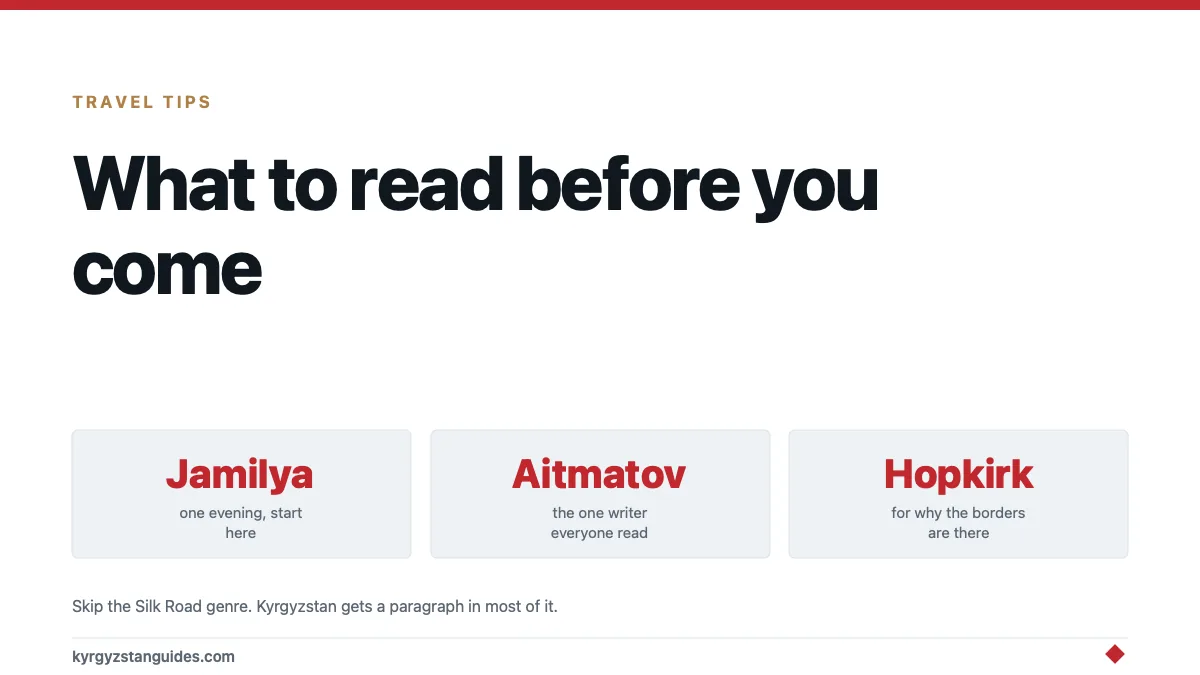
Jamilya (1958). A short novella (a hundred pages) about a wartime love affair in a Kyrgyz village while the men are at the front. Louis Aragon called the source book the most beautiful love story in the world, which is the kind of blurb that usually ruins a thing. In this case it roughly holds. Start here.
The White Ship (1970). A boy in a forest reserve on Issyk-Kul invents a mythology to survive the adults around him. This is the hard one and the one that stays with you.
The Day Lasts More Than a Hundred Years (1980). His most ambitious: a railway worker in the Kazakh steppe burying a friend, wound around a legend about memory and a science-fiction frame. Uneven, and the best thing he wrote.
Farewell, Gulsary! (1966). A man and a horse, and what the collective farm system did to both. Pairs directly with our pieces on the Kyrgyz horse and the farm collapse.
His work is also the foundation of the Kyrgyz Miracle in cinema, so reading him and then watching the films is a coherent project.
The epic
Manas. The national epic — longer than the Iliad and the Odyssey combined, traditionally recited rather than read, covered in our guide to it.
Be realistic. Full translations are enormous and aren't a holiday read. What is worth doing is reading a condensed prose version or a good summary, and then listening to five minutes of a manaschi reciting. The point is not the plot; it is understanding that this is a living oral art and that the man reciting it is doing something extraordinary.
Travel writing
The Great Game by Peter Hopkirk. Not about Kyrgyzstan specifically, and the single most useful book for understanding why the borders here are where they are. Nineteenth-century Anglo-Russian rivalry across Central Asia, written as narrative history. It explains Urkun, the Wakhan corridor and the whole shape of the region.
The Central Tian-Shan Mountains 1902–1903 by Gottfried Merzbacher. The expedition account by the man who mapped Khan Tengri and gave his name to a lake that empties itself every year. It is freely readable at the Internet Archive, dry in places, and a genuine primary source for the landscape you're walking in. Our piece on the explorers covers the context.
The Baburnama. Babur's autobiography, written by a man born fifty kilometres from Osh who went on to found the Mughal Empire. His descriptions of the Fergana valley (the fruit, the melons, the birds, the weather) are startlingly immediate for a text five hundred years old. It is out of copyright and widely available.
Travels in the Tian-Shan, 1856–1857 by Pyotr Semyonov, the first European into these mountains, is the companion volume to Merzbacher and exists in English translation.
History and current affairs
Anything on Central Asia by a regional specialist rather than a generalist. The field is small and the good work is identifiable.
For current affairs the better route is not a book at all. Eurasianet, The Diplomat, the Times of Central Asia and RFE/RL's Kyrgyz service publish continuously and are accessible free. Our media guide covers the landscape.
For the 2010 events specifically, Human Rights Watch's report Where is the Justice? remains the most careful English-language account, and is the background to our piece on 2010.
Practical reading for the trip itself
Different job, so a separate list.
Download before you leave. Connectivity stops at the mountains, as our internet guide explains. Anything you want to read on a long marshrutka journey needs to already be on the device.
Offline maps matter more than books. Vector maps downloaded in advance are the single most useful thing on your phone here.
A phrasebook is worth carrying physically. Handing a phone to someone to read is awkward; pointing at a line in a book is not. Our phrases guide covers the essentials and the place-name decoder turns a map into something readable.
Read the boring safety material before, not during. Altitude, mountain rescue and weather are the three that matter and none of them is useful to read for the first time in a tent.
What to skip
Most Silk Road books. The genre is enormous and most of it treats Central Asia as a corridor between places the author finds more interesting. Kyrgyzstan gets a paragraph.
Anything promising "the real Central Asia". It will be about Uzbekistan.
Older guidebooks. This country has changed substantially in ten years — visa rules, roads, accommodation, prices. Anything pre-2020 is background reading, not planning material.
Reading in Kyrgyz and Russian
If you have either language, the picture changes completely.
The Kyrgyz-language literary world is substantially larger than what reaches English. Aitmatov wrote in both Kyrgyz and Russian and translated himself, which is unusual and is part of why he travelled so far; most of his contemporaries did not have that route out.
Poetry carries more weight here than prose. Alykul Osmonov, on the 200 som note, and Togolok Moldo on the 20, are figures people can quote. Which is the test. A country that puts four poets and musicians on its currency and no politicians is telling you where it locates its literature.
There is also the oral layer that was never written down at all: sanjyra genealogy, the epic cycle beyond Manas, and the improvised aitysh tradition, which is still being performed and still being invented on the spot.
Bookshops in Bishkek carry Kyrgyz and Russian editions cheaply. If you read Russian, buy Aitmatov there rather than at home.
If you read nothing else
Jamilya, which takes an evening.
Then, while you're here, ask somebody what they read. The answer will frequently be Aitmatov, which tells you something in itself, a country of seven million with one writer everybody has read, whose father was killed by the state that then celebrated him.
FAQ
What is the best book about Kyrgyzstan?
For fiction, Chingiz Aitmatov's Jamilya is the standard starting point. For regional context, Peter Hopkirk's The Great Game explains why the borders and politics look the way they do.
Who is Chingiz Aitmatov?
The most prominent Kyrgyz writer of the twentieth century, widely translated, and the literary foundation of the country's 1960s cinema. His best-known works are Jamilya, The White Ship and The Day Lasts More Than a Hundred Years.
Should I read the Manas epic?
A condensed prose version or a good summary is worth it. Full translations run to enormous length. Listening to a recording of a manaschi reciting is more valuable than reading the text.
Are there good travel books about Kyrgyzstan?
Few written specifically about it. Merzbacher's 1902–03 expedition account is a genuine primary source, and Babur's Baburnama describes the Fergana valley vividly from the early sixteenth century.
Where can I follow news about Kyrgyzstan in English?
Eurasianet, The Diplomat, the Times of Central Asia and RFE/RL's Kyrgyz service all publish regularly and are freely accessible.
Are old guidebooks still useful?
For background only. Visa rules, roads, accommodation and prices have changed substantially, so anything published before 2020 shouldn't be used for planning.