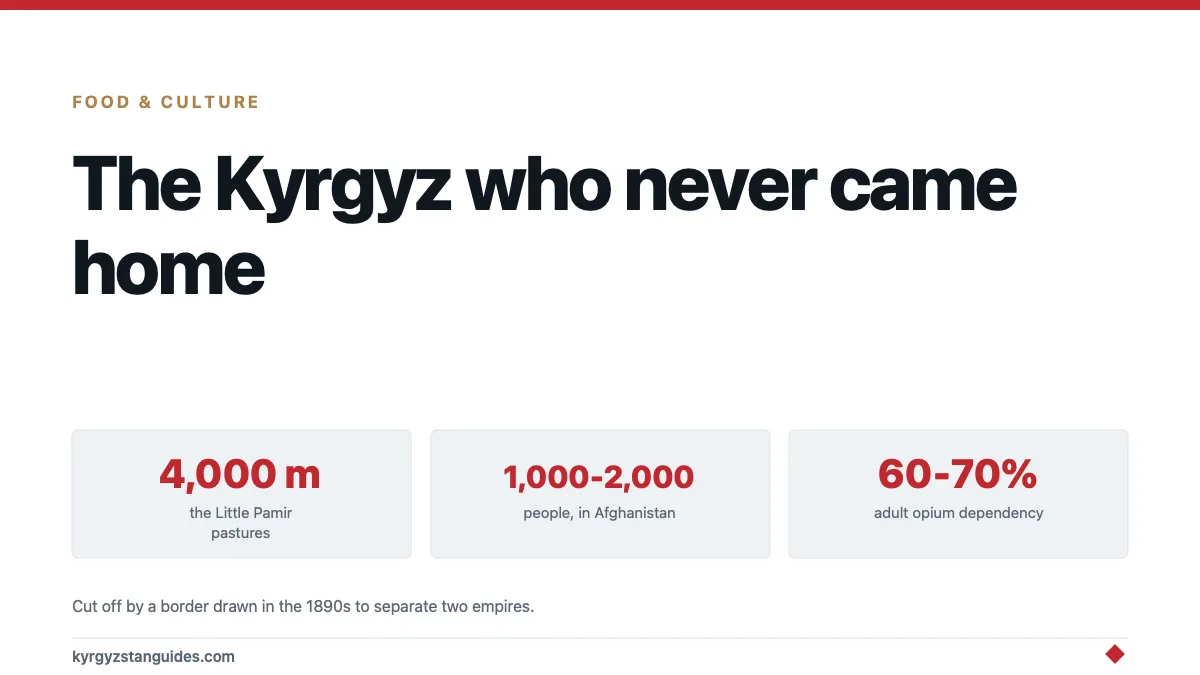
There are Kyrgyz people living at around 4,000 metres in the Wakhan Corridor of Afghanistan who have never been to Kyrgyzstan. There are between one and two thousand of them. They herd yaks and sheep on the Little Pamir, in one of the most physically isolated inhabited places on earth, and they have been stuck there for most of a century by a border they did not draw.
You'll not meet them on a Kyrgyzstan trip. You should still know they exist, because their situation explains something about this country that the yurt camps don't.
How they ended up there
The Wakhan Corridor is the thin finger of Afghan territory that reaches east to touch China, separating Tajikistan from Pakistan. It was created in the 1890s as a buffer between the Russian and British empires, a strip of land whose entire purpose was to keep two other powers from sharing a border.
Kyrgyz herders had been using those high pastures long before that line existed. When it was drawn, some of them were on the Afghan side of it.
The border hardened. Then the Soviet period closed it completely. Herders who had moved seasonally between the Pamir and what's now Kyrgyzstan found themselves permanently on the wrong side, in a country whose government reached them barely at all.
What life there's like
Extremely hard, by any measure.
The Little Pamir sits at roughly 4,000 metres. There are no trees, no crops, no roads, no clinics and no schools within reach. The economy is livestock, yaks, sheep, goats, traded with Wakhi communities lower down for flour, tea and cloth. Fuel is dung.
Infant and maternal mortality are extraordinarily high. The population is small enough that a bad winter or a disease outbreak is demographic rather than tragic. In 2020 a wave of malnutrition and illness led Kyrgyzstan to grant citizenship to 44 Pamir Kyrgyz and resettle them in Osh region.
This is the life that Kyrgyz nomadism actually looked like before roads, and it is worth holding alongside the version presented in yurt camps around Song-Kul. Those camps are real and the hospitality is genuine, but the people running them drive home in winter. The Pamir Kyrgyz do not have a winter option.
The opium problem
One thing consistently reported from the Little Pamir, and consistently left out of the romantic accounts.
Opium dependency is widespread. Reporting from the valley has put the figure among adults as high as 60 to 70%, and the local name for it (black medicine) tells you what it is being used for.
The mechanism isn't moral and isn't mysterious. There is no medical care within days of travel, opium arrives through trade from lower down, and it works on pain, cough, diarrhoea and cold. Where there is no clinic, a painkiller that also suppresses hunger becomes the household medicine. RFE/RL has documented the same pattern across Afghanistan wherever the health system has failed.
The other figure from the Little Pamir is worse. Child mortality among the Afghan Kyrgyz has been described as possibly the highest in the world, with fewer than half of children reaching their fifth birthday, alongside a maternal mortality rate in the same category.
That is what the absence of a health system produces at 4,000 metres. It's the strongest argument the resettlement advocates have, and it is the detail that makes the "last free nomads" framing (common in photography-led coverage) very hard to sustain.
The Turkey precedent
This has happened before, at scale.
In the late 1970s, as Afghanistan collapsed into war, a large group of Pamir Kyrgyz left, spent years in camps in Pakistan, and were eventually resettled in eastern Turkey. They were given land in Van province and became, over decades, a settled community.
Eurasianet has reported on how that turned out: the resettlement worked in the sense that people survived, and it cost them the thing that had defined them. A herding society placed in villages does not stay a herding society. Their grandchildren speak Turkish.
That precedent sits behind every current conversation about moving the rest.
What is happening now
The Taliban's return in 2021 restarted the question with urgency.
Kyrgyzstan announced it would accept 1,200 Pamir Kyrgyz. With the significant condition that they would have to reach the Kyrgyz border themselves, across Afghan territory and an international frontier, from a valley with no road.
In July 2022 the Kyrgyz government allocated close to $3 million to return and resettle them over the following two years.
Progress has been partial and slow. RFE/RL has followed the attempts and the picture is consistent: political will on the Kyrgyz side, genuine logistical impossibility on the ground, and a community that is itself divided about leaving.
That last part gets flattened in most coverage. Some want out. Others don't want to exchange herds and autonomy for a house on the edge of a town in Osh region with no obvious way to make a living. Both positions are reasonable.
The Centre for East European and International Studies has published an assessment of their situation since the takeover, which is the most careful thing written on it.
Why this belongs in a travel guide
Three reasons, and none of them are sentimental.
It explains the border obsession. Kyrgyzstan's frontiers were drawn by outsiders in ways that cut through communities, and the consequences are still being administered. That is also why border zones here involve permits, checkpoints and a level of official attention that surprises visitors.
It corrects the nomad story. Nomadism gets sold to travellers as freedom. The Pamir Kyrgyz are what unmediated mobility actually costs when the modern state doesn't show up: no clinic, no school, no market, no exit.
It's visible from where you will be standing. From Sary-Tash, the wall of the Pamir on the southern horizon is Tajikistan, and beyond it Afghanistan. If you drive the Pamir Highway, you pass within perhaps a hundred kilometres of the Little Pamir and there is no road that will take you there.
You're looking at the edge of it. That is the closest almost anyone gets.
FAQ
Who are the Pamir Kyrgyz?
Ethnic Kyrgyz herders living at around 4,000 m in the Little Pamir of Afghanistan's Wakhan Corridor, numbering roughly 1,000 to 2,000 people, separated from Kyrgyzstan by borders drawn in the 1890s.
Why are there Kyrgyz people in Afghanistan?
The Wakhan Corridor was created in the 1890s as a buffer between the Russian and British empires, cutting across pastures Kyrgyz herders already used. Soviet border closures later made the separation permanent.
Has Kyrgyzstan tried to bring them back?
Yes. After the Taliban's 2021 return Kyrgyzstan offered to accept 1,200, and in July 2022 allocated close to $3 million for resettlement over two years. Progress has been slow, and in 2020 a group of 44 was resettled in Osh region after a health crisis.
Where did the Pamir Kyrgyz who left in the 1970s go?
Most were eventually resettled in Van province in eastern Turkey, where their descendants are now a settled, largely Turkish-speaking community.
Can travellers visit the Wakhan Corridor?
The Afghan Wakhan isn't a realistic destination and is outside the scope of a Kyrgyzstan trip. The Tajik side of the Pamir, reached from Sary-Tash, is the closest accessible point.
Do all the Pamir Kyrgyz want to leave?
No. The community is divided. Resettlement means giving up herds and independence for an uncertain living near a town, and the Turkish precedent showed that survival came at the cost of the way of life.