Somewhere between $600 and $900 a month. That is what a comfortable remote-work life in Bishkek costs, a private one-bedroom apartment, a coworking desk, café lunches, unlimited home internet, and weekend trips into some of the best mountains in Asia. On pure cost, Kyrgyzstan beats almost every nomad base you have heard of. The catch is everything else, and the honest framing is this: Bishkek is an excellent summer base, not a year-round hub.
Here is the quick math and the quick caveat. The math: rent $250-450, coworking $60-100, food and transport a few hundred more, on internet that is genuinely fine for calls. The caveat: a 60-day visa-free clock for most Western passports, a thin nomad community, awkward time zones for US clients, and a winter smog problem severe enough to be a dealbreaker on its own. Details below.
Internet, coworking, and where people actually work
Fixed broadband in Bishkek is better than the country’s image suggests: 50-100 Mbps fiber plans are standard in newer apartment blocks and cost a few dollars a month by Western standards. Mobile data is absurdly cheap, large packages from O!, MegaCom, or Beeline run a few hundred som — and makes a reliable backup for load-shedding moments; our SIM card guide covers setup in ten minutes at the airport. Power cuts happen but are brief and rare in the center.
The coworking scene is small but real. Ololohaus and its sister ololo spaces are the anchor (proper desks, meeting rooms, a startup crowd, memberships in the $60-100 range) and a handful of smaller spaces and laptop-tolerant cafés fill the gaps. Sierra Coffee branches are the default remote-work cafés, with decent Wi-Fi and a tolerance for hours-long laptop sessions. Do not expect Canggu or Chiang Mai density: on a given weekday you might be one of five foreigners working in the room, which some people find lonely and others find like a reasonable place to get work done.
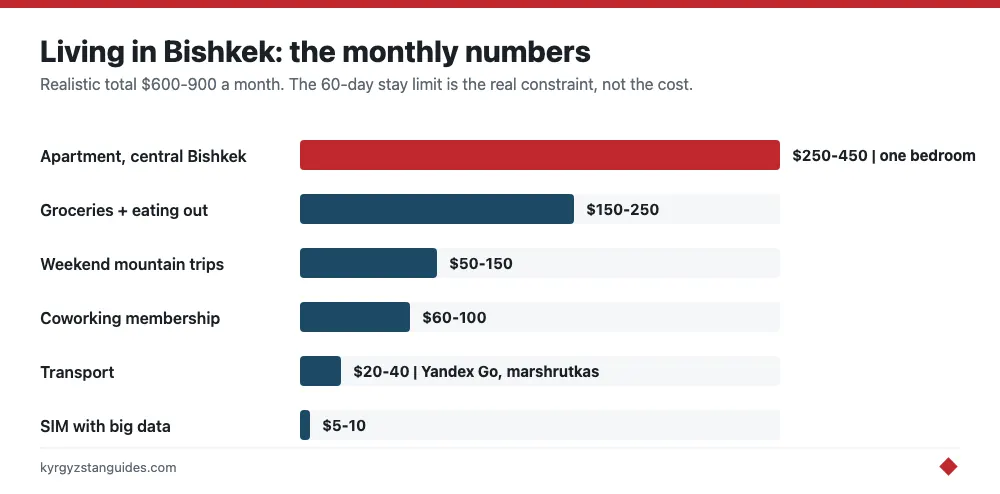
What a month actually costs
| Monthly item | Typical range (USD) |
|---|---|
| One-bedroom apartment, central Bishkek | $250-450 |
| Coworking membership | $60-100 |
| Groceries + eating out regularly | $150-250 |
| SIM with large data package | $5-10 |
| Transport (Yandex Go taxis, marshrutkas) | $20-40 |
| Weekend mountain trips | $50-150 |
| Realistic total | $600-900 |
Rents rose sharply after 2022 with the influx of Russian remote workers and have only partly eased, so quotes from older blog posts run low. Even so, this remains one of the cheapest capitals on earth where you can hold a video call, and the som’s stability against the dollar. Around 87-89 to 1 — makes budgeting boring in the best way.
Practicalities: apartments are found on lalafo and house.kg or, faster, through Telegram rental groups and hostel staff who know a landlord; monthly deals with no contract are normal, and paying in cash is expected. Cards work in supermarkets and mid-range restaurants in Bishkek, but the country runs on cash the moment you leave the center, so a fee-free travel card plus regular ATM withdrawals is the standard setup. Food is a quiet highlight of the budget, a filling lunch at a stolovaya-style canteen costs $2-3, and the Osh Bazaar produce run for a week of home cooking costs less than one delivery order back home.
Visas: the 30-day rhythm
Kyrgyzstan gives citizens of 55 countries — including the US, UK, and most of the EU — 30 days within any 60-day period visa-free. There is no automatic extension for tourists. Since 31 December 2025 the allowance is cumulative within a rolling 60-day window rather than per entry, so a border run to Almaty no longer resets the clock the way it used to — you only regain days as older ones fall outside the window. Anyone planning a long stay now needs a visa or residence document rather than a border-run routine. It works, but it's a rhythm you must plan around, and repeated back-to-back runs are at border officers’ discretion, so don't build a year on that assumption. A remote-work residence scheme aimed at relocating IT workers exists on paper, but for the typical traveling freelancer the 60-day clock is the practical reality. Indian passport holders need an e-visa before arrival — the process and current rules are in our visa guide.
Why summer is the whole pitch
From May to September, the case for Bishkek writes itself. Thirty minutes puts you at the mouth of the Ala-Archa gorge; a weekend covers Issyk-Kul’s beaches or a yurt night at Song-Kul; after-work hikes are a genuine, not aspirational, part of the week. The city is green, café terraces are full, and there's enough going on to fill the evenings without overwhelming anyone. The social scene follows the same season: a small but friendly circuit of expats, returned Kyrgyz professionals, and Russian remote workers organizes hikes and meetups through Telegram and Couchsurfing-style groups all summer, then visibly thins out by October.
Winter is a different city. Bishkek heats itself substantially with coal, sits in a valley that traps inversions, and posts air-quality numbers from November to February that rank among the worst in the world on bad days. Runners buy purifiers; many locals who can leave, leave. There is good skiing at Karakol and cheap ski touring beyond it (our winter guide makes the case for a visit) but as a place to live and breathe for three straight months, nomad Bishkek in January is hard to recommend. Add the time-zone reality (UTC+6 is friendly to Europe and Asia, brutal for US-afternoon meetings) and the year-round math stops working.
Beyond Bishkek: can you base anywhere else?
Sort of. Karakol is the tempting second option, a mountain town with ski slopes in winter, trailheads in summer, and a handful of cafés with workable Wi-Fi — and a few nomads make it work for a month or two. But fixed internet there is a tier below the capital, apartment stock is thin, and a single burst pipe or power cut has no backup coworking space to absorb it. Osh offers southern warmth and the best food in the country on even lower budgets, with the same reliability caveats. The honest pattern: keep Bishkek as the base where deadlines live, and treat Karakol, Osh, and the yurt country between them as places you go when the calendar is light.
The verdict, with a warning
Come for a summer. Sixty days in Bishkek with mountain weekends, then a run to Almaty and sixty more, is one of the best cost-to-quality-of-life ratios available to a remote worker anywhere — safe by regional standards (see our safety rundown), cheap, unclogged, and close to wilderness. Just do not sign up for the winter sight unseen, do not build a business plan on indefinite visa runs, and don't expect a built-in community to do the social work for you. Kyrgyzstan rewards nomads who bring their own structure, and repays them with the Tian Shan out the window.
An evening at one of the city’s five state theatres is the cheapest good night out in Kyrgyzstan: see theatre and opera in Bishkek, where the opera house’s own ballet starts at 300 som.
FAQ
How much does it cost to live in Bishkek as a remote worker?
Somewhere between $600 and $900 a month for a comfortable life: a private one-bedroom apartment, a coworking desk, cafe lunches, unlimited home internet and weekend trips into the mountains. Rent runs $250 to $450 and coworking $60 to $100.
Is Bishkek good for digital nomads?
As a summer base, excellent; as a year-round hub, no. On pure cost it beats almost every nomad base you have heard of, and the internet is genuinely fine for calls. The catch is everything else.
How long can I stay in Kyrgyzstan on a visa?
Most Western passports get a visa-free allowance counted within a 60-day window, which is the binding constraint on a longer stay. Check the current rule before planning around it, because the allowance was changed at the end of 2025.
Is the internet reliable in Kyrgyzstan?
In Bishkek, yes — good enough for video calls on home connections. Outside the capital it thins out quickly, which is one reason the city works as a base and the mountains work as weekends rather than as an office.
Is there a digital nomad community in Bishkek?
Thin. That is part of the honest framing: the cost and the mountains are the draw, not an established scene, and anyone expecting a Chiang Mai or Lisbon ecosystem will be disappointed.
What is the biggest drawback?
Winter, and the visa clock. Bishkek in the cold months is a different proposition from Bishkek in July, and the visa-free allowance limits how long you can simply stay put.